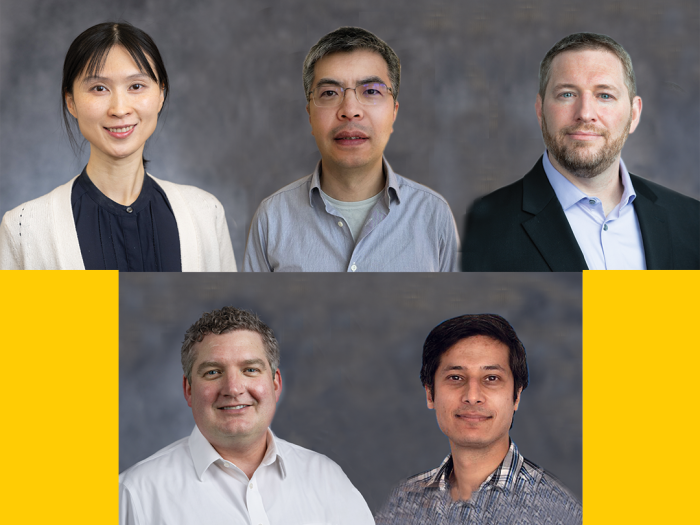
Ryan Mills, PhD

Computational Medicine and Bioinformatics
1301 Catherine St, Room 5B390
Ann Arbor, MI 48019
Manage Your Profile
Qualifications
-
PhDGeorgia Institute of Technology, Atlanta, GA, United States
2003 - 2006
-
MSGeorgia Institute of Technology, Atlanta, GA, United States
2000 - 2003
-
ABWabash College, Crawfordsville, IN, United States
1996 - 2000
Center Memberships
-
Center MemberFrankel Institute for Heart and Brain Health
-
Center MemberAI and Digital Health Innovation
Research Overview
The primary purpose of sequencing genomes is to identify the underlying genetic variation between individuals and to explore what role those changes have on human phenotypes. Our research laboratory develops and implements methods to precisely identify and resolve different types of genomic variation both between and within individuals. Our current efforts are focused on developing methods for discovering and characterizing somatic genomic variation in individual cells and tissues. Our goal is to integrate this information with other forms of biologically and medically relevant data to improve our overall understanding of human health and disease.
Over the past decade, our research has been conducted independently, collaboratively through partnerships with other research groups, and through membership in numerous large consortia including the 1000 Genomes Project, Human Genome Structural Variation Consortium, Brain Somatic Mosaicism Network, Impact of Genomic Variation on Function Consortium, and recently the Somatic Mosaicism across Human Tissues Network.
Areas of Investigation
1. Discovery and Analysis of Structural Genomic Variation in Human Populations: Our interest in structural variation began with early work constructing some of the earliest maps of insertion/deletion variation as well as the first large-scale sequence-based assessment of copy number variation across multiple human populations. Our current research has continued in this area, where we have published several methods for identifying different types of structural variation from whole genome sequencing including copy number variation, complex rearrangements, nuclear mitochondrial insertions, and mobile element insertions. We continue to progress in these areas, with ongoing projects studying allelic heterogeneity in polymorphic mobile element insertions and modeling the potential impact of structural variation on gene expression and chromatin structure. We are also investigating short tandem repeat expansions in large cohorts of individuals with neurodevelopment and neuropsychiatric disorders and have been developing cyberinfrastructure for low-cost/high-throughput analysis using Amazon Web Services (AWS) and other cloud-based systems.
2. Technologies to Identify Somatic Structural Variation in Human Tissues: While there are many studies on somatic structural variation in cancers, there are far fewer that explore their prevalence and impact within non-cancerous human tissues. This has been in part due to limitations of technology, limiting investigations to either higher frequency mosaicism or very large events detectable by microscopy or fluorescence in situ hybridization (FISH) based assays. Our group became involved in this area of research through our participation in the Brian Somatic Mosaicism Network (BSMN), a consortium formed to explore different types of genetic variation within human brain tissue. We helped lead initiatives to explore best practices in somatic SNV calling as well as somatic copy number variation from whole genome amplified single cell. In parallel to our BSMN-related research, we have also been exploring the somatic prevalence of nuclear mitochondrial insertions in the aging human brain. This work in aggregate, coupled with other ongoing research into somatic mobile element insertions, led to a recent award as part of the new Somatic Mosaicism across Human Tissues (SMaHT) consortium to continue to explore this type of variation in other human tissues by developing new tools and technologies.
3. Characterization and Impact of Human Papilloma Virus (HPV) in Head and Neck Cancers: Our interest in structural variation has further led to an ongoing collaboration on HPV integrations in head and neck squamous cell carcinomas (HNSCC). When HPV integrates into a human genome, it is often associated with structural rearrangements around the insertion site which can result in a focal amplification of the region, resulting in sometimes over 100 copies of the HPV element and surround area. This is likely due to a rolling circle amplification of the HPV genome, and while such amplifications are not present in every HPV-associated HNSCC, we hypothesize that different integration structures are associated with distinct mechanisms for carcinogenesis and progression. Our group developed an approach, SearcHPV, to identify HPV integrations and resulting rearranged genomic structures from targeted capture approaches and have contributed in its application to explore HPV characteristics as a biomarker and its role in mucoepidermoid carcinoma.
Links
Mills Lab
Recent Publications
-
Zhou W, Mumm C, Gan Y, Switzenberg JA, Wang J, Oliveira PD, Kathuria K, Losh SJ, McDonald TL, Bessell B, Deynze KV, McConnell MJ, Boyle AP, Mills RE. Alzheimer S Dementia the Journal of the Alzheimer S Association, 2025 Dec 1; 21: e103962Proceeding / Abstract / PosterBasic Science and Pathogenesis
DOI:10.1002/alz70855_103962 PMID: 41437633 -
Kirby AE, Loftus M, Golba EC, Lee C, Eichler EE, Marschall T, Korbel JO, Zody MC, Zhu Q, Zhou W, Zhao X, Yilmaz F, Ye K, Yang X, Wenger AM, Tubio JMC, Tallon LJ, Talkowski ME, Sulovari A, Stegle O, Shi X, Santamarina M, Sanders AD, Rodriguez-Martin B, Ren J, Regier AA, Rausch T, Raeder B, Porubsky D, Munson KM, Mu Z, Mills RE, Mari RS, Lu TY, Lin J, Li YI, Li C, Lewis AP, Lee J, Kumar S, Hsieh PH, Höps W, Hastie AR, Hasenfeld P, Harvey WT, Hall IM, Ghareghani M, Gerstein MB, Flicek P, Fairley S, Evani US, Ebler J, Ebert P, Devine SE, Corvelo A, Clarke WE, Chuang NT, Chong Z, Chen Y, Chen J, Chaisson MJP, Byrska-Bishop M, Brand H, Bonder MJ, Basile AO, Audano PA, Ashraf H, Abel HJ, Konkel MK. Mobile DNA, 2025 Dec 1; 16 (1):Journal ArticleStructural and transduction patterns of human-specific polymorphic SVA insertions
DOI:10.1186/s13100-025-00373-w -
Smith JD, Bhangale AD, Gu W, Brummel C, Gensterblum-Miller E, McLean S, Harms PW, Harms KL, Bichakjian CK, Spector ME, Mills RE, Brenner JC. Molecular Cancer Research, 2025 Nov 1; 23 (11): 923 - 935.Journal ArticleGenomic Signatures of Poor Prognosis in Merkel Cell Carcinoma: A Single-Institution Prospective Study
DOI:10.1158/1541-7786.MCR-24-1138 PMID: 40689859 -
Somatic Mosaicism across Human Tissues Network , Abyzov A. 2025 Dec 16; https://www.biorxiv.org/,PreprintComprehensive benchmarking of somatic mutation detection by the SMaHT Network.
DOI:10.1101/2025.10.09.678885 -
Wang S, Bae M, Wang J, Zhao B, Nguyen K, Mallett S, Switzenberg JA, Losh SJ, Sexton CE, Miao B, Dong S, Zeng X, Wang Z, McDonald TL, Mumm C, Gadde RK, Tariq AM, Chen Z, Feng WC, Burn A, Park J, Chu C, Shen H, Wang T, Urban AE, Zhu X, Li H, Burns KH, Chun H-JE, Park PJ, SMaHT MEI Working Group , Boyle AP, Mills RE, Zhou W, Lee EA. 2025 Oct 7;PreprintMulti-platform framework for mapping somatic retrotransposition in human tissues.
DOI:10.1101/2025.10.07.680917 PMID: 41278868 -
Logsdon GA, Ebert P, Audano PA, Loftus M, Porubsky D, Ebler J, Yilmaz F, Hallast P, Prodanov T, Yoo DA, Paisie CA, Harvey WT, Zhao X, Martino GV, Henglin M, Munson KM, Rabbani K, Chin CS, Gu B, Ashraf H, Scholz S, Austine-Orimoloye O, Balachandran P, Bonder MJ, Cheng H, Chong Z, Crabtree J, Gerstein M, Guethlein LA, Hasenfeld P, Hickey G, Hoekzema K, Hunt SE, Jensen M, Jiang Y, Koren S, Kwon Y, Li C, Li H, Li J, Norman PJ, Oshima KK, Paten B, Phillippy AM, Pollock NR, Rausch T, Rautiainen M, Song Y, Söylev A, Sulovari A, Surapaneni L, Tsapalou V, Zhou W, Zhou Y, Zhu Q, Zody MC, Mills RE, Devine SE, Shi X, Talkowski ME, Chaisson MJP, Dilthey AT, Konkel MK, Korbel JO, Lee C, Beck CR, Eichler EE, Marschall T. Nature, 2025 Sep 18; 645 (8081): E6Journal ArticleAuthor Correction: Complex genetic variation in nearly complete human genomes (Nature, (2025), 644, 8076, (430-441), 10.1038/s41586-025-09140-6)
DOI:10.1038/s41586-025-09547-1 PMID: 40858940 -
Logsdon GA, Ebert P, Audano PA, Loftus M, Porubsky D, Ebler J, Yilmaz F, Hallast P, Prodanov T, Yoo DA, Paisie CA, Harvey WT, Zhao X, Martino GV, Henglin M, Munson KM, Rabbani K, Chin CS, Gu B, Ashraf H, Scholz S, Austine-Orimoloye O, Balachandran P, Bonder MJ, Cheng H, Chong Z, Crabtree J, Gerstein M, Guethlein LA, Hasenfeld P, Hickey G, Hoekzema K, Hunt SE, Jensen M, Jiang Y, Koren S, Kwon Y, Li C, Li H, Li J, Norman PJ, Oshima KK, Paten B, Phillippy AM, Pollock NR, Rausch T, Rautiainen M, Song Y, Söylev A, Sulovari A, Surapaneni L, Tsapalou V, Zhou W, Zhou Y, Zhu Q, Zody MC, Mills RE, Devine SE, Shi X, Talkowski ME, Chaisson MJP, Dilthey AT, Konkel MK, Korbel JO, Lee C, Beck CR, Eichler EE, Marschall T. Nature, 2025 Aug 14; 644 (8076): 430 - 441.Journal ArticleComplex genetic variation in nearly complete human genomes
DOI:10.1038/s41586-025-09140-6 PMID: 40702183 -
Zhou W. 2025 May 12;Proceeding / Abstract / PosterA personalized multi-platform assessment of somatic mosaicism in the human frontal cortex
Featured News & Stories
Joshua Pickard, Ph.D., developed computational methods and tools for biomarker discovery
Highlighted Publications - August 2024