
Technology and Well-Being
An Interview with Dr. Andrew Rosenberg
11:00 AM
In this episode, Dr. Elizabeth Harry is joined by Michigan Medicine’s Chief Information Officer Dr. Andrew Rosenberg. Harry and Rosenburg discuss how technology has aided and created hurdles to positive well-being in the medical setting. The two talk about the human focus, and ways data and innovation can be helpful in creating better relationships to reduce burnout.
Transcript
Elizabeth Harry:
I am so excited to be with Dr. Andrew Rosenberg here today who's our Chief Information Officer at Michigan Medicine. As the inaugural Chief Information Officer for Michigan Medicine, Dr. Rosenberg guides the strategic planning and operations of information technology and services across University of Michigan Health and the University of Michigan Medical School. Previously he was the first chief medical information officer and the Executive Director of Information and Data Management for U-M Health beginning in 2010. From 2017 to 2018, Dr. Rosenberg also served as the Interim Vice President for Information Technology and Chief Information Officer for the University of Michigan. Previous clinical leadership included Director of Critical Care in the Department of Anesthesiology, Director of Critical Care Research and Medical Director of the Cardiac Surgical ICU. Dr. Rosenberg is the current president of the state of Michigan Epic Users Group EMUG and a member of the board for the Michigan Health Information Network.
Dr. Rosenberg attended U-M as an undergraduate and completed a residency in internal medicine at Johns Hopkins Medical School. He completed a fellowship in critical care medicine at the George Washington Hospital and an anesthesiology residency at University of Michigan. He was a Robert Wood Johnson Research fellow at U of M and an early diplomat with the board certification in clinical informatics. Dr. Rosenberg, Andrew, I'm so excited to have you with us today. So as we get started, could you start by sharing just a brief overview, you've had a really interesting professional journey, how you got to your current role as chief information officer and sort of the key responsibilities and goals that you aim to achieve within the organization?
Dr. Andrew Rosenberg:
Well, thanks for having me, and as you heard in the intro, you're right, my path is a little atypical. Although there are a few CIOs in the country who are like me and I think it reflects what's been going on in U.S. health care with how it has become digitized and now we're all working to become more digital and I'll talk about that a little bit further. But as to my background, it's the typical story of I think someone who's curious and interested in a lot of things, has had the fortunate opportunity to spend a lot of time and training, as you've mentioned in the intro with all of the clinical training and even the academic training.
I think the way I got to where I am right now is that I reflected what's happening in U.S Health care. I saw... I don't have a computer science background or a technology background, but whether it's in a variety of clinical care or running the fellowship in critical care or trying to get data to be used for research, both for myself but probably more importantly for the fellows and the faculty I was recruiting, I saw the need to implement digital systems. And my thought was we need people who understand that tripartite mission really, really well to help guide our experts in technology to meet at the middle, if you will. Whether it's becoming the first CMIO or the system CIO, what led me to that was that goal to find ways of making work not just more efficient and in some ways not better, but to actually advance the missions in those areas, knowing that technology is typically at the core of a lot of the advancements historically and I would say now in health care as well.
Elizabeth Harry:
Well, what I love about that answer and have seen in so much of your work is how centered it is on really trying to make things smoother for people as they're trying to deliver care or trying to do research and really as a recruitment and retention tool, seeing that need and that opportunity. We've had the opportunity to overlap in quite a few spaces because of the overlap between the work you do and well-being. So, I'm curious when you think about well-being, how do you define it within the context of your leadership role and the work that you do?
Dr. Andrew Rosenberg:
This is a tough question for me because personally I think I have interests in a work style and a series of behaviors that are not typical. Look at the duration of my training. I've been always attracted to very intense areas of clinical care: high risk, difficult, both in terms of work, but also even emotionally difficult areas of work and I've been attracted to it. But I actually think a lot of our folks are like that, to be frank. One, you can find many areas in health care that we do that are very high risk. Lives are at stake, people's wellness, people's health, mobility, almost any avenue you want to think about, we deal with that.
It's different though, but think about where people are in the academic world, whether it's in education or research. So, students, learners of various types, they're in some degree of high risk also because they're trying to acquire this information, they're trying to develop themselves, develop a profession. That we all know having been students for so long that that's a stress, but that's a different stress than a researcher who's more of an entrepreneur who's taking a risk of trying to discover things where there is no right path, which is very different of course from what I mentioned before in health care.
So, with all that in mind, when I think about well-being, one of the challenges for me is I gravitate to hard challenging work. But I don't think that that's necessarily the case for everyone, and so part of my job is to make sure it's not just what I would be doing, in fact, much more what's right for a variety of people. But I would say this, one thing that I've seen over and over is that people who come to work at a place like the University of Michigan and Michigan Medicine I think are fairly mission-focused. And the missions are different, so they can be focused on things that I just mentioned or even some other things, but that that mission is central to what they're doing. And I don't mean that as a platitude. I really don't mean that other than what I think is very accurate.
Compared to other professions, other industries, I think people gravitate to academic medical centers, whether it's the academic side, whether it's the clinical side, they really have at their heart the desire to advance medicine, advance health, take care of individual patients and their families, and therefore the stresses and the risks that we deal with are accommodated in different ways by those individuals. Let me give you one recent example that I think is kind of interesting. We had an outage that really was across the world, but certainly in the country and at the University of Michigan related to a software called CrowdStrike that affected the core of many computers and people remember the blue screen of death, the fact that their computers literally just stopped working.
That's one of dozens of kinds of immediate crises that everyone just jumps into and takes care of. Again, it's part of that mission, that sense of focus. The fact that people were up early, early in the morning, stayed up all day, stayed working through the weekend. Things that one would ordinarily associate with burnout or challenges to one's profession. Hey, you know you're asking me to work more than eight hours a day, more than 10 hours a day. For some people, more than 24 hours a day. Our staff, our employees of all sorts and types immediately just jumped right in. And I think the reason they jumped in is again, because they recognize that the work we do supports all the things I mentioned before.
It supports clinical, it supports patients, their families, it supports researchers trying to do cutting edge research and it supports a variety of learners and students, all of whom are trying to work in this area. And because we're recognizing that all those individuals are trying to work in this area as opposed to doing noble work elsewhere, but not at that level of mission, I think there are times where work that would ordinarily be considered burdensome or onerous are not. They're the opposite. People are excited and energized by working together around something that is and certainly feels incredibly impactful. And I'll end with this -- now, contrast that to work that feels valueless. That's I think the crux of where we then talk about wellness or burden. It's not when people are working hard and long and in risky areas. I think most of our colleagues, they gravitate to that. It's when the work feels of low value, that's where I think we have to focus time and energy.
Elizabeth Harry:
Yeah, I mean there's so much gold in what you just said, and one is just to acknowledge your team. I did see that when that outage happened, really folks working all weekend and all night to help make sure that our clinical teams could continue delivering care, our researchers could continue what they needed to do, that people were able to continue to move forward and their mission-driven work. And that was incredible and incredible camaraderie to see. I think you actually really hit on an important thread, which is that I think a lot of people enjoy the really complex challenging work. And it is the what can feel like low value add or administrative burden type work that makes it harder to get to that complex work or that makes it harder to get through that complex work, or at worst even makes it unsafe for us to be doing that complex work because we have our cognitive resources diverted away from thinking about really complex challenges and instead doing sort of more administrative burden things that we could either automate or have technology help us with.
And so part of what I hear you saying is that technology and the proper use of technology can really help put us back at the place where we have the cognitive bandwidth to solve these complex problems, which is what drew so many of us to health care to begin with.
Dr. Andrew Rosenberg:
Well, I think it's a double-edged sword. By the way, I would say whether it is administrative staff or non-clinical staff working in areas of crisis when we have floods in the building, when we have a security issue, whatever, I've told certainly my staff this -- it is identical in feeling to that what we have in the ICU or in the emergency department or during a very tough case in OR, or even not a tough case. The teamwork, the sense of esprit de corps, the working together toward that mission, the clinical side tends to be a little bit clearer and more frequent because of the interaction of the patient or the procedure. But in every one of those cases that I've worked in or before in internal medicine, even rounding, the sense of mission and the sense of purpose is very quickly there. But the work that I would call non-clinical work when we have crises and incidents like that, the feeling and the teamwork is identical and that's really cool.
Now to your point about technology, I think it's a two-edged sword. On one hand, technology historically in what we're doing is being deployed in part to automate previously low value human work. It's also to create new capabilities that we didn't have before or were unable to do or it's defined efficiencies. One of the great stories, in fact you may have experienced this, I certainly did. When we were in medical school and residency, the humans, mostly the residents, acted as what we now would call an EHR.
During rounds or before rounds, we would go to the lab and we'd write down labs on a piece of paper. We would then walk nine floors up to pathology and look at the specimens with the pathologists and mark down the findings. We would then go to radiology, do the same, go to ultrasound, do the same, repeat, repeat, and then we would carry literally the book on rounds. And when we were talking about a patient, someone's responsibility was to open up the book and repeat data when needed; others, it was to write notes elsewhere. And all of those tasks are now automated, if you will, and much more efficient in an EHR. The downside is that frequently technology then creates new issues and we'll I'm sure talk about some of those, but there's always been a balance about deploying technologies and new capabilities to remove previous burdens to do new work. But inevitably I've never seen the technology that then doesn't add some new problem that we then have to address.
Elizabeth Harry:
Well, it's like there's this socio-technical model of implementation of what is the technology and then what are the social changes that we need to make to adapt to the technology? Oftentimes, I think, when we implement technology, we don't give as much attention to that social piece. And so your point about rounds, I actually was at the engineering school recently sort of presenting how we rounded the engineering students and the irony is that we still round the same way. We still present the data in the same way as if we needed to collect it in that way and only one person had access to the data source even though everyone has access to the data source now. We haven't changed the way we tell the story during rounds. And so I think it's so interesting to look at why did we build systems the way they were and you just highlighted a great example of a system that was built around this process where only one person had access to the data, and so we had to tell the story in a group to people that didn't have access.
But now everybody has access to the data on their handheld or on their tablet in front of them, and we still tell the story in the same way because we haven't addressed that social piece of looking at it differently. I think that Epic chat is another really good example. It can be a tool that actually really reduces cognitive burden if used well by teams. It can also be a tool that really enhances cognitive burden and interruptions if there aren't agreements on how it's used on a team and it's sort of just stream of consciousness, messages are fired off. So I think that a lot of what I'm hearing you say is that this thoughtfulness of implementation is what really helps prevent the secondary problems coming up that technology often can impose.
Dr. Andrew Rosenberg:
Right. I gave a talk where I talk about something that came out of MIT in the '70s called the productivity paradox. It speaks to exactly what you were saying, Liz, which is not uncommonly new technologies are deployed, but workflows have not been changed before or even during that deployment and there are a lot of data to support this. But one fundamental point, which I think is a very difficult one, is that ideally we would talk about our workflows. We would talk about the way we work and where the problems are. We'd look at what the technology can do and will do and we would change our workflow as we deploy the technology. Your rounding example is one that I show where the story I talk about was lessons learned from 1893, the lessons 18, and I make a point. I didn't make a mistake there. It's from 1893 where at Johns Hopkins, Hopkins is known for several things but one of which is that's where rounding started, and I show a picture of the octagon, which was the clinical building at the time which had literally a round floor. It was a ward.
Elizabeth Harry:
Not like eight floors now that people are going all over the place.
Dr. Andrew Rosenberg:
It was one floor and it was round, and so they would walk around and do rounding. But I say that was not the innovation. We talk about that still today. We still do it as you mentioned. The innovation was actually the development of the residency, which started there. And because now we said, "Hey, after medical school, why don't you stick around for three or four years and develop your skills further?" That was the innovation.
The outcome of that innovation was, well, if you're going to be a resident, if you're going to be in residence and staying here, you can now walk around and see patients two or three times a day, which actually added to it as well. So I then flip a picture to exactly what you said. I said, so now that we've deployed all these computers on wheels and I show a picture of people just jammed up in a hall with eight or nine computers, because they're still doing a hundred-year-old workflow. And of course some of it is better, but actually some of it is worse now and what we really need to do, but the challenge there is for example, documentation.
We don't all need to write our own notes. We could write a form of a Wiki, if you could, but then it comes down to payment and reimbursement and other things that might still force us to stay in workflows. But the key to this is that the people doing the deploying, doing the optimization are a mixture, a hybrid of those who come from the front line who know the work, those who understand the technology, and then those who are interpreters in between. I think over time we've actually done that fairly well with our informaticians, our provider champions and a deeper integration between those who were doing technology before who really were literally working in the basement. To now, really understanding workflow and those who work on the front line better understanding the platforms and the technology and that hybridization is I believe not only where we need to go, but we've done a reasonable job of creating those teams.
Elizabeth Harry:
Yeah. Well, and not to belabor the point, because I want to ask you about data and how we can measure this. But one of the things that I just think is so funny about the rounding process too is that in doing the presentation of the patient, we are practicing a skill that we will literally never use again. So we have residents and medical students for their entire training practice a skill of this long presentation that they'll never do again. You and I, if we were going to call each other about a patient, would do a sophisticated one-liner that really got to the meat of what was going on. But you think of the last time you presented a patient, we don't do that anymore. So we spend all this educational time and energy practicing a skill that is not actually a skill you need in the real world, which I just think is so fascinating too. And have we stopped and looked at that and said, what are we learning here and why are we practicing this?
Dr. Andrew Rosenberg:
Well, it's funny you say that because I studied piano for a long time as a kid, and in the end it was a failure because I started with a very well-known and very traditional concert pianist where we spent years simply practicing. And I would say a more contemporary approach would be a bit of that, but then also let's start playing music that's actually fun to play instead of just drill, drill, drill, drill, drill. I think to that point, you're right, there's a certain degree of drilling. There's also though a difficult question I don't really have the answer is to what extent does that drill get to the point that then allows you and me to be able to distill to the key elements? But I think what's now going to become very interesting is the power of the voice, especially with AI enabled and voice enablement. When you think about it, the primary tool that we record data used to be the pen or pencil and now it's the keyboard.
But I think where we're going to be and I think where human cognition is going to be more efficient, and to your point about even retrieving and displaying information or presenting information. It'll be a combination of really well done visual displays, much like an airplane cockpit now is much more simple than the cockpits in the seventies and the fifties. They're more visually displaying information. I think human cognition can pick up much more data on well visualized information as opposed to lines of writing or even some degree tabular data.
I can look at a flow diagram and get a better sense of where a patient's IV fluids and total body water is compared to looking at an hour by hour recitation of their I's and O's, which we still do in the unit. But increasingly we're going to both ask our computers in normal human language and receive back in normal human language from computers what we currently do with people. And that to your point about how we're working in rounds or even how we work administratively, I think is going to change significantly when we can call up the data that we want when we want it, hear it or see it, and then it goes back and we don't have to try to maintain it.
A great example would be many of us still, I do, will still download PowerPoints and put them into files. I mean that's archaic. Really what we should have is the material should be linked to a common secure repository and that we go through a link to the data when we need it and otherwise it stays where it is as opposed to moving an email and being downloaded and going into a folder. And I know that younger employees will be much more facile and expect to not be moving data around, but to retrieve when they need it and otherwise store it where it is. I think that's an example, even what you said in rounding, we'll see more of that kind of behavior occur over time.
Elizabeth Harry:
Yeah, you could even envision sort of a large screen -- this is what some of the engineering students suggested -- like a large screen that has some of these visuals on it of how is a patient doing and things like that. And that a team is reviewing some of these sort of synthesized visuals that are pulled out of the EHR and to create meaning sort of higher-level second-order data, third-order data that has taken primary data and is helping to create meaning with the increasing complexity of data. So I think there's so many exciting things that are on the horizon around how can we help people interpret the mass of data that they're dealing with.
Speaking of data, one of the things that I think is so interesting about your field is that there's a lot of ways to look at what people are doing. There's a lot of ways to understand their behaviors. There's a lot of ways to understand how they're doing. Right now one of the primary ways that we understand how well our population is is by asking them, right? Are you engaged? Are you burnt out? And asking them in a survey. But with all the data that your team has access to, there's so many other ways to understand how well they are like looking at their usage patterns and some of the data that's baked into Epic. How do you and your team think about user data and understanding their processes with how they're engaging in interfaces to have a sense of how well they might be doing and what opportunities do we have to use more passive data, if you will, to understand how well our population is doing?
Dr. Andrew Rosenberg:
You mean the employees and the staff, how they're doing and their work?
Elizabeth Harry:
Yeah, yeah, and a sense of their well-being. Part of what I'm thinking about is Epic Signal data, right? How we can look at work outside of work and we can look at pajama time and we can understand teamwork for orders. We can understand how many people have help putting in orders or how many people are touching an in-basket message, how many times is it getting routed back to the physician to touch again and touch again, and all this sort of passive data on the back end that we can look at to really understand and get a picture of how high functioning are our teams and what kind of environment do we have.
Dr. Andrew Rosenberg:
Right. Well, let me give you a slightly complex answer to a very complex question that you just asked me. Prior to the digitization of health care, that question would be great and mostly unanswerable because the data were highly siloed in mostly in some form of analog form. They would be written surveys at best, and the results of that would generally be extremely siloed. Once we started digitizing survey data, like you said even the EHR data in Signal and some other tools, now we are surrounded and drowning in numerous data sources: Tableau dashboards, multiple Qualtrics survey. Like you said, the Epic platform alone can produce unbelievably exquisite data about how I'm using the EHR and things like that.
But in a way it's still purpose-driven and need-based data and we are being asked to produce so much of this that we are surrounded and drowned by that data. You can find it now. You can find employee survey, you can find individuals survey data or populations that they're in much more than we could 10 years ago. And I don't want to overly extol where AI is right now, but I do think we're at a cusp of something new. I think it'll take several years for the value to really start to emerge.
But the concept you're now starting to see where one could start to say instead of finding the data from the latest staff survey, instead we could call up through generative and other techniques, a variety of data points to get a sense of where and what people are now because people are different. For example, as you were asking that question, I was thinking, well, if I really wanted to know how I was doing, I would look at a complex series of IT, HITS, but other distributed and trusted service provider, IT and technology adoption and costs and usage and say, "Am I helping strategically Michigan Medicine deploy and use technology to the maximum it could?" That's what I'd be asking.
When I was a critical care doc, you would probably look at mortality lengths of stay, unexpected readmission rates, line infection, adherence to best practices and combine that. And you would also then potentially ask both the residence fellows, the nurses, the front line staff, "How's Andrew doing?" And do sort of a 360. That's how I would get up. Or you could distill all of that and essentially say, "Are you hearing complaints? Are you hearing positive glowing reviews?" And there's sort of a little bit of a catch-all to say, "Wow, Andrew, you're back in the ICU. We've missed you."
And I used to tell fellows that in some ways that one comment when you're walking through the unit and the nurses say, "Oh, I haven't seen you in three weeks. I'm so glad you're back." They're essentially summarizing a lot of other data points -- your availability, your communication, your empathy, your technical skills, your clinical skills, your calmness during tough situations, whatever those individual elements are, where there are ways to somewhat synthesize and summarize those.
Elizabeth Harry:
And those are telling us a lot about people's performance. What I always find so amazing is we can have folks that are not doing well internally, right? They're either burnt out or they're depressed or anxious or worse, and sometimes there are performance struggles and there are performance indicators that they're not doing well, but sometimes their performance doesn't struggle. Interestingly, there's some interesting data out there that shows that if you look at patient experience scores and burnout, there's like a bimodal distribution and that people that are very burnt out have poor patient experience scores. But people that are very burnt out also can have very high patient experience scores because one could surmise that part of why they're so burnt out is all the going above and beyond that they are doing to try to meet their patient's needs and hence why they have high patient experience scores.
And so with all the data you talked about, that provider walking into the ICU could be someone who's thriving and is really performing at their peak and experiencing professional fulfillment. That provider could also be someone who's on the cusp of burnout or burnt out because they're so available and they're closing all their charts regularly and all these things. So part of what I'm curious about, we do know there's some literature around the longer it takes for people to close their notes, the more likely they are to be burnt out. Or there's been some interesting AI studies looking at EHR usage and time in the EHR and how that correlates and predicts burnout and some machine learning studies out of Yale that have looked at that, which I think is really interesting.
But I'm so curious of we are swimming in this data mine, right? And there's a piece of me that worries that we're actually sitting on probably predictive data. We are probably sitting on data that could point to someone who's struggling, and I'm curious your thoughts on what those data pieces might be. Is it how long someone's in the EHR? Is it how many messages are being sent to them multiple times without being matured by somebody else? What kind of data can help us understand even if a person's performing well that maybe they're not doing well?
Dr. Andrew Rosenberg:
Well, it's an interesting question because it gets to part of what I did my Robert Wood Johnson Fellowship about though not about personal well-being or burnout, but about exquisitely detailed data to do predictions. Let me get back to that in a minute. My first answer to that sociological, psychological, emotional, political question I believe is obviously not technology at all, and in some ways, not even data. I think it gets to one of the downsides of improved digital data is the interpersonal connectedness.
I think at the end of the day, probably the best way to really know where someone is relative to what's going on, what's going on in their life, what's going on in their personal life, whatever lens it might take, because you're exactly right, the professional work may be exceptional. It's that things at home are completely falling apart or professional and home is life, but their personal health is falling apart or it's so many different things that at the end of the day, it really comes down to friends and colleagues who actually know and care for each other really.
And as the CIO, I will be the first to say, "Don't look to technology to really try to answer that fundamentally." It is we are humans and humans are biologically, in my opinion, both as a doctor, as a biology major, but just as a parent, a father, a husband, a human. We are social animals that in various ways we still ultimately need social connectedness. So if it were me, I would start by just asking, are you aware of anyone including yourself that is struggling? Because we know some people who are struggling and why, and they're struggling often for very different reasons.
Your work life is great, your home life is great, your physical wellness is great, and yet you're struggling. Why? Because you feel you're not in the right job. You don't want to be a doctor, you want to be a chef, whatever those are. There's so many avenues to that, but I think it starts with not data and not technology. And I think we all have a role including, by the way, via technology to better connect people. Or, I know we don't have enough time, but I would say one of the really cool things post-pandemic and technology is the ability to work remotely in a hybrid fashion. I also think it's incredibly potentially destructive because increasingly people get into cadences and patterns that are ultimately very lonely. I certainly feel that way myself periodically. I work from home more than half the time, whereas before I developed and derived all sorts of energy and wellness, if you will, by being around colleagues and others.
Elizabeth Harry:
It's the relationship piece.
Dr. Andrew Rosenberg:
It's the connected, the relationship, all sorts of things. Now, to the technology question and the prediction, I have a fairly pessimistic view of our ability to really predict it well, and partly it's because my early research was in predicting mortality and ICU readmission and lengths of stay. And arguably the data collected in the ICU is among the most granular in health care, and it's also in many ways the most predictive of the short-term things that happen in the ICU. As opposed to, for example, tumor classification in genetic matching, one could say it does a very good job of predicting outcome from a cancer, but in the ICU, I would say the data demonstrably by thousands of studies.
Yet with those data to try to predict a number of outcomes, we can only get maybe to about 90% at the individual level. And that's a really key point. We're not bad at a population level, but at the individual, what's going on? When you look at ROCs, when you look at that you know, for example with APACHE mortality data or deterioration indices, that it puts an individual in a group of people but it doesn't really speak to that individual. A individual who's in a group with a 90% mortality, some people would say, "Great, that means they have a 10% chance of living. Well, I'm going with that." And that's where I've always communicated very carefully and clearly.
So, I would counsel that when it comes to the amount of data, there are clearly ones that you've mentioned where we could get a sense of both populations and maybe even individuals. But we should be careful for two reasons. One, collecting that data in and of itself, for some people causes a burden. Whether it is work we ask them to collect the data through multiple surveys, multiple surveys over and over, or it's the data collected about them that they're really not aware of. Or when they're told, "Hey, Andrew, your document signage and closer rate is in the bottom 10%."
By the way, that was probably more true for me. I think I did a very good job as a doctor, but I frequently would sign my notes in batches every three or four days or on the weekend. Not ideal, but the note was there. And more importantly, I felt, "Listen, I'm doing all sorts of communicating." Signing the note is purely a financial and legal responsibility, but not in patient care. So if you then told me that I need to be signing my notes sooner and collecting those data, that would actually add burden or a hardship to me.
Elizabeth Harry:
Well, and it's such a good point. I mean, one of the things that has garnered a lot of attention is sort of work outside of work or pajama time. I know if you were to look at my pajama time or my work outside of work, it'd be quite high because I make a personal choice to finish my clinical day and go home and see my children and have dinner with them, and then after they're in bed, finish my notes if I need to finish notes. And so I know that I do a lot of my documentation in the evening, and I do a lot of my clinic prep early in the morning.
That works for my life, and that works for my work-life balance so that I can spend that time with my children. So I know there's been a lot of people that have talked about this sort of work outside of work or pajama time, and that we have to be careful about the downstream implications because for some people, it's how we make what is otherwise a very time-consuming role work still with a balance in a way that we feel like we can be present for other things in our lives.
And so for you closing those on the weekends, it would develop two data points. One, work outside of work, and two, delayed chart closure; both which would argue based on the studies that you'd be at higher risk of burnout, but it doesn't sound like you were. So it's interesting to realize that on a population whole, maybe yes, but there are individuals that can thrive with different sort of workflows.
Dr. Andrew Rosenberg:
And that's exactly my point, right?
Elizabeth Harry:
Yeah.
Dr. Andrew Rosenberg:
If it worked well for me, because my style, let me contrast my style to my wife who's a clinician here. I would spend hours in the ICU talking to people, to the staff, to the clinicians, to the families. And so I wouldn't, right after rounds in the afternoon, go back to my office and close out those notes. My wife on the other hand, who's an excellent clinician, gets the highest scores constantly in the clinic that was rated nationally among the best clinics. Her notes are done within minutes when the patient's done, and she communicates extremely well with the patients. But what she's rigorous about is then not all of that extra chitchatting that I do. It's a choice. It is by no means right or wrong, but the data of the two of us would be diametrically opposed, and yet, we're both working in a way that maximizes our utility, if you will.
But you're right, I don't want to diminish this because I think there probably are some data, and I would say working after hours in general is not a bad one to say something might not be right here. But like you I have friends, I've been over at their house where they're doing their notes but they're watching a football game on the weekend, and then they complain to me as a CIO, why is this happening? We're very good friends, but I point out, "Well, it's a personal choice what you're doing and it looks like you're working for three hours because you stop during the game and you pick up during commercials, or you could just work straight through and get it done in 25 minutes." That's why I counsel us to think carefully about what data we use, but I also fully agree with you that we can and do take advantage of some exquisite data.
Here's a great example that Signal and Epic does that I think is a good example. We found a number of clinicians who were two and three-fold deviation outside of the norm of their peers. Not comparing them to other types of doctors, but to their peers. When you're that far out of the norm and then you can combine it with other supportive data like not using these kinds of automated tools, it's a pretty good signal that he or she really doesn't understand the platform. That's one where we then said, "Hey, we have a fantastic ongoing education program that some of our informaticians have been doing." Demonstrably when they go through that extra training, 98% said it was well worth it, and we can see that their behaviors changed significantly.
Elizabeth Harry:
Is this the Home for Dinner Course?
Dr. Andrew Rosenberg:
This is the BOOST program, the Home for Dinner in particular that Greta and others have been doing. Marie Baldwin from HITS. That's a fantastic example of a business-led, clinician-led, clinician-designed program based on the detection data, if you will, that you mentioned to find individuals who for the most part are struggling, whether they know it or not. And more importantly, when then interacted and acted upon the vast, vast, vast majority, I mean really 98, 99% say that was worth it. Compare that to the training we all took when we started an Epic implementation that the vast majority would say was almost worthless because it really was not directed, it was not focused. In some ways it was necessary to get off the ground, but that's to me a good example of detection data to find people who are struggling, interact, and then demonstrable data to show it really helped.
Elizabeth Harry:
Yeah, I got to put a plug in for Home for Dinner. I think if people are listening and you want to make your work life more efficient, one thing that I've seen people do in Epic is continue sort of inefficient workarounds because it takes a little bit of investment to learn the ways to do it that are faster and easier but it's worth the investment, and that is something that people are really excited about. Andrew, one of the things I'm really excited about is this ambient documentation. You hit on it briefly, but how do you expect this to improve well-being and what downstream consequences do you think we might see?
Dr. Andrew Rosenberg:
Well, I think at the most fundamental level, it's what I mentioned earlier that Ambient Voice of whichever type, where literally just speaking, we get the work done that we need done. And here's the example I've given to a number of people. We actually have been using some form of Ambient Voice as we become faculty at AMCs when we have fellows, residents, students and others doing the actual work. And what we're doing, we're literally just speaking, we are hearing and then we're asking for data. The data is given to us usually in an auditory fashion. Occasionally we look at something, but usually in an auditory fashion. Then from that, we then dictate what we want done, "Here's the plan of the day, let's do this, let's do that." It's sometimes iterative and a discussion, but at the end of it, we've only been using our voice.
What Ambient Voice is going to do is return all of us to that ability. One of the key points is an orthopedic surgeon will have very, very different needs than a geriatrician doing primary care. The workflow is different, the language, the taxonomy is different, the cadence, the scale, the amount of data, the heterogeneity of the data there also different. So there won't be one Ambient Voice. I was just at a meeting talking to several CEOs of startup companies about this, and I suspect much like large language models or focus language models will have a variety of these technologies deployed. But fundamentally, they'll all be supporting people, not just clinicians, but people speaking, asking, getting the data they need and then using their voice to interact and act on what they need done.
The computers will be automating that more and more. That fundamentally will free up the ability for people to not be as burdened right now by an enormous amount of data acquisition and data documentation that's expected of them. The problem among several with our EHR and digital work is you'll hear it frequently, you've turned me into a clerk, you've turned me into a data documenter. And I think there's real truth in that. The Ambient Voice, I believe, will fundamentally shift that to at least make it more humanly natural the way we currently do it.
Now, you and I are not typing to each other in text in this. We're talking to each other, we're hearing what we're saying, we're modifying based on what we then respond to based on what we hear. That's fundamentally human and Ambient Voice is going to return some of the areas that are currently very burdensome to something that's much more of a natural feel, and I think in and of itself that will lighten the load. In fact, the data is supporting that and where people have been deploying some of this, it's somewhat bimodal, meaning some people really like it and some people are like, "Meh."
But more people who are engaged in it, not just like it, they are maniacally loving it. I think one of the reasons is that it's returning something fundamentally human to them that for a while, having to turn your back to a patient and type and click and add these data and do this, and those are a quality measure. Then there's a clinical measure and oh, here are the things I need for coding. It's overwhelming. But once the computer is taking care of those areas, like one of the VCs I was talking to was just that. It was about how to use Ambient Voice to accurately create the appropriate, not necessarily the most reimbursing, but the most appropriate codes that can be used for sending in a bill. The physicians and clinicians don't want to be doing that at all, and Ambient Voice in the underlying technologies will start to make that more possible than what we currently are doing.
Elizabeth Harry:
Well, and what I hear in that too is that there's opportunity for all of our care team members that this is going to help our billers and coders. I know that there's some pilots in there to really help our nurses and our MA's that are helping with the in basket think about prompts for in basket message responses. It sounds like there's technology for across the care team to really try to help all members of the care team in reducing administrative burden.
Dr. Andrew Rosenberg:
Right, and I'm sorry, I've been a little bit more clinician focused, but I've frequently talked about where our Ambient Voice pilot should also include particularly nurses. I think when it comes to data documentation, the nurses have as much if not more of a burden than the physicians. And then of course there are other staff as well. I think my comments earlier are equally applied. One can imagine at intake and at discharge, whether it's a nurse or a case manager or a pharmacist or any number of people. That the ability for Ambient Voice to listen and to Accurately know who's talking, what comments are being made by so, and to put it into the context of the provider, the clinician, the patient, the family member, that ability will significantly improve the workloads of those people we've mentioned.
Among the challenges, think about the complexity of models that can understand those different contexts, place the vocalized data appropriately into a variety of data cells, act on them, store that data. There are some fundamental infrastructure challenges, cost challenges, but technically and from a vision perspective, I think it's a very good vision for where we want to aim for a variety of the topics you and I have talked about, especially around burden and low-value work.
Elizabeth Harry:
Yeah, and I understand too that there's really neat innovation sort of in the med-ed space where they're using some AI assistance in processing applications to make sure that they're not missing applications that would be high value. It would never take out an application that would've been there otherwise, but make sure that we're not missing applications that get screened out via other mechanisms. I think even for our researchers, I've heard about tools that are really helping our researchers be able to pull grants together and things like that. So it seems like really across the tripartite mission, their assistance throughout this AI is an opportunity to try to help people reduce kind of the administrative burden.
Dr. Andrew Rosenberg:
Well, and it's something we talked about earlier, and I've given a few examples of this. But one of the challenges of creating so much data, so many communications, so many surveys, is just that we have too much data that most people can handle. You've spoken about this many times. The variety of tools, and one example within some of the newer generative AI would be we don't have to stop producing those data. But to action it, to get value from it, allow the tools to first do a summary or a scan of these various data sources that are relevant to you. The example I gave with Microsoft last month was they have a series of AI technologies that they've lumped into what they call Copilot, and you and I have even spoken about this a bit. Copilot, if you think about it, would be a technology and an AI assistant, an agent to do two things. One, to assist you like a human would.
Then secondly, and maybe the more interesting one, then to act on your behalf based on rules that you set. That agent aspect is something we've not talked about as much. We're still more on the assistant part, and I think that's fine. So here is the example I gave to Microsoft. There are several committees that you and I are on or several areas of work that a lot of your listeners might be doing where they receive a massive amount of data. It could be, for example, a grant submission, it could be a classroom full of tests scores or essays, it could be a consent agenda that's over a hundred pages, which is one of the use cases I gave. It could be any one of those and others where fundamentally, here's the problem and the solution.
The problem is you are essentially being asked to somehow review hundreds of pages of data and you'll never do it. Or dozens and dozens of pages, and you might do it, but it's going to be at some expense. Most teachers I know don't really look forward to grading essays. It's something they know they have to do, it's what they do, but it's a lot of real manual work. So now imagine the AI accurately can review that and highlight the key elements that you need to know. Take that consent agenda example. I don't read 100-page consent agenda, but we all vote on them.
Well, how about the AI assistance says, "Hey, Liz, Dr. Harry, you've been identified in 20 areas of this consent agenda. Of those 20, here are the ones that are asked of you to do something or might, and here are ones where you're supposed to be informed and suddenly a 100-page consent agenda or a 40-page grant submission or the rules of what you need to do suddenly are now summarized by an intelligent agent. That's what we do, for example, in the clinical world when we have fellows and residents and students. These are highly trained people summarizing complex data so that we can then do higher order value add. Same thing with nurses. I mean imagine all the intake data they need, but really allow tools to automate that. That's where I see Ambient Voice and some of the newer tools absolutely helping us not necessarily diminish the data we're producing, but to get through it in a much more efficient manner.
Elizabeth Harry:
Yeah. I think it's really exciting. So I guess as my last question as we close, from where you sit, your vantage point and all that you can see in terms of technology and when you think about everyone at Michigan Medicine's well-being, we think about everybody who is learning, training, delivering care, or investigating at Michigan Medicine, does the future look bright with the technology on the horizon? Do you have concerns? What are you thinking as you look forward with everything you're seeing and how it will impact well-being?
Dr. Andrew Rosenberg:
My guess is you would expect me to say, "Oh, the future is incredibly bright and technology..." I would say it's mixed. There's an interesting thing that when you hear from people, especially when we're talking about something that's very difficult. Well, I know it's very difficult, but the change we made has moved you're cheesed. It's whatever metaphor you want. It's made this difficult, but would you like us to just get rid of that entirely? Almost always people say, "No, no, I don't want that." So there's an interesting dichotomy where frequently new technology and new deployments and optimization updates, whatever we try to do has a mixed result.
Some people actually love it because it takes care of a problem that they previously had. For other people, I was doing fine and now you just switched it. I mean, our restrictions that we have to do around security are excellent examples of these. But ironically, there was a recent crossover trial of Ambient Voice done at University of Vermont where they took clinicians who were not using it at all, and they had them trial for one month Nuance and one month Abridge, the two big leading Ambient Voice. And over time there'll be more and more coming too.
Interestingly, they did say there was one that they preferred to the other, but they were unanimous that either was better than nothing at all. That to me, I think is a more typical response if we do technology correctly. We'll complain. We will argue, we will want it to be better and optimized. But if we do it properly, I think there are very few people who would go back to not having an EHR. I think in basket's a great example. In basket when it started was superb and wonderful. Now it's getting difficult. Email when it first started was miraculous, now it's also. And that's a typical response to a technology, especially when it starts out simple and good. People then say, "Well, this is great, now I want this." Then inevitably it starts to get bloated.
So my long answer to your question is there will be a continued adoption and use of technology, but it's creating a drag. From my perspective on that we don't typically talk about but I deal with every day, is the financial challenges of simply maintaining what we have when we're constantly asked to do something new. How do we replace the needed computers in a 42,000 computer fleet? Every year, 25% of them really need to be replaced. And as we grow more and more, as more and more people need managed devices and these computers, simply replacing those is a small example of many of the burden and the drag that we have.
At the same time, if we can make sometimes personal and organizationally tough choices to not have everything be as optimized to every individual who asks for it, we can free up enough time, effort, money to do new technologies that still advance things. My challenge and the answer to your question is there's no question one could look out probably five years and see some very real things that are coming that are going to be helpful. But inevitably, we need front-line people, not only IT people to be hybridizing as groups to find the right balance for problem-solving, for needs. They need to know what other people are doing to say, "Oh, no, no, we really need to spend money for them to get that versus me, me, me."
They also need to periodically like we do in our personal lives, say, "Hey, I'm going to have to give up this so that you can get that so that we as a family or a group can do these things." It's very human. When I think about what we're going to be doing with technology. There's certainly by no means one or two absolute key things. For example, AI is not remotely going to solve all of our issues at all. And where it does start to help, inevitably it will create something new, bias-restricted views of what that AI is doing versus what a human might do. There are so many potential things. We're going to have to keep our eye on that. But all of that said, I would not have switched my career to get into technology. We are not running superb technology groups if we didn't think that these tools, these services, these products, these new Innovations that we're doing in the technology space are not fundamentally changing what we're doing. They are, and they will continue to be doing that.
Elizabeth Harry:
Well, I think it's very exciting. I also love the human focus from our chief information officer. I think that's amazing and something I know about you as a person, but did not expect to infiltrate the role in the discussion as much. So I very much appreciate that. Thank you so much for joining the podcast. I've really enjoyed getting to talk to you about all of these issues today. What I also love that you've highlighted that we often talk about is this distribution of responsibility, and it really is. We're a large organization and we need every single person that's part of this organization helping be part of the solution and part of the problem because burnout and lack of well-being is a really complex problem. And so we all need to be innovators in coming together to help solve the problem as you named. So, thank you so much for joining. It was wonderful to chat with you. I really appreciate you taking the time.
Dr. Andrew Rosenberg:
Oh, my pleasure. Thank you.
Well-Being at Michigan Medicine
Listen to more Well-Being at Michigan Medicine podcasts - a part of the Michigan Medicine Podcast Network.
Featured News & Stories
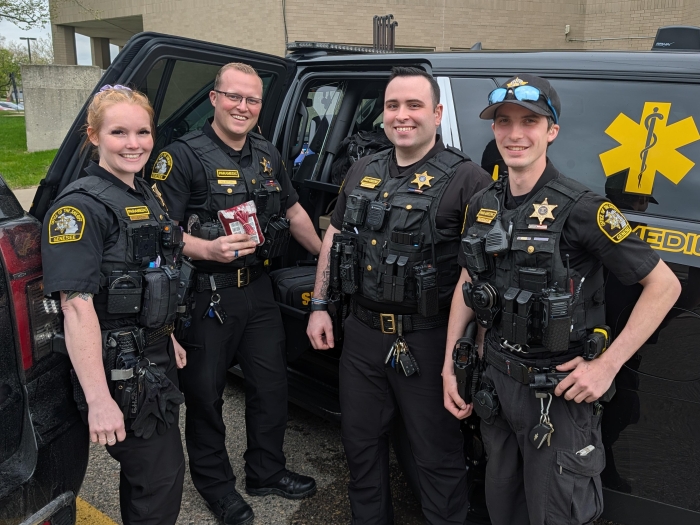
U-M Emergency Medicine Helps Bring Pre-Hospital Blood Transfusions to Genesee County EMS
Honoring the Heart of Care: Nurse Well-Being in Action
Serious disparities persist in maternal death rates in the U.S.

From Patient Art to Lifesaving Impact
Permission to Flourish: Well-Being for High Performers with Shigehiro Oishi

