
Ananya Sen
Sen covers cancer clinical care and pediatric cancer research, ophthalmology, endocrinology, diabetes, emergency medicine, survival flight, and children's and women's health. Sen completed her Ph.D. in Microbiology from the University of Illinois Urbana-Champaign where she then worked as a science writer after graduation.


Health Lab
New oral nanomedicine boosts effectiveness of cancer immunotherapies
University of Michigan researchers developed an oral drug that can increase the ability of T cells to attack tumors. The drug uses the microbial metabolite 3,4-dihydroxybenzoic acid, which is derived from dietary fiber.

Health Lab
New drug combination may help treat advanced prostate cancer
University of Michigan researchers found that combining BET bromodomain and DNMT inhibitors may slow the growth of treatment-resistant prostate cancer by targeting transdifferentiated tumors.

Health Lab
Rare genetic eye disease treated with gene therapy helps 2 children see again
Mia and Niko Spicer were diagnosed with Leber’s congenital amaurosis type 2, a rare genetic eye disease, and were treated with the gene therapy Luxturna to improve their vision.
Health Lab
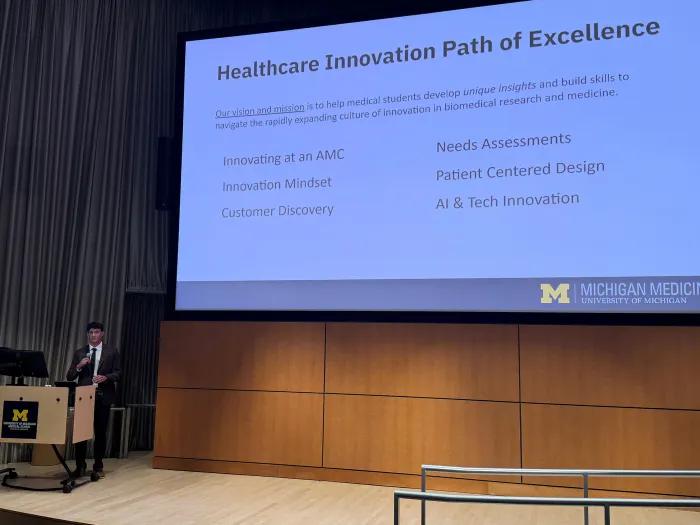
Medical students develop novel technological solutions for unmet patient needs
University of Michigan medical students showcased AI-driven healthcare innovation projects focused on melanoma support, transplant recovery and primary care access.

Health Lab
Trial focuses on duration of therapeutic hypothermia for out-of-hospital cardiac arrests
U-M researchers led the ICECAP trial, the largest U.S. study of therapeutic hypothermia after out-of-hospital cardiac arrest, finding longer cooling offered no benefit.

Health Lab
Using genetic testing, doctors help patient find answers for her diabetes
For 30 years Autumn Caris thought she had type 1 diabetes. After learning about MODY, a rare and often misdiagnosed type of diabetes, she finally got answers at U-M.

Health Lab
Researchers create new path to target hard-to-drug prostate cancer protein
University of Michigan researchers have identified a specific pocket within ERG, a driver of prostate cancer, and have developed a small molecule probe, called PBITE-1, that can bind to it.

Health Lab
Receiving personalized treatment for a rare neuroendocrine tumor
Danielle Schuldt was diagnosed with a rare endocrine tumor and underwent surgery as part of her treatment. She now undergoes regular surveillance to monitor for cancer recurrence.

Health Lab
Collaboration with community child care centers creates innovative research tool
Michigan Child Care Related Infections Surveillance Program, or MCRISP, brings together child care providers in Washtenaw County, Mich. and doctors at the University of Michigan Health to effectively monitor pediatric respiratory and gastrointestinal illness transmission.

Health Lab
Teenage patient receives treatment for papillary thyroid cancer
Teen hockey player Gavin Hewitt was diagnosed with papillary thyroid cancer and underwent surgery and radioactive iodine treatment.

Health Lab
Phase 1 trial of alrizomadlin shows promise in targeting metastatic salivary gland cancers
University of Michigan researchers, in partnership with Ascentage Pharma, developed a drug known as alrizomadlin, or APG-115, to target metastatic salivary gland cancers.

Health Lab
Urine-based test detects aggressive prostate cancer
Researchers at have validated a previously developed urine test, which can potentially bypass invasive procedures for prostate cancer detection among men who are unlikely to benefit.

Health Lab
Gut hormone FGF15 changes how mice respond to weight loss
University of Michigan researchers found that a gut hormone known as fibroblast growth factor 15, or FGF15, is essential for preserving lean mass during diet-induced weight loss. Their results suggest that effective weight-loss strategies need to be tailored to each patient.

Health Lab
New dual-target drug may help overcome immunotherapy resistance in pancreatic cancer
U-M researchers developed a new strategy to improve immunotherapy treatments for pancreatic cancer.

Department News
UM researchers awarded grants from BrightFocus Foundation for vision research
BrightFocus Foundation awarded $15.2M in research grants for Alzheimer’s, macular degeneration, and glaucoma, including support for Michigan Medicine researchers Jason Miller, MD, PhD, and Mark Draelos, MD, PhD, advancing new approaches to vision loss and disease detection.
