
Statewide Clinical Research Partnerships
Supporting U-M research within the Statewide Network of Care.

U-M Research at/with the Statewide Network of Care (SNC)
University of Michigan Health (U-M Health) is committed to ensuring Michiganders have access to the right care in the right place and therefore has developed a number of collaborations and affiliations with health systems, hospitals, and providers throughout the state so that patients can receive care closer to home. U-M Health is Michigan Medicine’s clinical enterprise and includes three main parts:
- Academic Medical Center (AMC)
Adult Hospitals, Children’s and Women’s Hospitals, and Ambulatory Care Services - outpatient centers and clinics - Regional Network
UM Health-Sparrow, UM Health-West, and their medical group - Joint Ventures and Affiliates
Such as MyMichigan Health, Trinity Health and Holland Hospital
The “Statewide Network of Care”, or “SNC”, broadly describes the combination of Regional Network, Joint Venture, and Affiliate sites – all U-M Health sites that are not part of the Academic Medical Center (AMC).
Research is a valued activity within and across U-M Health, including the SNC. It is important that U-M study team members (faculty, staff, students, house officers, and post-doctoral fellows) from U-M Ann Arbor (including the Medical School), U-M Dearborn, and U-M Flint (“U-M Researcher” and collectively “U-M Researchers”) who wish to conduct human subjects research at/with SNC sites understand that, while U-M Health includes the three components listed above, U-M research conducted by U-M Researchers at/with SNC sites differs from U-M research at/with the AMC.
Extending U-M research throughout the SNC is an integral part of the vision and requires significant coordination. The Medical School Office of Research and the Michigan Institute for Clinical & Health Research (MICHR) launched Statewide Clinical Research Partnerships (SCRP) to ensure that U-M researchers interested in extending research opportunities to SNC patients are supported in navigating the unique administrative and regulatory requirements that need to be addressed when working across SNC sites. SCRP serves as a centralized resource to guide researchers through these distinct pathways, offering individualized consultations and study-specific support.
U-M Research at/with Statewide Network of Care Sites: Three Key Differences
U-M research at/with the SNC is different from U-M research at/with the AMC because of:
- Operational and organizational differences
SNC sites...- Are separate legal entities from the AMC.
- Are non-academic healthcare systems that do not have parallel research infrastructures to that of U-M.
- Have their own electronic health record (EHR) systems that are separate from and not currently integrated with the AMC’s EHR.
- Have their own Institutional Review Boards (IRBs).
- Negotiate their own contracts with sponsors.
- Manage their own research finances and billing.
- Additional Approval Requirements
- U-M research at or with SNC sites requires additional approvals than research that is conducted at or with the AMC.
- For research purposes, SNC sites are like any other external organization or institution.
- With SNC sites, U-M Researchers are entering another institution’s facility to conduct research with their patients. This is different from multi-site research.
- No research activity, including research within an SNC site, with their patients, or with their data, and all aspects of a study (including recruiting), may take place at or with an SNC site until approved by the site and U-M. Michigan Medicine Statewide Clinical Research Partnerships (SCRP) will issue an Approval Notice once all required approvals have been secured.
- Role of SCRP in the Research Process
- The Michigan Medicine Statewide Clinical Research Partnerships (SCRP) team helps U-M Researchers navigate obtaining approvals for conducting U-M research at or with SNC sites.
- The first step is always to submit a SCRP Intake Form for each study as early as possible.
- SCRP will explain necessary steps for each specific study scenario.
Research Request Process for U-M Research at Statewide Network of Care (SNC) Sites
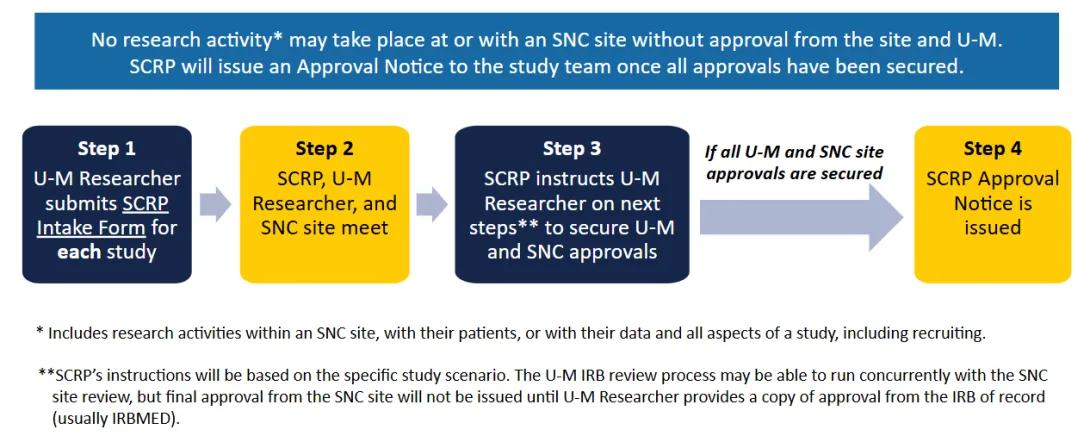
No research activity within a Statewide Network of Care (SNC) site, with their patients, or with their data, and all aspects of a study (including recruiting), may take place at or with an SNC site without approval from the site and U-M. Michigan Medicine Statewide Clinical Research Partnerships (SCRP) will issue an Approval Notice once all required approvals have been secured.
The required process for U-M research at or with SNC sites:
Step 1: U-M Researcher submits SCRP Intake Form for each study to SCRP.
Step 2: SCRP, U-M Researcher, and SNC site meet.
Step 3: SCRP instructs U-M Researcher on next steps to secure U-M and SNC approvals. SCRP’s instructions will be based on the specific study scenario. The U-M IRB review/approval process may be able to run concurrently with the SNC site review and approval, but final approval from the SNC site will not be issued until U-M Researcher provides a copy of approval from the IRB of record (usually IRBMED).
Step 4: If all U-M and SNC site approvals are secured, a SCRP Approval Notice is issued.
Guidance for Conducting U-M Research at/with the Statewide Network of Care
The first step for U-M Researchers who are interested in conducting research at/with a SNC location is to submit a Statewide Clinical Research Partnerships (SCRP) Intake Form. Note that at this time, processes have been developed for extension of U-M research to Chelsea Hospital, UM Health-Sparrow, and UM Health-West. If you wish to conduct U-M research at or with an SNC site other than these three sites, please email SCRP at [email protected] (instead of submitting the Intake Form) to let us know the site of interest and to discuss options and requirements.
Important considerations for U-M research at/with SNC sites are noted below, but SCRP will help U-M research teams navigate the regulatory and administrative processes and requirements that need to be addressed for their specific study scenario.
Employment
- Physicians within the SNC can be employed by U-M, the Regional Network (UM Health-Sparrow, UM Health-West, and their joint medical group), another health system (e.g., Trinity) or independently (i.e., private practice).
- U-M-employed physicians who provide clinical care at SNC sites often do so under terms outlined in a Professional Services Agreement (PSA).
- U-M-employed faculty, staff, and trainees (i.e., post-doctoral fellows, house officers, students) conducting research at SNC sites must act as agents of U-M (not of the SNC sites) and use U-M (not SNC) offices and systems to manage all aspects of the study. This is true even for U-M Principal Investigators (PIs) who provide clinical care at the SCN site under a PSA.
- All research staff (e.g., clinical research coordinators) conducting study activities under a U-M-employed PI must be employed by U-M (not the SNC site).
Approvals for Research
Approvals for research conducted at/with U-M do not automatically extend to SNC sites. No research activities may occur at/with any SNC sites until necessary approvals are obtained. This includes approvals for exactly who from the U-M study team is doing what research activities at/with the site.
All SNC sites are separate legal entities from the AMC and must be treated as such. For example, a study approved by a U-M IRB has not necessarily been IRB-approved to be conducted at a SNC site.
- IRB
All U-M research activities conducted at the SNC sites must be overseen by IRBMED, and IRBMED will be the IRB of record in most cases. Adding study activities at/with a SNC site will require changes to the study’s eResearch application. U-M Researchers must work with the IRBMED using this guidance to obtain necessary approvals. - External sponsor awards and contracts
Adding U-M study activities at a SNC site may require changes to the study’s award or contract (if externally funded). Changes may include adding performance site(s) to the award and/or changing the class code to reflect the off-campus indirect cost rate. Engaging a SNC site as an independent performance site led by a non-U-M clinician will require subcontracts. SCRP will help study teams navigate when and which U-M offices to contact about this.
Access to SNC Patient Data
- Use or disclose Protected Health Information (PHI) only after IRB approval.
- Establish a Data Use Agreement (DUA) between U-M and the SNC site if the SNC site will be sharing identifiable information with U-M for research purposes. A DUA is needed even if U-M Researchers already have access to the UMHN site’s electronic health record (EHR) for clinical care purposes.
- Care Everywhere (CE), an Epic EHR feature that allows clinical care providers to share a patient's health care record across health care systems for treatment and care coordination purposes, cannot be used to request or access outside records for research purposes unless this access directly supports research-related clinical care (e.g., tracking adverse events for patient safety). Using CE to obtain information solely for research without a clinical care component is prohibited. For specific study questions regarding using CE in research, reach out to the MiChart Research Team here (requires Level 2 login).
Personnel and Protocol Changes
It is the U-M study team’s responsibility to immediately email SCRP ([email protected]) regarding any planned changes to personnel or protocols that affect research activities at or with SNC sites. No such changes are allowed until approved by both the IRB of record (usually IRBMED) and the SNC site, except as necessary to eliminate apparent immediate hazards to research participants. Should the latter occur, you must email SCRP as soon as possible.
Detailed guidance can be found in this Manual on Essentials for Conducting University of Michigan Research at or with Statewide Network of Care Sites (PDF)
"Conducting U-M Research with the Statewide Network of Care"
Presented on Jan 13th, 2026 to the Cardiovascular Center Clinical Research Group
The Foundations for Conducting U-M Research at or with Statewide Network of Care (SNC) Sites training helps U-M Researchers (U-M study team members from U-M Ann Arbor (including the Medical School), U-M Dearborn, and U-M Flint, including faculty, staff, students, house officers, and post-doctoral fellows) understand how research at or with Statewide Network of Care (SNC) sites, which includes UM Health-Sparrow and UM Health-West, as well as joint ventures and affiliates, is different from research at or with the Academic Medical Center. The training takes approximately 30 minutes and covers the key administrative and regulatory requirements as well as expectations that must be adhered to when conducting U-M human subjects research at or with an SNC site.
The training can be accessed in Cornerstone (course code: MCHR-00701).
AMC researchers must submit requests for letters of support from UM Health-Sparrow, UM Health-West, and/or Chelsea Hospital to SCRP as soon as possible, but no less than 8 weeks prior to the deadline.
Please use the following process to request a letter of support:
- Optional: Download this template for UM Health-Sparrow or this template for UM Health-West and customize with basic information about your proposal by completing the sections that are highlighted in yellow. Note that NIH has replaced letters of support with letters of collaboration and therefore these templates are not applicable to NIH grants.
- If you have not done so already, submit a SCRP Intake Form for the project.
- Email the completed letter to [email protected] and include:
- SCRP Intake Form number, if available to you
- Name of the proposal
- Name of the PI
- Name(s) of anyone at the site that you worked with to customize support for your letter
- Name(s) and contact information, if known, for the person(s) who should receive the completed letter
- Your deadline
Statewide Network of Care Sites
U-M Health and Trinity Health Joint Venture at Chelsea Hospital
The joint venture between U-M Health and Trinity Health allows physicians to work collaboratively to care for patients at Chelsea Hospital.
Read more about the joint venture.
Chelsea Hospital Rehabilitation
Through the joint venture, patients who previously would have received inpatient rehabilitation at the U-M Academic Medical Center now receive care at Chelsea Hospital.
To ensure that patients have the opportunity to participate in the breadth of research available at U-M, the guidance above regarding conducting U-M research at/with the Statewide Network of Care must be followed.
General Frequently Asked Questions
No, this is not an approved use of this function by Epic. You must establish the necessary approvals prior to accessing network site EHR data for research.
No. Approval to access the EHR for clinical care does not automatically extend to research. Specific data use agreements for research may need to be established, regardless of whether or not a provider is credentialed. Epic’s “Rules of the Road” guidelines state that users may only access Care Everywhere (CE) to request and view patient information for the purpose of treatment and care coordination. Access for research is explicitly not allowed when the EHR data have not already been accessed for treatment and care coordination. Some research-related work DOES fit with this definition. An example of a scenario that falls within the Rules of the Road is when a study coordinator views CE documentation in an effort to confirm whether an outside encounter is impactful or related to the patient’s research treatment regimen.
The Rules of Road specifically address that users should not be requesting outside documents for research recruitment, feasibility, or cohort development. The Rules do not have any specifications or restrictions on how the data may be used after it has been retrieved for treatment or care coordination purposes. Information that was originally requested for the purpose of treatment or care coordination, once received, may be accessible to researchers. Specific questions regarding using CE in research should be sent to the MiChart Research Team here.
Credentialing can be helpful in regard to obtaining physical and EHR access at a network of care site, however, it is important to know that approvals to access the EHR and space for clinical care do not automatically extend to research. Appropriate approvals for such access for research purposes must be in place before any research activity can occur. Investigators can begin the process to obtain these approvals by submitting an intake form for the study to the SCRP team. SCRP will help the study team navigate the requirements that are needed for the requested access.
There is not a single answer to this question, as it depends on how the study team intends to identify and recruit eligible participants, and at which site they will be doing this. For example, the levels of approvals and workflows would differ depending on if recruitment is to be done via flyer vs. if the study team requires EHR access vs. if the study team is requesting EHR data reports to be pulled from the site so that participants can be identified. The sites also differ by their research approval processes. Questions about specific study scenarios can be sent to the SCRP team for guidance at [email protected]
There is not a single answer to this question, as it depends on the study, what the PI would like to do, if the study is externally sponsored, and at which site they are intending to work. Each scenario and site require different approvals and workflows. Some sample considerations for a study that includes in-person activities, however, would include the following:
Who will be conducting the research activities (i.e., Michigan Medicine PI, Michigan Medicine staff, or network site staff) and what will they be doing?
a. If Michigan Medicine personnel do they already have space at the site, or would that need to be negotiated? Are they credentialed at the site?
b. If help from network site personnel is needed, is there an adequate budget to pay them for this work?
c. Would the site’s involvement rise to the level of being engaged (by the federal definition) in the research?
Will EHR access be needed?
While UM Health-Sparrow, UM Health-West and Chelsea Hospital all use Epic, they are all on different instances (from each other and from Michigan Medicine). Also, at this time, view-only EHR access is the only type of access available to Michigan Medicine study teams in these other EHRs.
Is there funding for off-site activities?
It is the responsibility of the investigator(s) to obtain necessary funding and to develop a budget when extending a study to the U-M Statewide Network of Care sites.
Some things to consider:a. Has the budget for off-site work been accounted for (i.e., is the off-campus indirect cost rate required for the project if it is externally funded)?
b. Would the study team incur significant and unexpected costs for mileage to/from the site?
AMC researchers must submit requests for letters of support from UM Health-Sparrow and/or UM Health-West to SCRP as soon as possible, but no less than 8 weeks prior to the deadline. Additional information can be found here.
Chelsea Hospital Frequently Asked Questions
Inpatients at Chelsea Hospital are Chelsea Hospital patients with Chelsea Hospital Medical Record Numbers (MRNs).
No. There are several steps that must be taken to ensure that the appropriate regulatory and administrative approvals are in place before any U-M study activity can begin involving patients at Chelsea Hospital. Please reach out to the SCRP team through the U-M Health Statewide Network of Care Intake Form or submit general inquiries through email ([email protected]) as early as possible before you intend to start your study. In addition, it is very important to reach out early in grant planning to address budgeting and contracting issues that are specific to research at or with Chelsea Hospital.
No, this access is limited to view-only at this time. You may not enter orders in the Chelsea Hospital EHR. To be granted view-only EHR access, you will need to complete a series of steps.
Yes. Electronic communication with study participants who have already been recruited and enrolled in the study may continue during their admission to Chelsea Hospital. No in-person study activities, however, may be conducted during this time without necessary study-specific approvals with Chelsea Hospital.
No. Individuals requiring inpatient rehabilitation who are younger than age 18 years would receive care at C.S. Mott Children’s Hospital.
Contact Us
Michigan Medicine Statewide Clinical Research Partnerships
General inquiries:
[email protected]
To get started with research activities within the Statewide Network of Care:
Submit a SCRP Intake Form
