Ryan Baldridge
Manage Your Profile
About
I grew up in Northern Kentucky and attended Northern Kentucky University as an undergraduate student. During this time, I worked at the Wood Hudson Cancer Research Laboratory with Dr. Bonnie Richmond and later in the lab of Dr. Patrick Schultheis at Northern Kentucky University. I graduated with two BS degrees in 2007 (in Biological Sciences and Chemistry). My PhD training was with Todd Graham at Vanderbilt University where I worked on mechanics of phospholipid "flippases", graduating in 2013. I completed my postdoctoral training with Tom Rapoport at Harvard Medical School in 2017, working on mechanics of the the endoplasmic reticulum associated degradation system (ERAD). I started my lab at the University of Michigan Medical School in September 2017.
Links
Baldridge Lab
Qualifications
-
Damon Runyon Cancer Research Foundation FellowHarvard Medical School, Cell Biology, United States
2013 - 2017
Postdoctoral Fellowship
-
PhD, Biological SciencesVanderbilt University, Nashville, TN, United States
2007 - 2013
-
BS, Biological SciencesNorthern Kentucky University, Highland Heights, KY, United States
2003 - 2007
-
BS, ChemistryNorthern Kentucky University, Highland Heights, KY, United States
2003 - 2007
Research Overview
We are interested in the basic mechanisms of protein quality control systems at cellular membranes. We study how these systems select their substrates, and aim to identify the cellular pathways regulated by them. These processes are important in pathologies related to cell stress, protein misfolding, and protein misregulation. Human illnesses linked to these problems include Parkinson’s disease, Alzheimer’s disease, and various cancers. Our longer-term goals are to understand how changing conditions in cells target substrate proteins to these integral-membrane quality control systems and exploit these systems to enable targeted protein degradation from cellular organelles.
Recent Publications
-
Russ JE, Peterson BG, Taylor S, Baldridge RD. Proceedings of the National Academy of Sciences of the United States of America, 2025 Dec 29; 122 (49): e2513595122 - e2513595122.Journal ArticleCompetition between Der1 and ERAD-M substrates controls Hrd1 complex function
DOI:10.1073/pnas.2513595122 -
Dennison DD, Baldridge RD. Journal of Cell Biology, 2025 Sep 1; 224 (9):Journal ArticleUbiquitin chain variability directs substrates of the Tul1 ubiquitin ligase complex to different degradation pathways
DOI:10.1083/jcb.202312133 PMID: 40694054 -
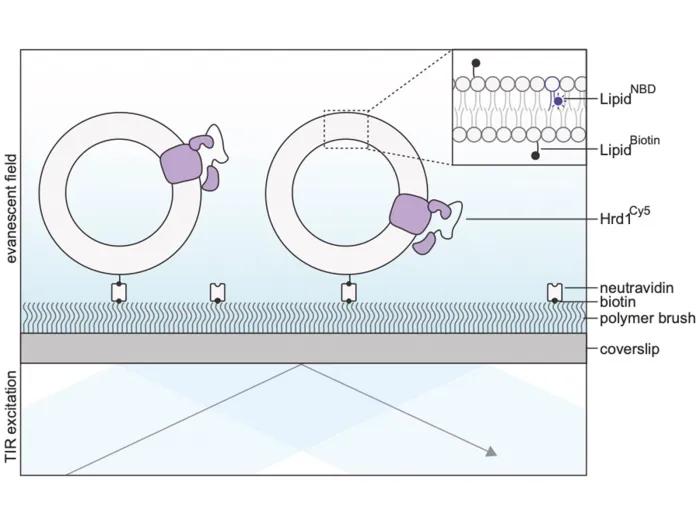
Moochickal Assainar B, Ragunathan K, Baldridge RD. Nat Commun, 2024 Sep 12; 15 (1): 1340 - 1340.Journal ArticleDirect observation of autoubiquitination for an integral membrane ubiquitin ligase in ERAD.
DOI:10.1038/s41467-024-45541-3 -
Peterson BG, Hwang J, Russ JE, Schroeder JW, Freddolino PL, Baldridge RD. Cell Rep, 2024 Sep 12; 42 (11): 113451 - 113451.Journal ArticleDeep mutational scanning highlights a role for cytosolic regions in Hrd1 function.
DOI:10.1016/j.celrep.2023.113451 -
Hwang J, Peterson BG, Knupp J, Baldridge RD. Sci Adv, 2024 Sep 12; 9 (2): eadd8579 - eadd8579.Journal ArticleThe ERAD system is restricted by elevated ceramides.
DOI:10.1126/sciadv.add8579 -
Peterson BG, Glaser ML, Rapoport TA, Baldridge RD. eLife, 2024 Sep 12; 8: e50903 - e50903.Journal ArticleCycles of autoubiquitination and deubiquitination regulate the ERAD ubiquitin ligase Hrd1.
DOI:10.7554/eLife.50903 -
Baldridge RD, Rapoport TA. Cell, 2024 Sep 12; 166 (2): 394 - 407.Journal ArticleAutoubiquitination of the Hrd1 Ligase Triggers Protein Retrotranslocation in ERAD.
DOI:10.1016/j.cell.2016.05.048 -
Baldridge RD, Xu P, Graham TR. J Biol Chem, 2024 Sep 12; 288 (27): 19516 - 19527.Journal ArticleType IV P-type ATPases distinguish mono- versus diacyl phosphatidylserine using a cytofacial exit gate in the membrane domain.
DOI:10.1074/jbc.M113.476911
Featured News & Stories
Jeffrey Knupp, PhD, receives a postdoctoral fellowship from the Michigan Pioneer Fellows Program
Congratulations to Basila Moochickal Assainar, PhD
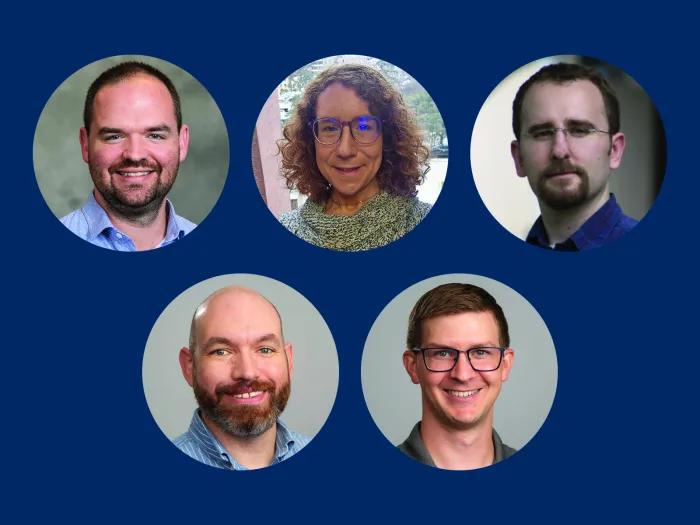
Five Biological Chemistry faculty members receive promotions in 2025
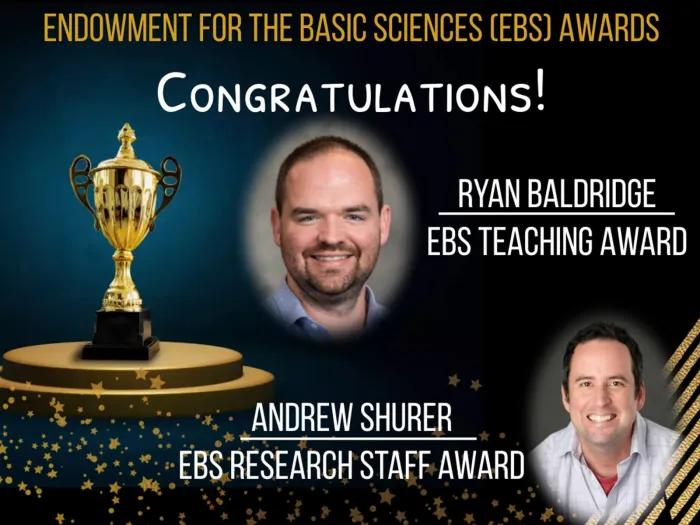
Ryan Baldridge and Andrew Shurer receive Endowment for Basic Science Awards