
Ananya Sen
Sen covers cancer clinical care and pediatric cancer research, ophthalmology, endocrinology, diabetes, emergency medicine, survival flight, and children's and women's health. Sen completed her Ph.D. in Microbiology from the University of Illinois Urbana-Champaign where she then worked as a science writer after graduation.


Health Lab
FDA-approved drug offers hope for patients with polycythemia vera, a rare bone marrow disorder
FDA-approved rusfertide offers new hope for polycythemia vera patients by reducing phlebotomy dependence, easing symptoms, and improving daily life.

Health Lab
Pediatric patient treated for rare kidney cancer
When 18-month-old Maria was diagnosed with an exceptionally rare kidney cancer, specialists at C.S. Mott Children's Hospital created a customized treatment plan that saved her life.

Health Lab
Engineered nanoparticles sensitize gliomas to radiotherapy
University of Michigan researchers discovered a new pathway that sensitizes mIDH1 gliomas to radiation in human and mouse mIDH1 glioma cells and mouse models, paving the way for phase 1 clinical trials in humans

Health Lab
Mediterranean diet can slow progression of age-related macular degeneration
Fish, vegetables and whole grains in the Mediterranean diet can help reduce progression of age-related macular degeneration and support long term eye health.

Health Lab
U-M alumni return from Central Asia to seek treatment for their child at Mott
After a leukemia diagnosis overseas, a young girl returned to Michigan for expert pediatric cancer care at C.S. Mott Children’s Hospital.

Health Lab
Patient with retinitis pigmentosa receives new hope at Kellogg’s low vision clinic
Retinitis pigmentosa can lead to vision loss, but DNA testing, inherited retinal disease research and AI glasses offer new hope.

Health Lab
New oral nanomedicine boosts effectiveness of cancer immunotherapies
University of Michigan researchers developed an oral drug that can increase the ability of T cells to attack tumors. The drug uses the microbial metabolite 3,4-dihydroxybenzoic acid, which is derived from dietary fiber.

Health Lab
New drug combination may help treat advanced prostate cancer
University of Michigan researchers found that combining BET bromodomain and DNMT inhibitors may slow the growth of treatment-resistant prostate cancer by targeting transdifferentiated tumors.

Health Lab
Rare genetic eye disease treated with gene therapy helps 2 children see again
Mia and Niko Spicer were diagnosed with Leber’s congenital amaurosis type 2, a rare genetic eye disease, and were treated with the gene therapy Luxturna to improve their vision.
Health Lab
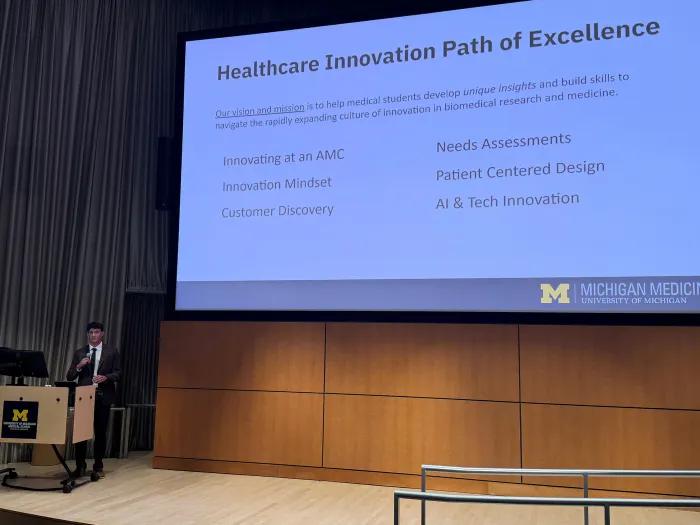
Medical students develop novel technological solutions for unmet patient needs
University of Michigan medical students showcased AI-driven healthcare innovation projects focused on melanoma support, transplant recovery and primary care access.

Health Lab
Trial focuses on duration of therapeutic hypothermia for out-of-hospital cardiac arrests
U-M researchers led the ICECAP trial, the largest U.S. study of therapeutic hypothermia after out-of-hospital cardiac arrest, finding longer cooling offered no benefit.

Health Lab
Using genetic testing, doctors help patient find answers for her diabetes
For 30 years Autumn Caris thought she had type 1 diabetes. After learning about MODY, a rare and often misdiagnosed type of diabetes, she finally got answers at U-M.

Health Lab
Researchers create new path to target hard-to-drug prostate cancer protein
University of Michigan researchers have identified a specific pocket within ERG, a driver of prostate cancer, and have developed a small molecule probe, called PBITE-1, that can bind to it.

Health Lab
Receiving personalized treatment for a rare neuroendocrine tumor
Danielle Schuldt was diagnosed with a rare endocrine tumor and underwent surgery as part of her treatment. She now undergoes regular surveillance to monitor for cancer recurrence.

Health Lab
Collaboration with community child care centers creates innovative research tool
Michigan Child Care Related Infections Surveillance Program, or MCRISP, brings together child care providers in Washtenaw County, Mich. and doctors at the University of Michigan Health to effectively monitor pediatric respiratory and gastrointestinal illness transmission.
