Incentives2Quit

Incentives2Quit is a hybrid human-digital motivational interviewing-grounded incentive-based treatment. It is a state-of-the-science program that helps to sustain motivation and successfully quit smoking. The program includes monetary incentives that reinforce biologically-verified cessation (via breath CO measures) while simultaneously building intrinsic motivation and skills to maintain long-term tobacco cessation. Incentives2Quit is an effective motivational and incentive-based treatment, established during our previous pilot demonstration project among Medicaid beneficiaries.
Contact Us
2800 Plymouth Rd, Building 16
Ann Arbor, MI 48105

Pregnant Michigan Medicaid beneficiaries can now be referred to Incentives2Quit!
Contact us to find out if you are eligible.
IRBMED: HUM00244852
Our App
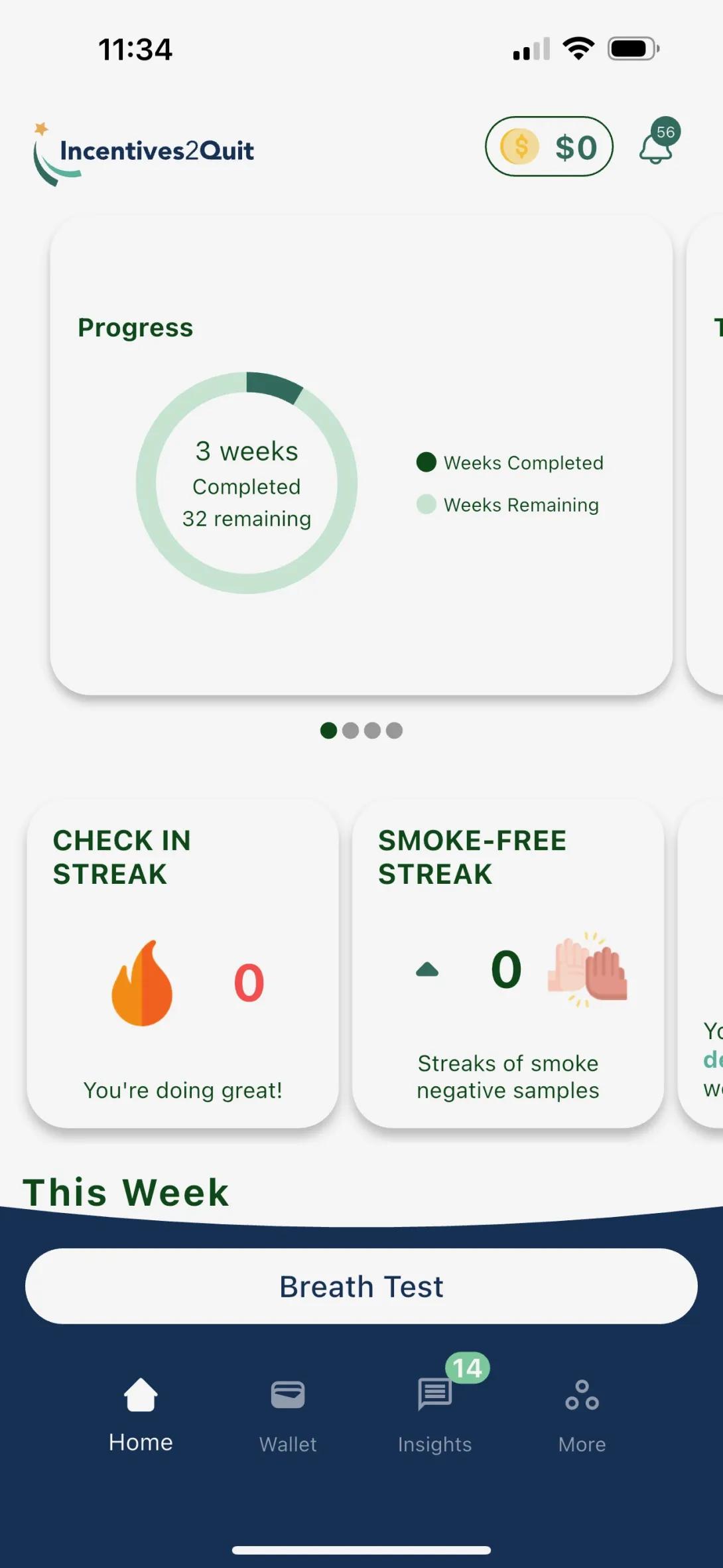
The Home screen is where beneficiaries can see a quick view of their wallet balance, notifications, and chatting with a coach; the Home screen also displays trends, streaks, and progress throughout the program.
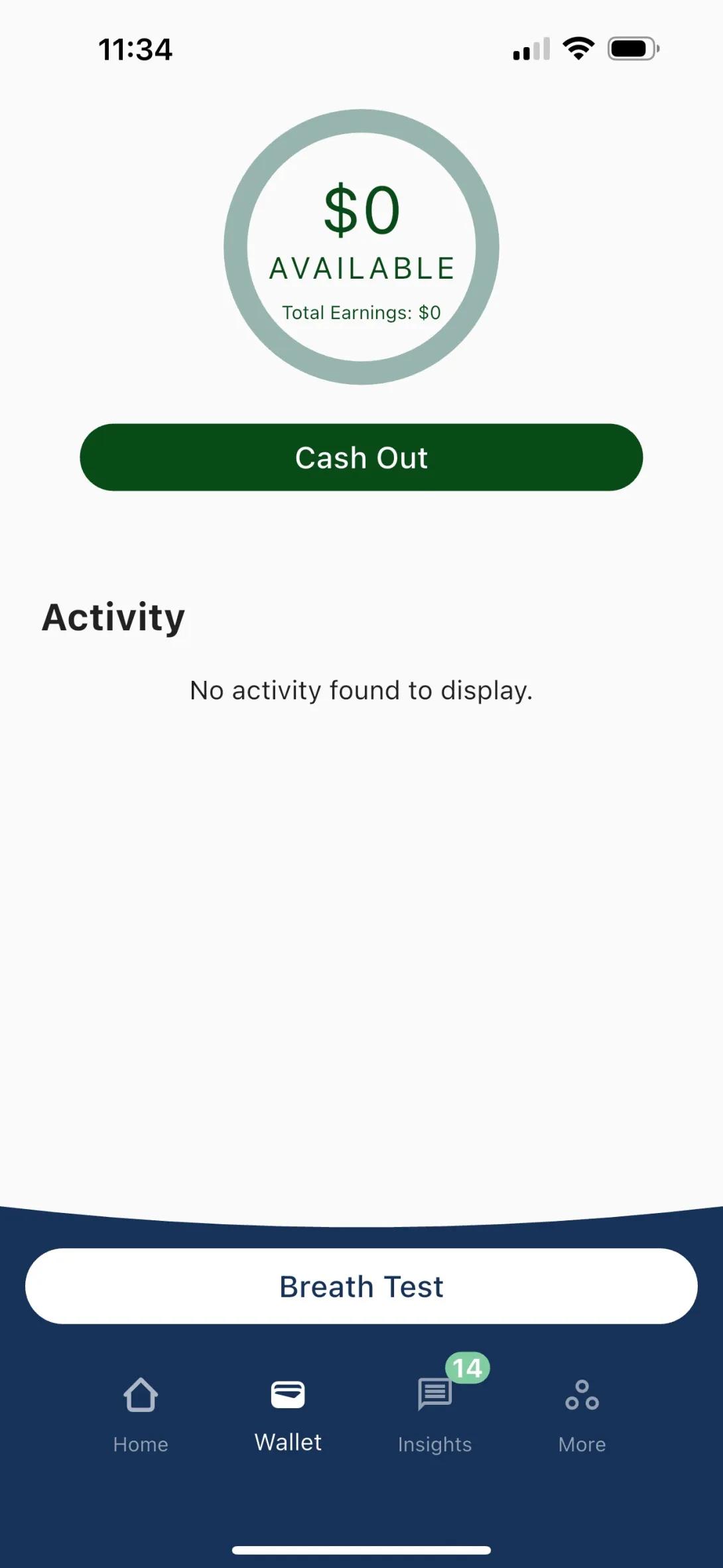
The Wallet page shows the current reward balance and allows beneficiaries to withdraw funds.
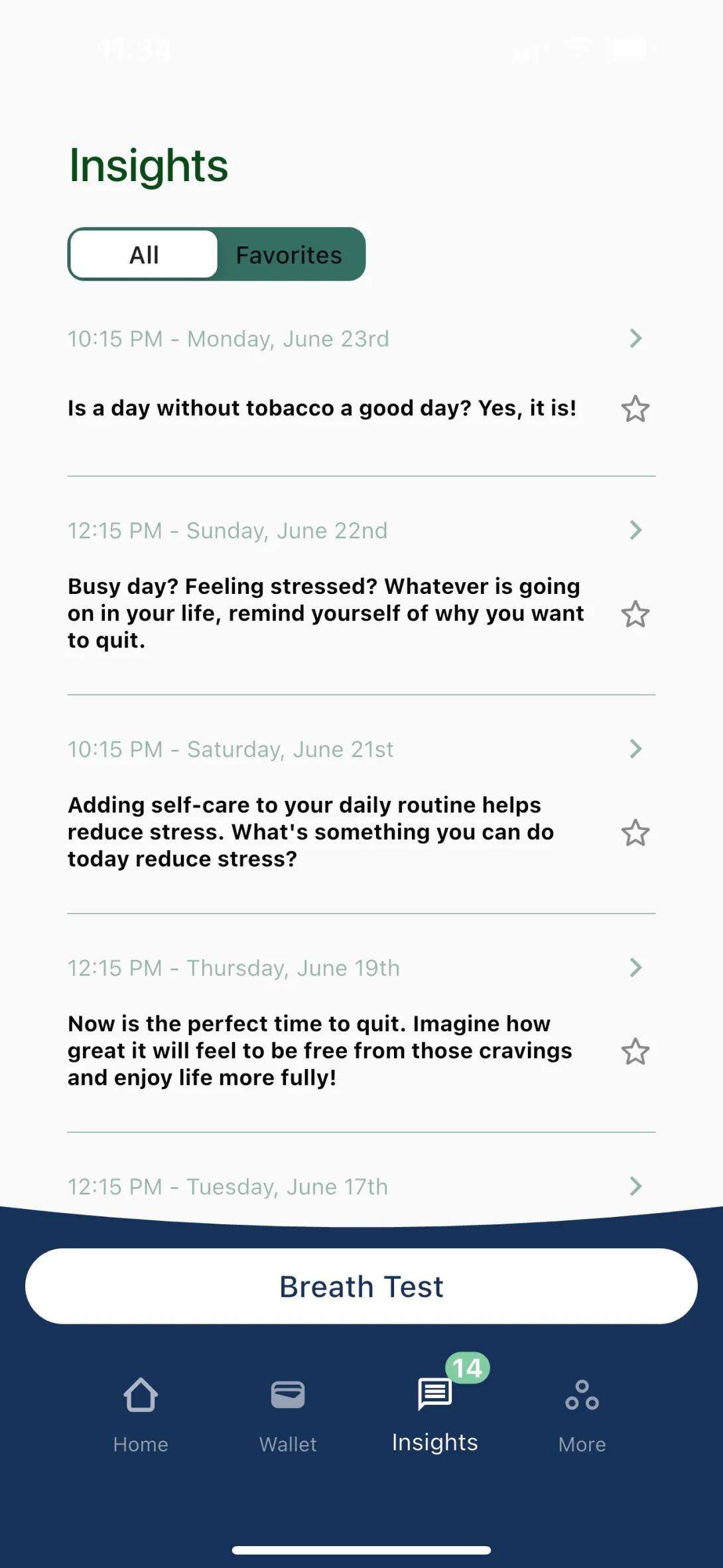
The Insights tab shows all the motivational messages, or “insights” that have been received by the patient during the program; beneficiaries are able to look back on these and “star” or “like” their favorites, only serving to enhance the motivation and momentum to quit.
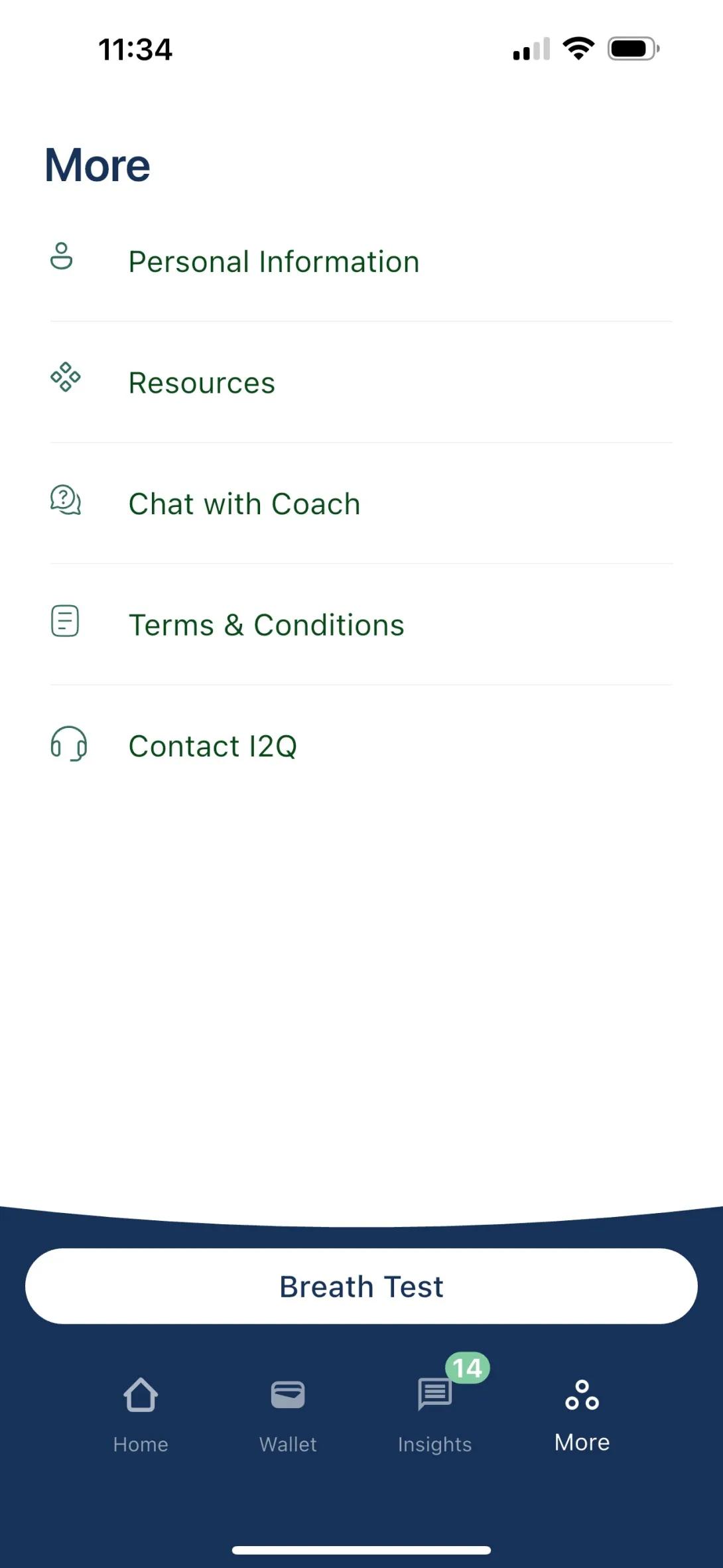
The More tab includes account information, digital copies of the resource guides, and the ability to chat with a coach, and the terms of agreement.
The Science Behind Incentives2Quit
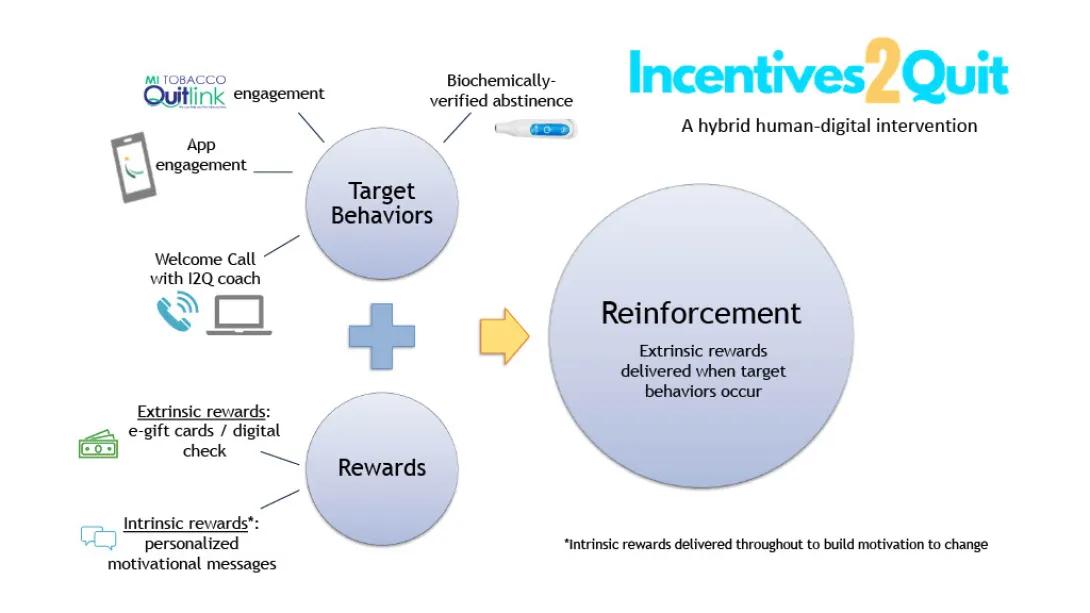
Description:
The diagram above represents the conceptual model of Incentives2Quit. The program has four key components that reinforce a person’s internal and external motivations to change their smoking behaviors. We target biochemically-verified abstinence from combustible tobacco, and engagement with the program app and the MI Tobacco Quitlink. These target behaviors are incentivized through extrinsic rewards (i.e., money) and intrinsic rewards (i.e., personalized motivational messages). Together, the target behaviors and rewards lead to reinforcement of behavior change and smoking cessation.
Why Smoking Cessation?
- Cigarette smoking is the leading cause of preventable death in the United States and Michigan.2
- If no one smoked cigarettes, 1 of every 3 cancer-related deaths in the United States would not happen.2
- Cigarette smoking is responsible for nearly 1 in 5 deaths in the United States every year.2
- Smoking causes an increase in blood pressure, leading to an increased risk of stroke and coronary artery disease.2
- 24.5% of Medicaid recipients smoke cigarettes nationwide compared to 14% of the general population.3
- In Michigan, 41.3% of Medicaid recipients smoke compared to 19.3% of the general population.3
- Nationally, Medicaid could save $2.6 billion in 1 year if 1% of beneficiaries stopped smoking.3
In summary, quitting smoking is the single best health behavior change to improve quality of life and length of life.
1. An Incentive-Based Mobile Health Program for Smoking Cessation in Low-Resource Populations with a Pilot Micro-Randomized Trial
Tomlinson, D.C., Bonar, E.E., Zimmermann, L., Fernandez, A., Tzilos Wernette, G., Nahum-Shani, I., Coughlin, L.N. An Incentive-Based Mobile Health Program for Smoking Cessation in Low-Resource Populations with a Pilot Micro-Randomized Trial. (Under review).
2. Health effects of cigarette smoking. Centers for Disease Control and Prevention
Centers for Disease Control and Prevention. (2021, October 29). Health effects of cigarette smoking. Centers for Disease Control and Prevention. https://www.cdc.gov/tobacco/data_statistics/fact_sheets/health_effects/effects_cig_smoking/
3. Estimation of 1-Year Changes in Medicaid Expenditures Associated with Reducing Cigarette Smoking Prevalence by 1%.
Glantz, S. A. 2019. “Estimation of 1-Year Changes in Medicaid Expenditures Associated with Reducing Cigarette Smoking Prevalence by 1%.“ JAMA Network Open. https://jamanetwork.com/journals/jamanetworkopen/article-abstract/2730483
Testimonials
Tobacco Cessation Champions
We completed 20 interviews with tobacco cessation champions in the state of Michigan to better understand the barriers and opportunities to improving tobacco cessation services in Michigan to help people make more quit attempts and be successful in their quit attempts. Here’s what some champions had to say about Incentives2Quit:
Monetary incentives will always be compelling to people without question. The convenience of text messaging is a good program.
For some people, having the ability to connect to an outside app or provider would be a helpful way for them to maintain their motivation.
Patients
The incentives gave me a reason to stick with it.
The program as a whole was extremely beneficial to me. I felt surprised when the end date arrived but this may have been because it took me a while to get to such a lower level of smoking.
Everything is going well - very excited about quitting smoking.
I’m super excited. I really, really want to quit!
I liked the ability to see the level of CO in my system as the weeks went on the most. Seeing the levels lower or raise was crucial to see how much it affects even one cigarette. While intrinsic and extrinsic motivation was really great tied together but I feel almost more rewarded today to continue.
News & Events
Incentives2Quit 2.0 has launched for pregnant Michigan Medicaid and dual enrolled Medicare-Medicaid beneficiaries.
May 7, 2025: 35th Annual Albert J. Silverman Research Conference
The Incentives2Quit team presented three posters at the 35th Annual Albert J. Silverman Research Conference hosted by the University of Michigan Department of Psychiatry. The team presented on: 1) the outcomes of the daily ecological momentary assessments completed during the pilot of Incentives2Quit; 2) the key themes of barriers and facilitators to cigarette smoking cessation in Michigan – outcomes from the Tobacco Cessation Champion interviews; 3) Incentives2Quit for perinatal Medicaid beneficiaries. Check out the posters below to learn more!
- Ecological Momentary Assessments in an Incentive-Based Intervention for Smoking Cessation: Predicting Near-term Engagement and Smoke Status
- Key Themes of Barriers and Facilitators to Smoking Cessation in Michigan: A Rapid Qualitative Analysis of Michigan Tobacco Cessation Champions
- Hybrid human-digital motivational incentive intervention for smoking cessation among perinatal Medicaid patients
May 21, 2024: Peer Survey Results presented at the MI Peer Conference
The Michigan Department of Health and Human Services Peer Support Services and the University of Michigan partnered to learn more about peers’ thoughts on tobacco use. The survey was distributed to over 3,000 recipients (peer support specialists, peer recovery coaches, and community health workers). The survey found that most peers strongly agree that smoking is harmful to health with 4 out of 10 respondents having had negative consequences of tobacco use.
Among the available supports for smoking cessation (i.e., nicotine replacement therapy [NRT] , counseling, Quitlink/Quitline, medications, and peer-to-peer support), peer-to-peer support was most endorsed as being very effective, especially among peers with past tobacco use. Among peers who currently use tobacco, the Quitlink/Quitline and NRT were endorsed as very effective. Medications, NRT, and peer-to-peer support were rated very effective the most among the other supports available.
May 22, 2024: 34th Annual Albert J. Silverman Research Conference
The Incentives2Quit team had the opportunity to present on Incentives2Quit pilot demonstration outcomes at the 34th Annual Albert J. Silverman Research Conference hosted by the University of Michigan Department of Psychiatry. The poster was titled “Pilot implementation of a motivational incentive smoking cessation program for rural Medicaid patients."
Poster
Press Releases
- Virtual program to promote smoking cessation among Medicaid enrolled expectant mothers - The tobacco cessation incentivization program tested at the U-M Addiction Center will now be available to pregnant participants
- Molina Healthcare and University of Michigan Launches Incentives2Quit Program
Check Out Our Publications
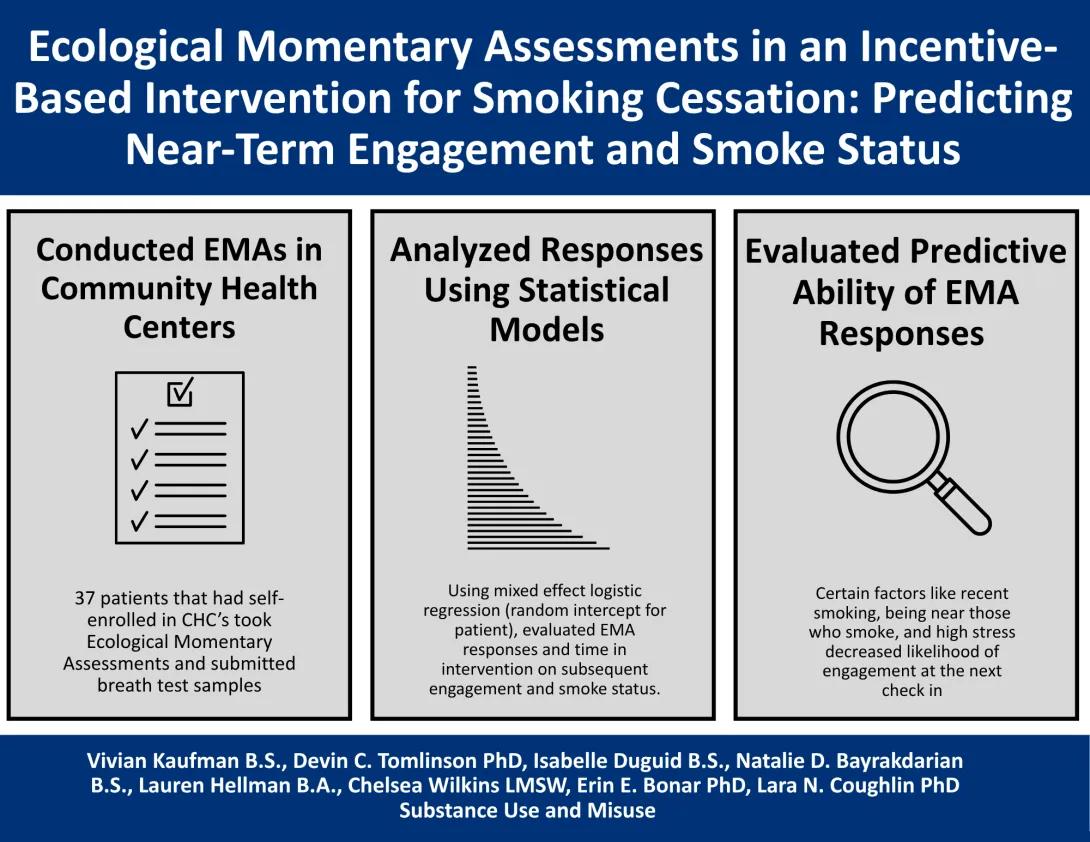
Visual abstract titled “Ecological Momentary Assessments in an Incentive-Based Intervention for Smoking Cessation: Predicting Near-Term Engagement and Smoke Status.” The graphic is divided into three vertical panels:
1. Left panel (Conducted EMAs in Community Health Centers): Icon of a checklist. Text below: “37 patients that had self-enrolled in CHCs took Ecological Momentary Assessments and submitted breath test samples.”
2. Middle panel (Analyzed Responses Using Statistical Models): Icon of a bar chart. Text below: “Using mixed effect logistic regression (random intercept for patient), evaluated EMA responses and time in intervention on subsequent engagement and smoke status.”
3. Right panel (Evaluated Predictive Ability of EMA Responses): Icon of a magnifying glass. Text below: “Certain factors like recent smoking, being near those who smoke, and high stress decreased likelihood of engagement at the next check in.”
Footer lists author names and affiliations: Vivian Kaufman B.S., Devin C. Tomlinson PhD, Isabelle Duguid B.S., Natalie D. Bayrakdarian B.S., Lauren Hellman B.A., Chelsea Wilkins LMSW, Erin E. Bonar PhD, Lara N. Coughlin PhD — Substance Use and Misuse.
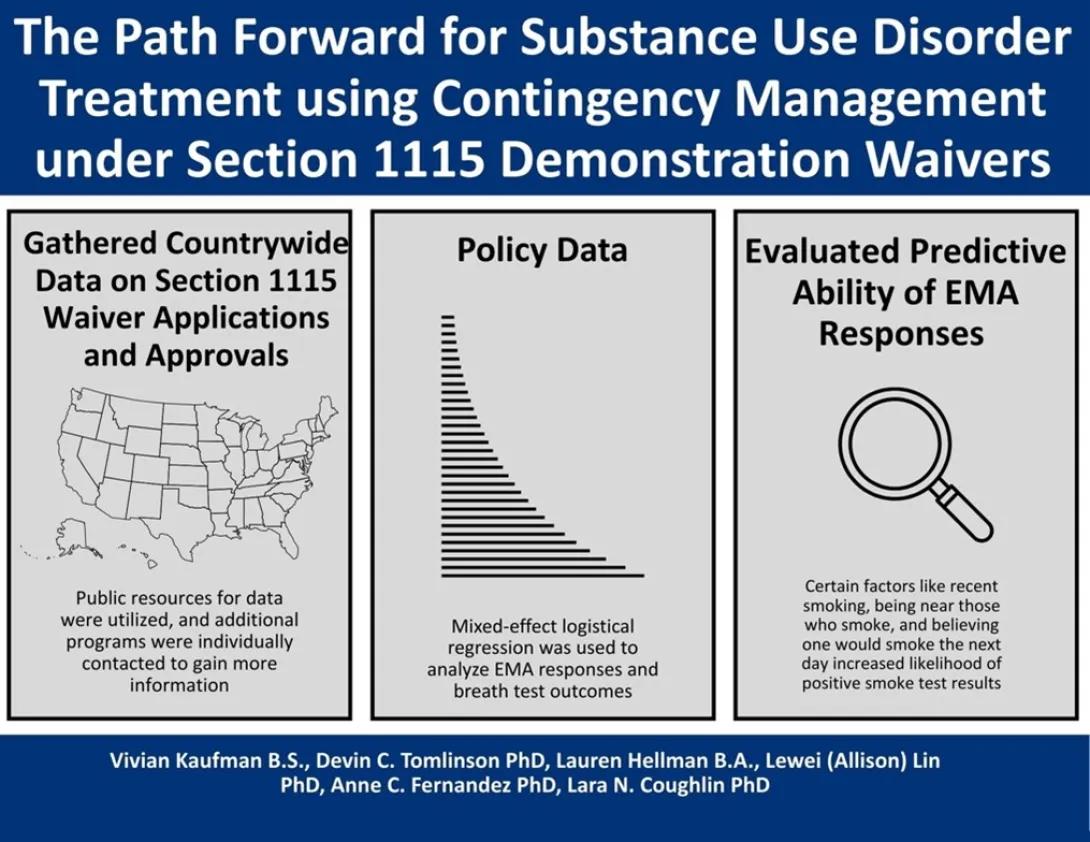
Visual abstract titled “The Path Forward for Substance Use Disorder Treatment using Contingency Management under Section 1115 Demonstration Waivers.” The graphic is divided into three vertical panels:
1. Left panel (Gathered Countrywide Data on Section 1115 Waiver Applications and Approvals): Icon of a U.S. map. Text below: “Public resources for data were utilized, and additional programs were individually contacted to gain more information.”
2. Middle panel (Policy Data): Icon of a horizontal bar chart. Text below: “Mixed-effect logistical regression was used to analyze EMA responses and breath test outcomes.”
3. Right panel (Evaluated Predictive Ability of EMA Responses): Icon of a magnifying glass. Text below: “Certain factors like recent smoking, being near those who smoke, and believing one would smoke the next day increased likelihood of positive smoke test results.”
Footer lists author names and affiliations: Vivian Kaufman B.S., Devin C. Tomlinson PhD, Lauren Hellman B.A., Lewei (Allison) Lin PhD, Anne C. Fernandez PhD, Lara N. Coughlin PhD.
Tomlinson, D.C., Wilkins, C., Bayrakdarian, N., Dolecki, F., Bonar, E.E., Fernandez, A., Tzilos Wernette. G., & Coughlin, L.N. (2024) Michigan tobacco cessation champions: A rapid qualitative analysis. Prev Med Rep. 2025;49(102945):102945. doi:10.1016/j.pmedr.2024.102945
- Within the interviews with Michigan Tobacco Cessation Champions (n=20), three main themes were identified through rapid qualitative analysis:
- Clinician and Smoking Cessation Efforts
- Smoking Cessation Efforts: Underfunded, Underutilized, Not Marketed or Accessible
- What to be Mindful of with Smoking Cessation Interventions
- Across the themes, champions addressed that the appeal, accessibility, and functionality of current tobacco cessation systems could be improved through improvement of trust and relationships between providers and patients as well as addressing the stigma that follows tobacco cessation.
Lothumalla, S., Tomlinson, D., Duguid, I., Wilkins, C., Bayrakdarian, N., Hellman, L., Jannausch, M., Werner, P., Lapidos, A., & Coughlin, L. (2025). An exploration of Michigan certified peer support specialists’ perceptions on tobacco use and additional future supports. Tobacco Prevention & Cessation, 11. https://doi.org/10.18332/tpc/200025
- Certified peer support specialists, recovery coaches, and community health workers uniquely connect to individuals who smoke cigarettes through shared, lived experiences. From 11/30/23 – 2/1/24, a needs assessment survey was sent to peers in Michigan to identify their perceptions of currently available and additional supports needed for tobacco cessation, with 172 responses collected. The results were analyzed and disseminated. The report reviews overall ratings of tobacco cessation services, as well as ratings stratified by rurality.
Coughlin, L. N., Salino, S., Jennings, C., Lacek, M., Townsend, W., Koffarnus, M. N., & Bonar, E. E. (2023). A systematic review of remotely delivered contingency management treatment for substance use. Journal of Substance Use and Addiction Treatment, 208977.
Within a systematic review of remotely delivered contingency management treatment for substance abuse, it was found that remotely delivered contingency management is feasible, acceptable, improves substance use outcomes, and increases engagement in health care services among individuals who engage with the treatment.
Coughlin, L. N., Bonar, E. E., Walton, M. A., Fernandez, A. C., Duguid, I., & Nahum-Shani, I. (2022). New Directions for Motivational Incentive Interventions for Smoking Cessation. Frontiers in digital health, 4, 803301. https://doi.org/10.3389/fdgth.2022.803301
- To address barriers that may exist with motivational incentive interventions for smoking cessation, the present literature shows how technological advancement in abstinence monitoring as well as digital delivery of reinforcers has made these interventions increasingly accessible.
Patient Resources (Local and National)
Michigan Tobacco Quitlink
A 24/7 free service offering phone, online, and text messaging support. The Quitlink offers free Nicotine Replacement Therapy (NRT) to eligible Michigan residents who are enrolled in the program and receiving coaching by phone or online. Please talk to a Quitlink coach about NRT if you’re interested.
1-855-DÉJELO-YA or 1-855-335-3569
https://michigan.quitlogix.org
Michigan Medicaid Tobacco Cessation Benefits Information
Visit the link below to view a table of tobacco cessation benefits covered by each Medicaid Health plan
https://tinyurl.com/tobaccocessationbenefits
Blue Cross Complete of Michigan
Tobacco Digital Health Assistant. A free telephone-based support group to help you quit tobacco.
Available 24/7 - Call to Enroll
1-800-784-8669 or TTY 1-888-229-2182
https://tinyurl.com/tobaccoquitprogram
Molina Healthcare Smoking Cessation Program
Call Member Services at 888-898-7969 (TTY 800-649-3777) for more information.
https://www.molinahealthcare.com/members/mi/en-us/mem/medicaid/overvw/coverd/hm/edu/stpsmokin.aspx
Great Lakes Bay Pride Tobacco Cessation Resources
Set of resources and links to start your smoking cessation journey.
https://greatlakesbaypride.org/tobacco-cessation
Smokefree.gov
Offers tools and tips to help you quit smoking.
Bridges to Access
Bridges to Access can help you get Zyban or Bupropion SR. To apply, fill out a short form and ask your doctor to sign and submit it for you.
Call 1-866-728-4368 or visit www.bridgestoaccess.com
Coping with Nicotine Withdrawal Symptoms
https://www.medicalnewstoday.com/articles/323012
https://www.webmd.com/smoking-cessation/nicotine-withdrawal-tips
Benefits and Milestones to Quitting Smoking
https://www.verywellmind.com/after-the-last-cigarette-how-your-body-heals-2824388
Keeping Your Hands Busy to Stay Cigarette Free
https://www.mondaycampaigns.org/quit-stay-quit/keep-hands-busy-stay-quit-monday
Pathways to Freedom: Winning the Fight Against Tobacco
Toolkit from the Department of Health and Human Services
We Want to Quit: Supporting Cessation in African American Communities
Toolkit from the Center for Black Health and Equity
Bay County Quit Kits
Suicide and Crisis Lifeline
Connects callers to free and confidential support from trained crisis counselors
Toll-free and available 24/7
Call: 988 or 1-800-273-8255
Visit: 988lifeline.org
Michigan Peer Warmline
Find a peer support specialist who has lived experiences of behavioral health issues, trauma, or personal crises. They are trained to support and empower callers.
Available 10 AM – 2 AM each day, 7 days a week.
Call: 1-888-PEER-753 or 1-888-733-7753
Visit: https://mcal.my.site.com/mical/s/michigan-warmline
National Crisis Line
Free, confidential, and available 24/7 from anywhere in the USA. Speak with a crisis counselor about any type of crisis.
Text: HOME to 741-741
Chat online: https://www.crisistextline.org
United Way 211
Three-digit number to call for specific information about resources and support for housing, food, transportation, and more.
Phone: 211
Visit: https://www.211.org
Michigan Works!
Job training and professional development to get back to work, find new employment, obtain credentials, and more.
Call 800-285-WORKS (800-285-9675)
Visit www.michiganworks.org
Going PRO in Michigan
Resources to enter a skilled trade apprenticeship or training program.
For more information, fill out the form on the website under “contact”
Visit www.going-pro.com
Job Corps
Free education and training program for eligible young people (16-24 years) that qualify as low-income.
Call 800-733-5627
Visit www.jobcorps.gov
Career One Stop
Find local resources that help you look for work and offer job search workshops, free computer access, and more.
1-877-US2-JOBS (1-877-872-5627) or TTY 1-877-889-5627
National Domestic Violence Hotline
A 24-hour hotline for any type of domestic abuse, including dating abuse.
Call 1-800-799-SAFE (1-800-799-7233)
Text: START to 88788
Visit https://www.thehotline.org/
U.S. National Sexual Assault Hotline
A 24-hour free, safe, anonymous, and confidential service.
Visit: https://rainn.org/
RAINN National Sexual Assault Hotline
A 24-hour safe and confidential support service for survivors of sexual assault.
1-800-656-HOPE (1-800-656-4673)
Chat online: https://rainn.org/resources
Michigan Coalition to End Domestic & Sexual Violence
24/7 free and confidential support.
Sexual assault hotline:
- Call: 855-864-2374
- Text: 866-234-1454
Domestic violence hotline:
- Call: 866-864-2338
- Text: 877-861-0222
- Resources: https://mcedsv.org./provider-directory/
National Human Trafficking Hotline
Anti-trafficking hotline advocates are available 24/7 to take reports of potential human trafficking. Available 24/7 in more than 200 languages.
Text: 233733
Chat online: https://humantraffickinghotline.org/en/chat
The Women’s Center of Southeastern Michigan
Provides women in crisis with access to low-cost help from a therapist, career coach, divorce specialist, family law attorney, or financial advisor.
Call: 734-973-6779
https://www.womenscentersemi.org
Michigan Abuse and Neglect Reporting Hotline
Toll-free number allows you to report abuse or neglect of a child or vulnerable adult.
Available 24/7
Visit: https://www.michigan.gov/mdhhs/adult-child-serv/abuse-neglect/childrens/report-process
MI Bridges
Connects individuals and families in Michigan to state and local resources, as well as MDHHS benefit programs, to promote household stability.
Visit: https://newmibridges.michigan.gov
MI State Housing Development Authority (MSHDA)
Provides financial and technical assistance to help you find safe and decent affordable housing.
Visit: https://www.michigan.gov/mshda
Housing Choice Voucher: 517-241-0809
Life Wireless
Offers free cell phone service (and, for qualifying individuals, free phones) to Medicaid beneficiaries in Michigan.
Learn more here: https://shorturl.at/oUQTt
United Way 211
Three-digit number to call for specific information about resources and support for housing, food, transportation, and more.
Phone: 211
Visit: https://www.211.org
Trans Lifeline
Hotline designated to connect trans people to community resources and support.
Call 877-565-8860
Available Monday through Friday, 1 PM – 9 PM EST
Check out www.translifeline.org for more information
The LGBT National Help Center Line
Provides peer support and resource information to people with questions regarding sexual orientation and/or gender identity.
American Psychological Association – Understanding Sexual Orientation and Identity
Accurate information for those who want to better understand sexual orientation and identity.
For more information: https://www.apa.org/topics/lgbtq/orientation
List of articles about sexual orientation, gender identity, and gender
Community Mental Health Services Programs of Michigan
Mental health services in Michigan are coordinated through local Community Mental Health Services Programs (CMHSPs). Please find information from your local CMH at the link below, including 24-hour Crisis Support Lines.
https://tinyurl.com/Local-CMHPS
SAMHSA National Helpline
24/7 free and confidential service to speak with someone about mental health, substance use, or family problems. Provides information on support groups, community-based organizations, and local treatment options.
1-800-622-4357 or TTY 1-800-487-4889
Text your zip code to HELP4U (435748) to find help near you.
Visit: https://www.samhsa.gov/
Mutual Help Groups for Substance Use
These support groups are for people who want to stop using substances and/or those who are affected by the substance use of another person.
Narcotics Anonymous: http://www.na.org/
Alcoholics Anonymous: http://www.aa.org/
SMART Recovery: http://smartrecovery.org/
amilies Against Narcotics: http://www.familiesagainstnarcotics.org/
Recovery Dharma: http://recoverydharma.org/
In The Rooms: https://www.intherooms.com/
Harm Reduction Resources
NEXT Distro: http://nextdistro.org/
- An online and mail-based harm reduction service designed to reduce opioid overdose death. Get naloxone/Narcan, fentanyl test strips, and sterile syringes mailed to you.
Narcan Vending Machines in Michigan: https://tinyurl.com/fp3rmj36
Syringe Service Programs: https://tinyurl.com/2d7ea3vr
- Syringe Service Programs connect community members with sterile injection supplies.
- Find a Syringe Service Program near you:
- Google Maps: https://tinyurl.com/ywtdst2u
- SSPs Michigan Directory: https://tinyurl.com/4d3e8276
Planned Parenthood of Michigan
Provides reproductive health care to people of all ages, gender identities, national origins, races, and sexual orientations
Payment: insurance, self-payment, and Medicaid
Book an appointment: 1-800-230-PLAN (1-800-230-7526)
https://www.plannedparenthood.org/planned-parenthood-michigan
Head Start
Preschool and family program for low-income families.
National Maternal Mental Health Hotline
Hotline counselors are available 24/7 in English and Spanish. Interpreters are available who can support 60 other languages.
Available via phone and text: 1-833-852-6262
Hotline FAQ: https://tinyurl.com/hotline-FAQ
Postpartum Support International – Helpline
50+ free virtual support groups related to pregnancy and parenthood for many communities
https://www.postpartum.net/get-help/psi-online-support-meetings/
March of Dimes
Find resources, tools, and information to help you throughout every stage of pregnancy.
https://www.marchofdimes.org/find-support
Great Start to Quality
Provides free educational resources and consultation on how to best support a child’s education.
https://greatstarttoquality.org/
Grievewell
Grievewell provides free one-on-one peer counseling and resources in a safe place to grieving children, teens, adults, and families as they move step-by-step through grief and find their way to healing.
https://www.grievewell.com/for-grievers
Email: [email protected]
RxKids
Rx Kids is a prenatal and infant cash prescription program that provides moms with $1,500 during pregnancy and babies with $500 a month for a designated length of time that varies between 6-12 months. To qualify for Rx Kids, you must be a resident of one of the participating locations in Michigan (City of Flint, City of Kalamazoo, Clare County, Pontiac, Royal Oak Township, Hazel Park, or eligible counties in Eastern Upper Peninsula. Online application: https://rxkids.aidkit.org/apply See their website for more information: https://rxkids.org
March of Dimes
Provides resources and support for bereavement and related to those impacted by ectopic pregnancy, miscarriage, stillbirth, or neonatal passing.
Call: 1-888-663-4637
https://www.marchofdimes.org/find-support/topics/miscarriage-loss-and-grief
Share: Pregnancy and Infant Loss Support
Provides resources and support groups, including Zoom meetings and online chat rooms, to individuals impacted by the loss of a child.
Call: 1-800-821-6819
https://nationalshare.org/online-support/
Star Legacy Foundation
Offers resources and virtual support groups to individuals and families impacted by all types of perinatal loss.
Call: 952-715-7731
https://starlegacyfoundation.org/family-support/
Von Voigtlander Women’s Hospital
List of resources available for pregnancy loss, including financial concerns, grief support, and rememberance.
https://www.umwomenshealth.org/resources/loss-desired-pregnancy
The Compassionate Friends
Provides highly personalized support to families experiencing the loss of a child.
https://www.compassionatefriends.org/find-support/
Informational Leaflets from the Miscarriage Association
https://www.miscarriageassociation.org.uk/information/leaflets/
Postpartum Support International – Online Support Group
Free online support group for those experiencing early pregnancy loss.
Every Tuesday at 12 PM or 4 PM (EST)
https://www.postpartum.net/group/early-pregnancy-loss-support-for-moms/
Call: 1-800-944-4773
Loss & Grief in Pregnancy & Postpartum – List of Helpful Resources
https://www.postpartum.net/get-help/loss-grief-in-pregnancy-postpartum/
Additional Resources
Related News from Michigan Medicine

Lung health expert weighs in on Zyn and other nicotine pouches
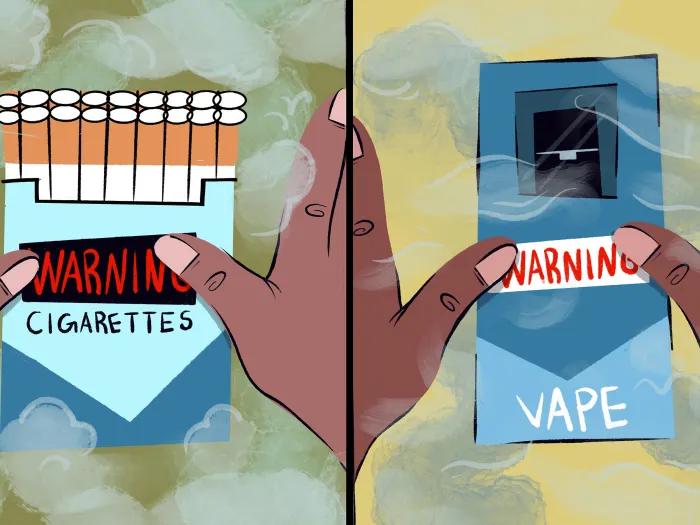
A link between e-cigarettes and oral cancer