
Rebecca Dzombak
Rebecca Dzombak is a science writer and editor based in Washington State. She earned her Ph.D. in Earth and Environmental Sciences at the University of Michigan and has since been covering many aspects of the natural world, from conservation to cancer, for outlets such as The New York Times, National Geographic, and Scientific American.


Health Lab
Blood-based multi-cancer screening tests: Ready for primetime?
Blood-based multi-cancer screening tests may hold promise, but U-M experts recommend proven cancer screening methods and genetic risk assessment first.

Illuminate
Closing the Gap
Rogel researchers are studying how to improve cancer care for adolescents and young adults ages 15–39, a group facing unique physical, emotional, social, and life-transition challenges. Their work focuses on tailoring treatment and support to better meet the needs of these patients.

Health Lab
Stopping Ewing sarcoma relapses where they start
Research on stopping Ewing sarcoma relapses through Michigan Medicine.
Illuminate
Big Data, Better Cancer Care
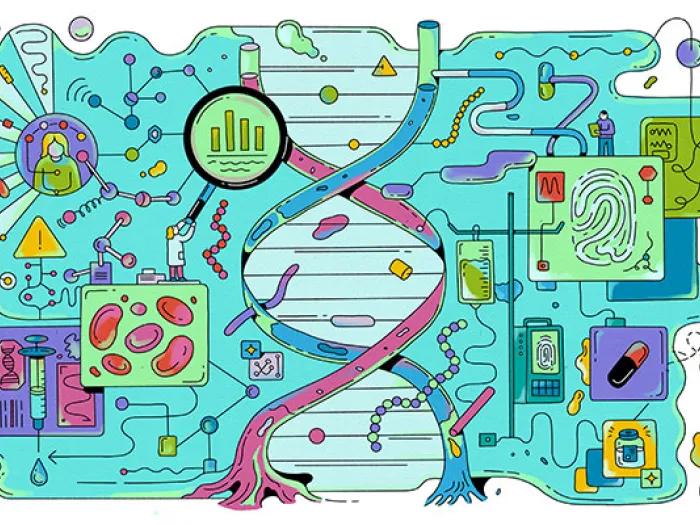
University of Michigan Rogel Cancer Center researchers are using patient-centered health data science to improve cancer care. Their work focuses on secure patient data collection, storage, and analysis; personalized treatments; earlier detection of adverse reactions; large digital cancer databases; and more equitable, human-centered oncology care.
Illuminate
Wearing your heart(rate) on your sleeve
Wearable health technology, such as heart rate sensors, can enable real-time health data collection in an accessible and equitable way.

Health Lab
Enzyme identified as new therapeutic target for “cold” tumors
A study identifies an enzyme as a new therapeutic target for “cold” tumors.

Health Lab
Massive study identifies new biomarkers for renal cancer subtypes, improving diagnosis and—eventually—treatment
A study led by University of Michigan Health Rogel Cancer Center researchers identifies novel biomarkers in renal cell carcinomas.

Illuminate
A Path of Hope for Glioblastoma Treatment
The University of Michigan has become a world-renowned institution for treating aggressive brain tumors. From identifying deadly tumors sooner, understanding the biology of how and why they grow, and uncovering promising new treatments, Rogel researchers are carving a path that creates hope for patients, becoming a hub of innovation in the process.
