APS 101: Antibody Isotype Alphabet Soup: IgG, IgM and IgA, Oh My!

As you may know, several laboratory tests play a role in diagnosing APS, including those for lupus anticoagulant, anticardiolipin antibodies, and anti-β-2 glycoprotein I antibodies. For some of these tests, you may notice that different types of antibodies get reported: IgG, IgM, and sometimes IgA. What do these different letters mean?
If we reach way back in our brains, some of us may have learned about (and likely forgotten!) these antibodies in a biology class, and we doctors learn about them during our immunology training in medical school. Let’s review the different subtypes (also known as isotypes) of antibodies.
Antibodies are proteins that our body produces to fend off infections. The white blood cells that produce antibodies are called B cells. Once an antibody attaches to a bacterium or virus, it is now labeled as a “bad guy” (as my preschooler would call them), and other parts of our immune system come along and neutralize or gobble them up. Half of the antibody is specific to the particular bacterium or virus, while the other half defines the isotype (IgG, IgM, etc.) and relates more to the function or functions of the antibody. The part of the immune system that includes B cells and antibodies (the adaptive immune system) allows our body to remember a previous infection (or vaccination) so that it can quickly respond if the same bad guys try to infect us again.
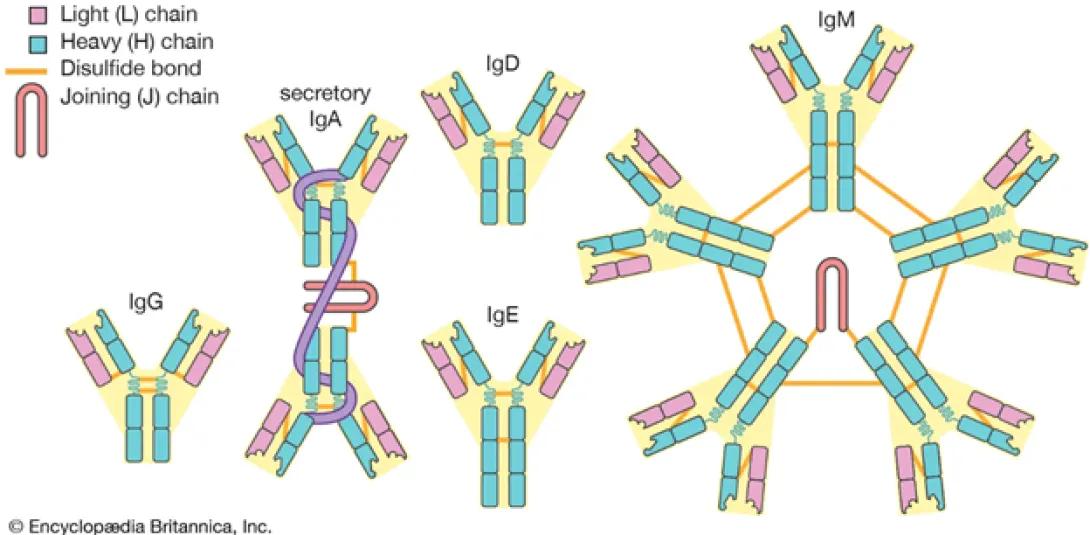
IgG: Most consider this the most common type of antibody. It looks like a “Y” with the top half consisting of two identical areas that recognize bits of bacteria or viruses. If you get a blood test to see if you responded to a previous vaccine (like measles or chicken pox), they test for this type of antibody. This is also the type of antibody that crosses the placenta and provides protection to newborn babies from Mom’s vaccines and previous infections. In APS, the IgG antibodies (for example, anti-beta-2 glycoprotein I IgG) are the antibodies most strongly tied to clinical events like blood clots.
IgM: The IgM antibodies look kind of like a star made up of five IgG antibodies, with each “point” on the star able to recognize infectious pieces. IgM’s claim to fame is that it can be rapidly released by B cells in response to an infection. For example, when someone gets infected with the Epstein-Barr Virus (EBV, which causes mono!), the first antibody detected in the blood is anti-EBV IgM, with the classic IgG antibodies taking significantly longer to be produced (and detected on a blood test). In APS, it has long been appreciated that the IgM types of antiphospholipid antibodies are also found in patients who have APS. Compared with the IgG type, such antibodies do not appear to carry as much risk for blood clots and other complications. Yet, there does seem to be some risk, which is why we continue to test for them. A key future goal is to gain a better understanding of which IgM antibodies truly carry risk and which should be ignored.
IgA: IgA antibodies look like two IgG (Y’s) connected together, or probably like a dog bone to our favorite APS mascot, Sparky. IgA antibodies are not so abundant in the blood, as they are specifically designed to be released in other parts of the body, such as the mucous membranes. This means we have more IgA than other types of antibodies in saliva, tears, and along the linings of our intestinal and respiratory tracts. Some labs report IgA levels of antiphospholipid antibodies. These antibodies do not seem to be as central to the development of APS in most cases. However, we are not completely off the hook, as IgA antibodies may play a solo or, perhaps more likely, amplifying role in some patients. For example, our team recently found an increased risk of atherosclerotic cardiovascular events in some patients with IgA antiphospholipid antibodies1. Examples of atherosclerotic cardiovascular events include heart attacks and strokes.
There are other isotypes of antibodies, too, specifically IgD and IgE. The latter type plays an important role in allergic diseases, but neither is thought to be very important for systemic autoimmune diseases like APS.
Overall, knowing the specific isotype of antiphospholipid antibody present in a person helps us better understand their risk of having an APS-associated problem, like blood clots or pregnancy complications. IgG tends to predict the most risk, followed by IgM and IgA. While such information doesn’t tell us everything about a patient, it still provides useful clues about what to expect and try to prevent in the future.
References:
Image: https://www.britannica.com/science/immune-system/Classes-of-immunoglobulins
1. Zuo Y, Navaz S, Liang W, Li C, Ayers CR, Rysenga CE, Harbaugh A, Norman GL, Solow EB, Bermas B, Akinmolayemi O, Rohatgi A, Karp DR, Knight JS, de Lemos JA. Prevalence of Antiphospholipid Antibodies and Association With Incident Cardiovascular Events. JAMA Netw Open. 2023 Apr 3;6(4):e236530. doi: 10.1001/jamanetworkopen.2023.6530. PMID: 37014642; PMCID: PMC10074226.
In This Story

Jacqueline Madison, MD
Clinical Assistant Professor
Featured News & Stories

12-year-old shares journey with sickle cell anemia on Capitol Hill

MyVoice poll finds youth have mixed perceptions of oral nicotine pouches

LGBTQ+ Aging in America

Michigan’s aging brains need more protection, poll shows

ASCO 2026 Rogel Recap