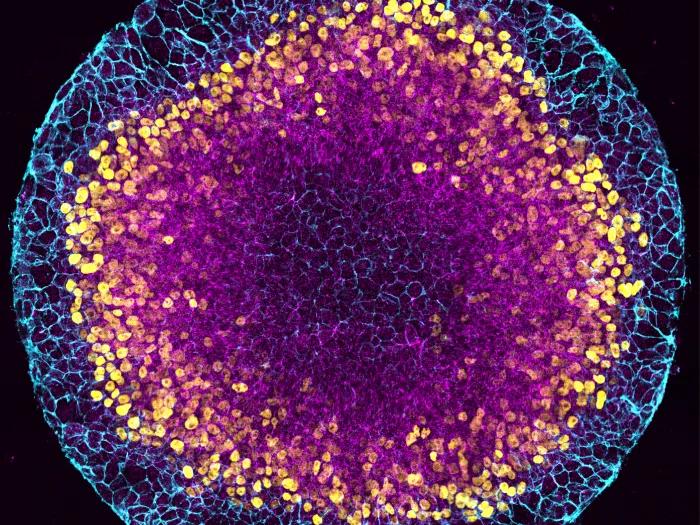
PhD student Dina Tekle publishes a research article in PNAS
Reconstructing EBV reactivation and DNA damage response kinetics in morphologic pseudotime
Biological Chemistry PhD student Dina Tekle, her mentor Elliott SoRelle (Microbiology and Immunology), and U-M colleagues Craig Dobry (Microbiology and Immunology) and Jonathan Sexton (Medicinal Chemistry, Internal Medicine) provide new insights into Epstein-Barr Virus (EBV) biology in research recently published in PNAS. The team used single-cell high-content screening (HCS) and morphologic pseudotime analyses to reconstruct host-virus dynamics from fixed cells. Results from their study of EBV reactivation include:
- Differential responses to physiologic lytic stimuli and clinically relevant drugs observed
- Quantitative morphologic metrics of treatment-dependent responses and lytic-mediated chromatin reorganization obtained
- Spatiotemporally dysregulated DNA damage responses (DDR) identified in lytic cells via coordinated changes in nuclear structure, DNA synthesis, viral lytic proteins, and double-stranded break DDR factors
The researchers expect their approach will support high-throughput single-cell virology and be applicable to other intracellular pathogens and cellular dynamics for which live-cell imaging is challenging or technically intractable.

For more U-M Biological Chemistry news, please visit our News & Stories page. Send questions or comments to [email protected].
In This Story

Dina Tekle
PhD Student, Biological Chemistry | Elliott SoRelle Lab

Elliott SoRelle, PhD
Assistant Professor
Featured News & Stories
Improving care for patients with brain injuries
3D-Printed Models - Conjoined Twins

Emerging into the Future
Critical Care Program Fulfills Patients’ Final Wishes, Bringing Comfort to Last Moments
New Findings on a Decade of Medicaid Expansion in Michigan