Robin Petroze’s vision to move global surgery forward: Build on momentum
The new director of the Center for Global Surgery discusses current global surgery efforts and opportunities for growth in the department.
Author |
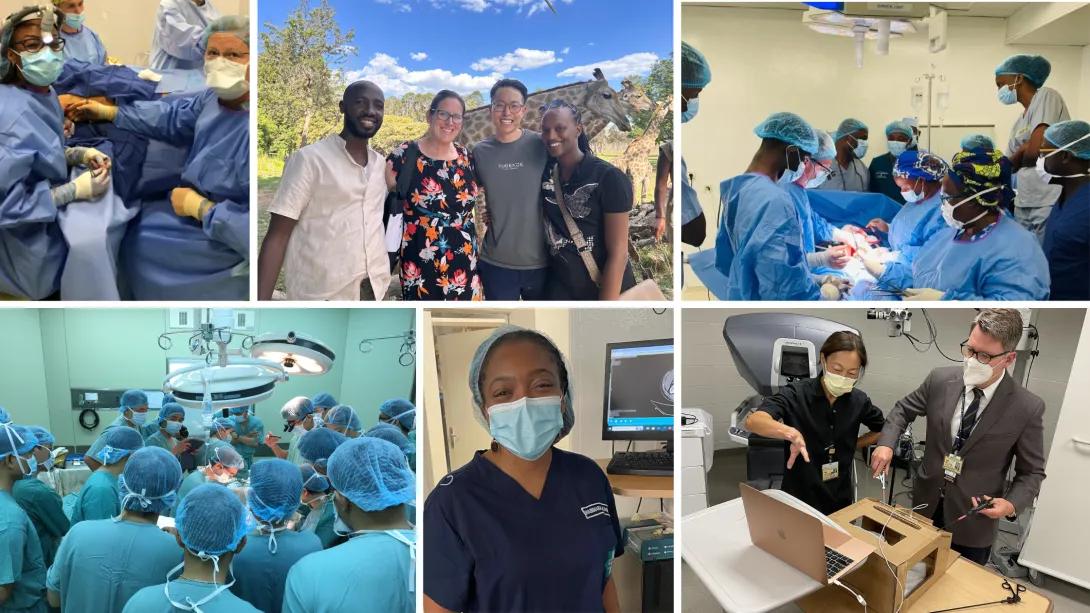
Robin Petroze, MD, MPH, a pediatric surgeon with an extensive background in global surgery, came to Michigan Medicine because of the potential she saw to expand the department’s global surgery footprint.
Petroze’s predecessor, Krishnan Raghavendran, MBBS, founded the Center for Global Surgery and served as its first director until November 2024. He laid a strong foundation for the work that Petroze is looking forward to building on.
“Global surgery centers are rare in academic surgery departments. The leadership and development of the center has really been visionary so far in setting an international footprint for the surgery department,” Petroze said.
As the new director for the department’s Center for Global Surgery, Petroze has a vision to build on the momentum.
The key: Integration.
The global surgery landscape in the department currently
Multiple current faculty members have their own global surgery projects that engage in various ways with the Center for Global Surgery. Grace Kim, MD, a minimally invasive surgeon, created ALL-SAFE, a multinational collaboration to create an open-source education platform aimed at teaching laparoscopic surgery.
Gifty Kwakye, MD, MPH, developed a collaborative partnership with Komfo Anokye Teaching Hospital (KATH) looking at barriers to colorectal cancer screenings. Jeffrey Punch, MD, has partnered in both Ethiopia and Rwanda to develop kidney transplantation programs. Other faculty have similar institution partnerships, like Ragahvendran’s in India and Sierra Leone developing emergency response training programs.
Petroze has built partnerships in Rwanda for the past 15 years and is now developing neonatal surgical outcomes databases and training partnerships for multidisciplinary system strengthening. She sees an opportunity to lean on surgery faculty to more visibly strengthen their international collaborators.
Residents also have fellowship options they can explore during their research time, such as the relatively new Global Surgery Fellowship through the Center for Global Surgery. Plastic surgery resident Brigit Baglien, MD, was the inaugural fellow and spent her time focused on breast reconstruction in Africa.
General surgery resident Phillip Hsu, MD, PhD, the current global surgery fellow, is collaborating in Rwanda to develop training resources for general practitioners. Petroze is also one of Hsu’s primary mentors for the fellowship. Both Hsu and surgical critical care fellow Joseph Boachie, MD, who is working in Ghana, are supported by NIH Fogarty grants.
Working globally for mutual benefit
“I think the lessons of global surgery are the focus on health equity, disparities and health systems. A curriculum in global surgery explores the diversity of surgical problems, the surgical workforce, and the extent of the role that poverty has on health outcomes, which is also true domestically,” Petroze said.
Operating in different environments had identifiable impacts on Petroze’s domestic practice. When she looked at her metrics for common cases like appendectomies at her last job, she learned that her cases were cheaper, faster and had more junior resident involvement. She attributed that to experiences where she had to be conscious of available resources and be an adaptable educator.
Aside from looking at resource conservation and sustainability, global surgery provides a wealth of information around surgical pathologies, which are great opportunities for researchers and clinicians to innovate around care and improve patient lives. These are also an important opportunity for trainee exposure to surgical pathologies.
A vision for integration
In the next several years, Petroze is focused on creating more global surgery opportunities for faculty at all levels.
“Global surgery is not just going abroad and doing surgeries or creating training programs – it’s about partnering for mutual benefit. I think we have a lot of strengths that are unique to Michigan Surgery that I think makes us an ideal partner,” Petroze said. “That elevates our international footprint and reputation in addition to making a difference.”
There are a lot of unique pathways that can fit with diverse interests and time commitments for faculty, Petroze said. She wants to specifically engage with department section heads and center directors to imagine how global surgery can integrate into research and innovation spaces that already exist.
Building these global opportunities and partnerships also needs to be done with trainees in mind, Petroze says. It keeps the training program competitive and also improves on the clinical and research exposures for residents that will help them in their future practices. “The challenges our trainees will face as they progress into practice are global,” Petroze said. “Whether it’s the next pandemic or latest technology, we’re more connected than ever before – as are our patients and their surgical problems.”
Making her vision come together will take buy-in from multiple people, but Petroze’s confident it’s possible. “The support is there. Of anywhere it can be successful, Michigan Medicine is certainly the place,” Petroze said.
Featured News & Stories