A Welch lab publication is recognized in Molecular Systems Biology with a cover design
Author |
The Welch lab developed PertubNet, a generative AI model that can predict shifts in cell state—changes in overall gene expression—in response to multiple types of unseen cellular perturbations, including responses to drugs.
This tool was published in Molecular Systems Biology (Volume 21, Issue 8, 4 August 2025.) and was recognized with the opportunity to design the cover of the journal.
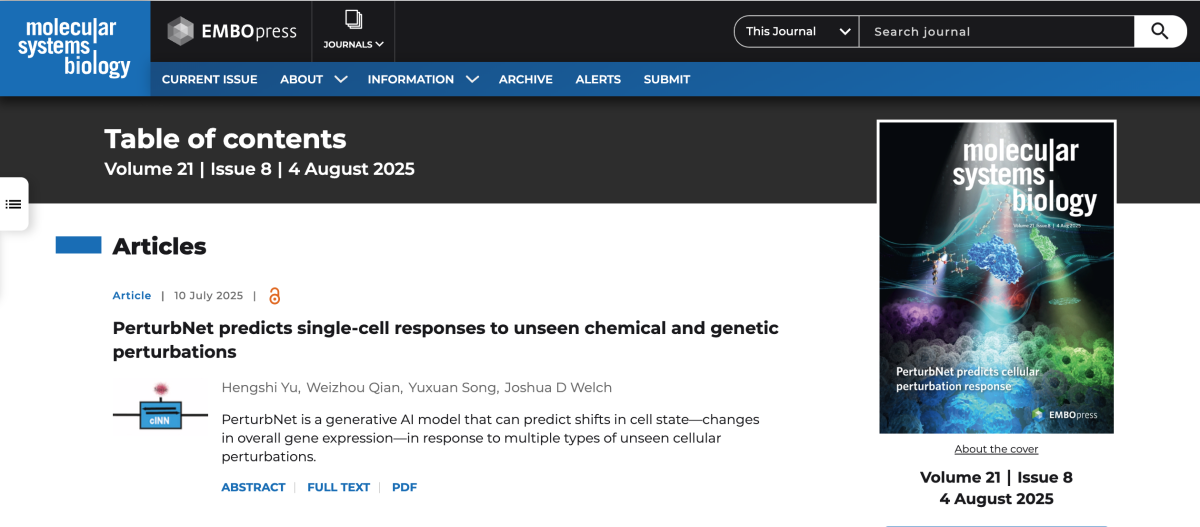
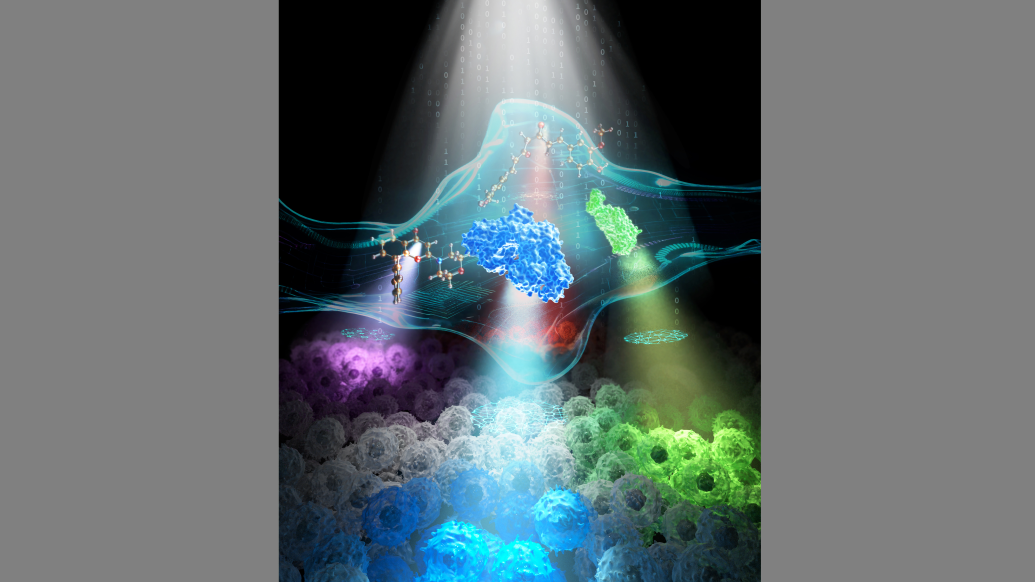
Weizhou Qian, co-author in this publication, commented on the cover illustration: “I like how this design combines a visually striking sci-fi aesthetic with a clear conveyance of the key idea behind PerturbNet—mapping perturbations, such as chemical and protein variations, to different cell distributions. The beam of light shines from the top to the bottom, passing through a blue, tech-inspired space embedded with various chemical molecules and proteins, representing the perturbation representation network in PerturbNet. It then travels through a circular neural network at the bottom—symbolizing the mapping function—and illuminates cells in distinct regions, representing different cell state distributions. The background 0s and 1s further emphasize the AI-driven nature of the tool. My friends also found this image quite interesting—some even said it looks like a UFO capturing cells or like cells dancing in a club.”
The illustration was created by YC Zhang.
About the scientific publication
Understanding how drugs influence cellular responses helps discover treatments with desired effects, potentially benefiting a myriad of therapeutic applications.
PerturbNet is a computational tool that uses a flexible framework to “mix and match” neural networks and predict effects of chemical, gene knockdown, gene overexpression, and DNA sequence mutations.
PerturbNet shows competitive performance with previous methods tailored to predict either chemical or genetic effects.
It accurately predicts gene expression changes induced by coding sequence mutations in TP53, KRAS, and GATA1. An in silico screen of all possible single amino acid substitutions in GATA1 identifies candidates likely to modify erythroid cell differentiation.
Cited article
PerturbNet predicts single-cell responses to unseen chemical and genetic perturbations, Hengshi Yu, Weizhou Qian, Yuxuan Song, and Joshua D Welch, Mol Syst Biol (2025), https://doi.org/10.1038/s44320-025-00131-3
In This Story

Weizhou Qian
PhD Student

Joshua Welch, PhD
Associate Professor
Featured News & Stories

Helping an employee-turned-patient overcome a brain tumor

Shipt gift helps address food insecurity

Family Medicine researchers find clinicians question Black expectant moms more about cannabis use than white moms
BRCF Flow Cytometry Service Enhancements Coming July 1

Celebrating outstanding teaching and research at the 2026 Endowment for Basic Sciences Awards