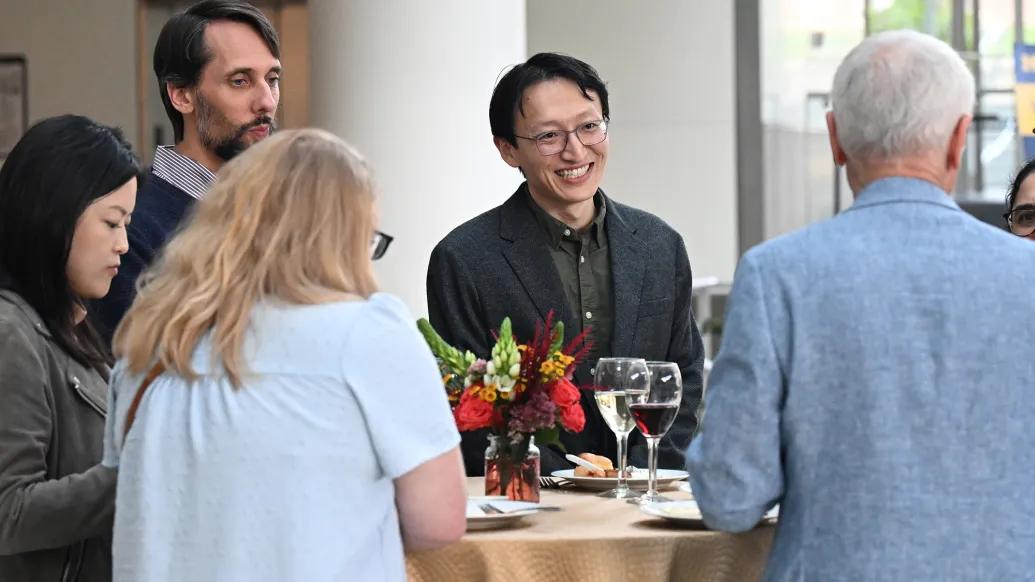
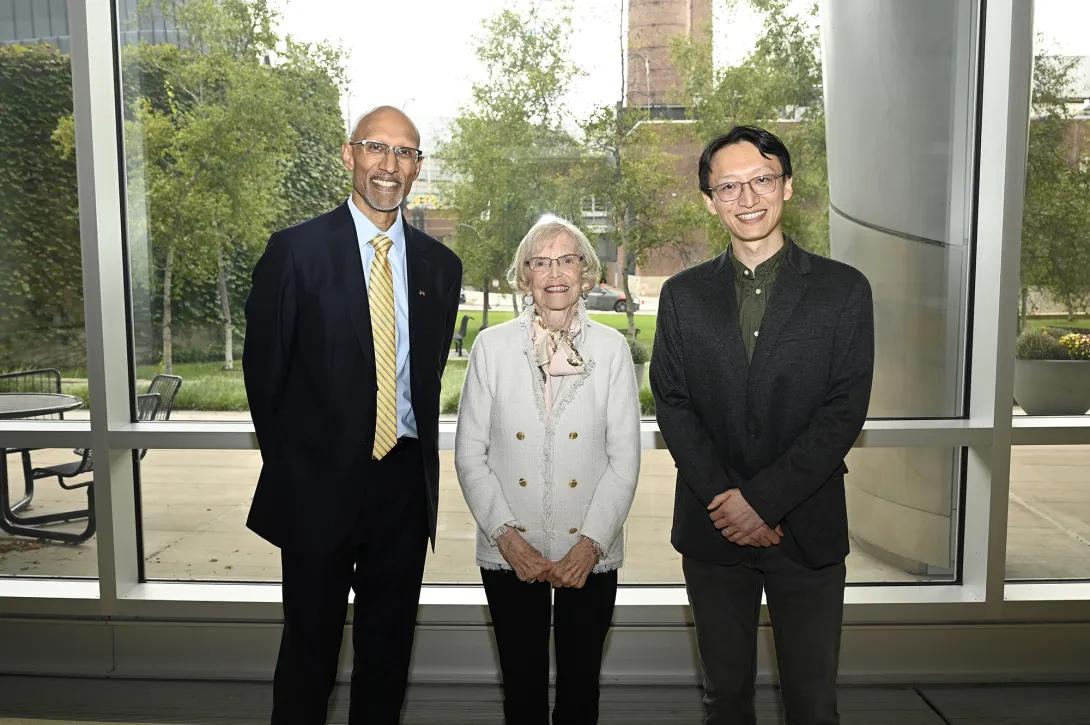
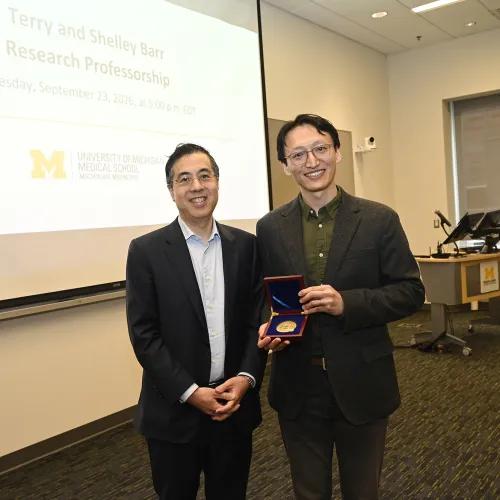
During a ceremony on Sept. 23, 2026, Yunlu Zhu, PhD, was appointed the Terry and Shelley Barr Research Professor. Zhu is a faculty member of the Michigan Neuroscience Institute, assistant professor of Otolaryngology–Head and Neck Surgery, and assistant professor of Molecular and Integrative Physiology.
This new professorship honors Terry and Shelley Barr, University of Michigan alumni whose support of Michigan Medicine and U-M has advanced neurology and concussion research, Alzheimer’s disease research and care, cardiovascular medicine, and dentistry.
Shelley Barr earned a Bachelor of Science in dental hygiene from U-M in 1958. Terry Barr played football at U-M before completing his Bachelor of Arts degree in 1957 and later played for the Detroit Lions. Since Terry’s death in 2009, Shelley has continued their shared legacy of supporting scientific discoveries that improve lives.
Zhu earned his doctoral degree from the University of Virginia, where he studied neurodevelopment, glia, and neuroimmunology. He completed postdoctoral training in systems neuroscience at New York University Grossman School of Medicine. His laboratory uses zebrafish to understand how the brain transforms gravity signals into stable movement and how disruptions in these neural circuits lead to balance deficits.
“My lab seeks to understand how the brain maintains balance and why that ability becomes impaired in disease,” said Zhu. “Because balance problems can be an early sign of neurodegenerative disease, this work could help us better understand the underlying mechanisms and ultimately identify these conditions sooner. The Terry and Shelley Barr Professorship will help advance this research, and I am deeply grateful for the Barr family’s generosity and belief in my work.”
At the appointment ceremony, MNI Executive Director Ravi Allada, MD, delivered remarks recognizing the generosity of the Barr family and the exceptional work of Zhu. Dean Thomas Wang, MD, also delivered remarks and presented medallions on behalf of the U-M Board of Regents to Zhu and Shelley Barr.
Featured News & Stories
How Bipolar Symptoms Unfold Differently in Women and Men
Many hospitals still don’t do enough to prevent UTIs from catheters

BRCF Holiday Closures

Emily Kautz, M.A., nominated for inaugural Michigan Medicine award

15 years of data will help uncover how flu spreads—and how to reduce its impact