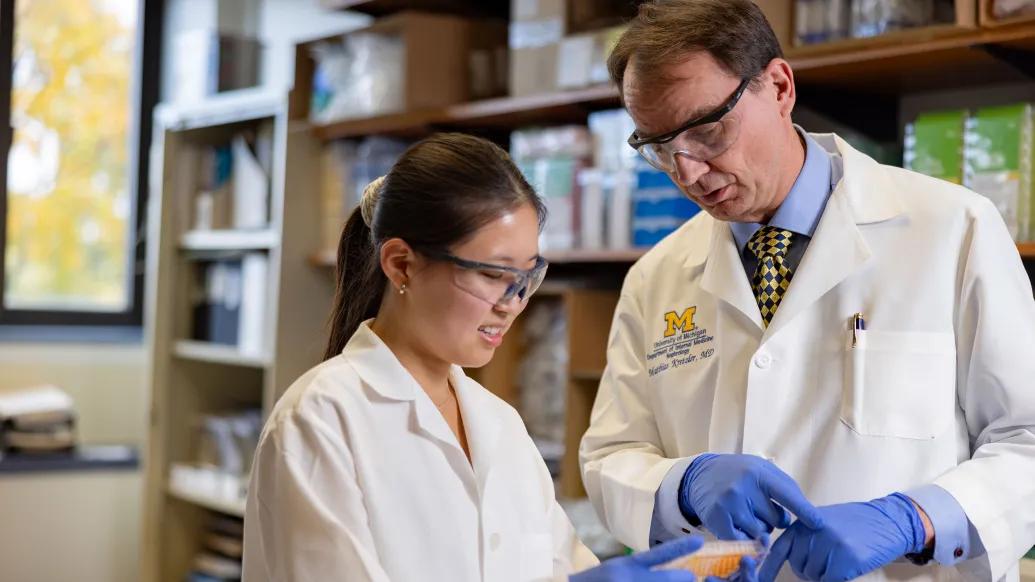
Matthias Kretzler, MD is the Warner-Lambert/Parke-Davis Professor of Medicine in the Department of Internal Medicine and a research professor of Computational Medicine and Bioinformatics. He is a world-renowned leader in kidney disease research.
What is the health question your lab is trying to answer?
We study the mechanisms involved in the onset and progression of kidney diseases to find targeted therapeutic interventions that can stop kidney disease and improve the lives of those at risk of developing as well as those living with these debilitating diseases.
What’s the potential impact of your research?
There are many causes, involving complex interactions of genetic, environmental and behavioral factors, that contribute to kidney diseases. The most common conditions that lead to kidney diseases include obesity, hypertension, diabetes and autoimmune diseases.
The prevalence of these risk factors is increasing globally with an unequal burden on low and lower middle-income countries. Further, the early stages of kidney disease are often undetected, allowing limited opportunities for intervention before progressing to kidney failure.
In the last 50 years, beyond kidney replacement therapies like dialysis and transplant, nephrologists have had few tools to treat patients. With few alternatives, the steroids and immunosuppressants prescribed to young and old people with kidney diseases are associated with severe side effects and variable efficacy.
Therefore, due to the numerous paths leading to kidney disease under different progression rates, it is important that treatments are tailored to the patient based on where they are in their disease course.
To this end my research team and I have built networks of investigators around the world to identify the disease causes, develop novel therapies with our pharma partners and study them in precision medicine trials, including the Nephrotic Syndrome Study Network (NEPTUNE), Cure Glomerulonephropathy (CureGN) and Kidney Precision Medicine Project (KPMP) studies in the US, the European Renal cDNA Bank network, and the H3 Africa Kidney Disease Research Network in sub-Saharan Africa.
Our open science collaborations are now providing valuable insights that will change the course of kidney disease treatment and management.
What are some of the recent discoveries you’ve made?
Our team and others have observed that, despite different causes or insults to the kidney, downstream disease mechanisms overlap across several different types of kidney diseases. This is valuable information since it allows for drugs that are developed for the more common causes of kidney diseases to be repurposed for people dealing with rare diseases, who might otherwise have few treatment options.
In the last decade, the progress we have made and our collaborations with industry partners have expanded treatment options for patients with kidney diseases. It is changing how we are thinking about kidney diseases by incorporating molecular mechanisms in play in the kidney, in addition to the traditional evaluation of kidney biopsies for distinguishing pathological features and lab measures of overall kidney function.
We are now, through our NEPTUNE-Match and Breakthrough T1D funded studies, working to develop sensitive non-invasive, preferably urine-based measures of the underlying disease mechanism for individual patients to enable matching the disease mechanism to the appropriate treatment, thereby improving efficacy and minimizing unnecessary side effects.
How did you become interested in your field?
I have always been fascinated by the cellular and morphological complexity of kidneys and the crucial role they play in maintaining the overall health of the body. During my MD/PHD program, I had the opportunity to work in Wilhelm Kriz’s Anatomy and Cell Biology research team on the mechanism of glomerular filtration barrier failure.
The more we started to understand how the kidneys work, the more fascinated I became with what could go wrong to impede this amazing piece of biological machinery. It was clear to me from early on in my training that I wanted to be a nephrologist.
I love that in nephrology we establish long-term relationships with our patients, treating the whole patient often over many years in a team effort to protect their kidneys and live full lives. However, I realized early how limited we were in helping our patients. So, what was frustrating to me as a clinician became the motivation for my research.
What drew you to U-M?
My MD/PhD mentor recommended the U-M to me for a study abroad stay in 1992, and I was a medical student working with the nephrology team. The connections established then and the knowledge of how much fun it can be study and work in Ann Arbor brought me back as a postdoc to expand my research efforts towards cutting edge modern molecular biology tools working with Josie Briggs, MD, Juergen Schnermann, MD, and Larry Holzman, MD at U-M.
After returning to Germany, I created, under the mentorship of Detlef Schlondorff, MD, a molecular nephrology laboratory at the Medizinische Poliklinik in Munich. Bringing the molecular technologies I built during my fellowship at U-M to patients’ biopsies allowed me to build a European-wide network, the European Renal cDNA Bank, which has now grown into worldwide alliance of kidney research centers working on defining the molecular mechanisms underlying kidney diseases.
To advance my research further in personalized medicine approaches, I found an ideal environment at U-M, where I can be embedded in the fascinating collaborative network of molecular biologists, clinician-scientists, mathematicians, bioinformaticians, and systems analysts at work in Ann Arbor.
What advice do you have for developing scientists in your field?
Above all, be curious. Don’t be afraid to seek out expertise and explore new areas. Be open to sharing knowledge and ideas, expanding horizons and being collaborative so we can all work together to benefit the people living with kidney diseases
Why is federal funding important for your work?
Federal, non-profit and government funding is key to unlocking the fundamental biology that is the scaffold on which translational research builds. We have been very successful through our bold, renal pre-competitive consortium (RPC2) to partner with industry on sharing technology and data in the pre-competitive (early in development) space that have and will lead to breakthroughs in treatments in a focused manner with direct benefits to the pharma partners.
However, without the various sources of public funding, the cohort studies that are at the center of all our knowledge generation, the generous, selfless donation of biosamples and data by patient participants from all over the world and at University of Michigan would not be possible.
The development of new technologies like single cell RNA sequencing and spatial transcriptomics, basic research in the development of appropriate disease models, like organoids and mouse models, that are needed for pre-clinical and basic research, would not be possible. These observational studies, technologies and models then become key to the translational work that we can do in partnership with private entities.
In This Story
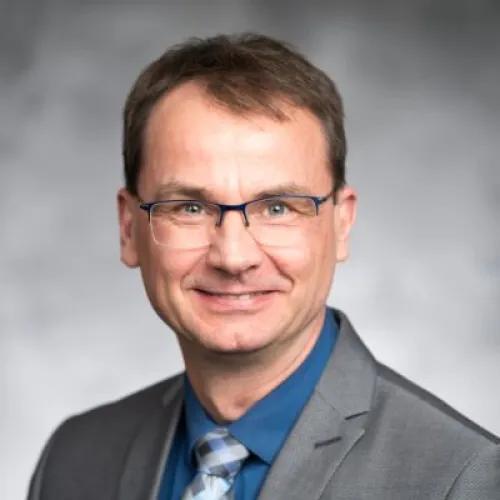
Matthias Kretzler, MD
Professor
Featured News & Stories
Faculty Spotlight: Jacqueline Madison Advances Care for Patients with Autoimmune Disease

What’s the latest on 7-OH and kratom availability and addiction care?

A metabolic “switch” that could help reset scar-producing cells in scleroderma

Depression in OBGYN residents needs more attention, study suggests
Improving the clinical experience through data and better EHR workflows