Beating the odds against chronic total occlusion
David Schneider was told he was out of treatment options. Luckily, these cardiac specialists said otherwise, performing an advanced minimally invasive surgery that got David's life back on track
5:00 AM
Author |
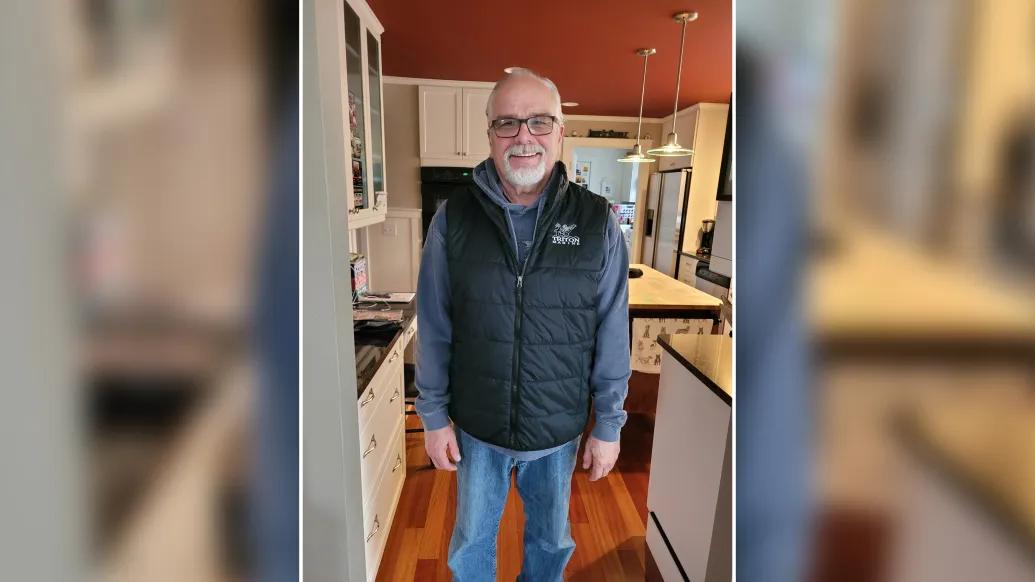
David Schneider had enjoyed a decades long career as the director of the Macomb Culinary Institute at Macomb Community College, and later as a consultant to two other culinary programs.
He’s the first to admit his diet as a chef wasn’t exactly heart-healthy – lots of butter, red meat and rich foods on trips he’d take to Europe with his students. Schneider’s family history was not good either.
His mother, father, and uncles on both sides of the family all had heart attacks, his father not living to see 65.
With the odds stacked against him, Schneider, who turns 70 this fall, retired from the culinary institute nine years ago and began going on long, daily hikes with his wife, Katherine, in the parks and forests near their home in Boyne City in northern Michigan.
Fate struck one day in April 2022.
Schneider was gathering wood for the fireplace and as he tossed the bundles into his car, he started feeling pain in his back that got progressively worse with each toss.
Figuring he’d pulled a muscle – “I didn’t know what it felt like to have a heart attack,” he recalled – Schneider got into the car to run errands with his wife.
When they finished, he suggested they go to the park where he’d try to walk it off.
But they hadn’t gone more than half a block when he lost all energy and felt weak enough to fall down.
He knew he was in trouble.
Cardiologists at a local hospital diagnosed a heart attack, and a heart catheterization revealed multiple blockages which they unsuccessfully attempted to open with stents.
Told there were no other options, Schneider received medical therapy and was scheduled to return in a month to see another cardiologist.
He felt alone with nowhere to turn, and had little confidence in the doctors, he recalls.
As luck would have it, a close friend had just read an article about Daniel Menees, M.D., director of the Chronic Total Occlusion Program at the University of Michigan Health Frankel Cardiovascular Center.
She suggested getting a second opinion. The Schneiders were soon on a 250-mile drive to Ann Arbor.
“The minute I walked in the door of this hospital I felt at home and taken care of. Dr. Menees is amazing, and he has the best bedside manner I’ve ever seen in a doctor,” Schneider said.
“He talked with me a lot about my options, and that really builds your confidence.”
Menees and his team partner Brett Wanamaker, M.D., reviewed the imaging studies from the local hospital and started formulating their plan.
The imaging revealed an artery at the back of the heart that was heavily diseased but not completely blocked.
However, Schneider had complete blockage of the left anterior descending artery, the largest of the three main coronary arteries that supplies blood to the front part of the heart.
Advancing treatment for patients
In the past, treatment options for patients with a chronic total occlusion were largely limited to medication or coronary artery bypass grafting (or CABG), an open-heart surgery in which an artery is taken from another part of the body and used to create a new path for blood flow.

Today, Menees and his specially trained partner Wanamaker, offer patients an advanced, minimally invasive option with percutaneous coronary intervention, which ultimately helped Schneider.
“The narrative on opening chronic total occlusions has been changing,” Menees said.
“Patients are often told this is something that doesn’t need to be done, that the body will create natural bypasses and that medication is all that is needed. But patients like David who are severely limited by symptoms despite the use of these medications, do have other options worth exploring.”
In Schneider’s case, they did discuss open-heart surgery as an option but ultimately agreed to first try to put in stents in two separate procedures.
He got his life back and he’s back to doing the things he wants to do. The procedure can be technically challenging, but seeing a patient like David who was told he had no other options, that’s really the most satisfying thing.”
– Daniel Menees, M.D.
First, they placed two stents to open the artery at the back of the heart. A month later, Menees and Wanamaker were able to open the main chronic total occlusion LAD at the front of the heart and place three more stents to keep that critical artery open.
An expert surgical team was on standby if for any reason they needed to change course and do the bypass surgery, Menees reassured his patient.
“We had very nice results. He immediately felt better,” Menees said.
“He got his life back and he’s back to doing the things he wants to do. The procedure can be technically challenging, but seeing a patient like David who was told he had no other options, that’s really the most satisfying thing. He has really been a great success story.”
Living life to the fullest, a year later
A year after surgery, Schneider is a different man.
The chef and culinary instructor has completely changed his diet, giving up all salt, fats, dairy and red meat in what he calls a self-regulated 80% vegetarian diet.
He dropped 25 pounds hiking two to three miles a day with Katherine and their Corgi, and is back to his normal activities, traveling, restoring a 1965 Ford pickup truck and spending time with family.
“I used to live to eat and now I eat to live,” Schneider said.
“My wife keeps me focused on healthy meals. She does most of the cooking now and we lean a lot towards vegetarian food."
He will continue to see Menees for follow-up visits twice a year, which he said he looks forward to.
“Dr. Menees said I’m good to go, everything is good to go. I don’t say I have a new lease on life, I just have a great life looking forward. I don’t feel repaired. I feel, just, new.”

Health Lab
Explore a variety of health care news & stories by visiting the Health Lab home page for more articles.
Media Contact
Public Relations
Department of Communication at Michigan Medicine
Stay Informed
Want top health & research news weekly? Sign up for Health Lab’s newsletters today!
Featured News & Stories
Treating a rare coronary artery aneurysm without open heart surgery
A heart attack 9 days after giving birth: Mother of 4 shares her SCAD experience
A night of two national titles for U-M, as scientists and basketball players both triumph
Perimenopause and heart health: What you need to know
Failed TAVR? Heart surgeons explain TAVR explant, options and risks