Big gaps seen in home medical test use by older adults
People with more education and higher incomes are more likely to use them. Use is lower among older Black adults
12:07 PM
Author |
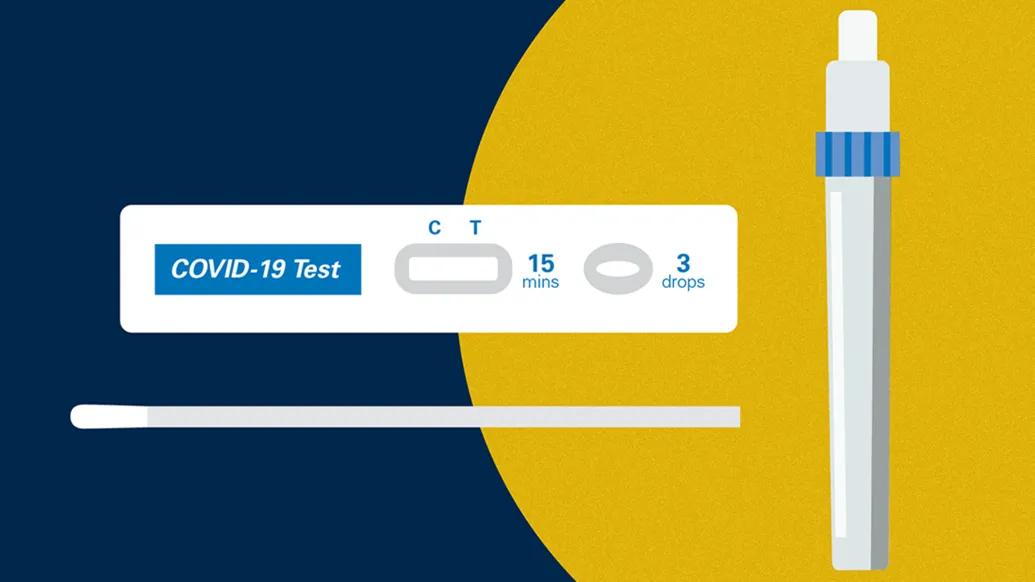
With a fresh wave of free COVID-19 rapid tests now shipping to households nationwide, and many other types of at-home medical tests now available on store shelves and websites, a study looks at what older adults think about this newfound ability to get answers to medical questions without leaving home.
The study, based on data from a survey of people between the ages of 50 and 80, asked about their experiences with and views about many types of at-home tests.
It included questions about tests for cancer, infections, allergies, genetic traits and more – both tests that give immediate results and those that get mailed in.
In general, 48% of older adults had bought at least one of these tests in the past, not counting free COVID-19 tests and other free tests, according to findings published in the journal Inquiry and based on data from the University of Michigan National Poll on Healthy Aging.
Almost all – 91% – of those who had bought a test said they’d do it again in future.
Nearly 80% of them saw at-home tests as more convenient than a conventional medical test, 60% called them trustworthy and 75% said they give good value for the money.
But even among older adults who hadn’t yet tried at-home testing at the time of the poll, 75% said they’d likely try one in the future, and 71% said they saw such tests as more convenient, though much lower percentages said they were trustworthy or a good value.
Differences in use and views of at-home medical tests
However, the data reveal some major disparities by education, income, race/ethnicity and gender.
Such gaps may increase disparities in early detection of disease or risk, say the authors, who are current and former members of the U-M Institute for Healthcare Policy and Innovation where the poll is based.
SEE ALSO: Should You Get At-Home Genetic Testing? Know the Facts First
Older adults who have a college degree or higher, or a household income over $100,000, were much more likely to have bought at least one at-home medical test than those in other education and income brackets, at 56% and 61%, respectively.
Those with college-level education were also much more likely to say such tests are more convenient than testing at a clinic, and that they’d likely buy some sort of at-home test in the future.
At the same time, 36% of Black older adults said they had bought at-home medical tests, compared with 46% to 53% of older adults who are white non-Hispanic, Hispanic, or members of other racial or ethnic groups.
As for interest in future use, 87% of women said they would likely buy at-home tests, compared with 76% of men.
Nearly 89% of those with college educations said they would, compared with 78% of those with high school educations or less.
In addition to these disparities, lead author Joshua Rager, M.D., M.A., M.S., said the high percentage indicating they had bought a home DNA test for medical or ancestry-tracing reasons surprised him.
Overall, 16% of older adults had done so. But 24% of those with college educations and 22% of those with incomes over $100,000 had.
One of the largest companies selling such DNA tests, 23andMe, is facing financial turmoil right now, leading experts to raise concerns about past customers’ ability to control how their genetic information is used.
The data in the study come from a poll taken in early 2022, so the authors say it will be important to continue to study older adults’ views of, and use of, at-home testing.
Rager and poll director Jeffrey Kullgren, M.D., M.P.H., M.S., both note that the rise in at-home testing is something clinicians need to be aware of, and ask their patients about.
Sharing at-home test results with health providers
The poll shows that while more than 90% of all older adults feel people should share their at-home test results with their clinical care team, the percentage who actually did so varied widely.
In all, 91% of those who screened for cancer at home said they told their primary health care provider.
SEE ALSO: The end of the Pap test?
By comparison, 55% of those who took an at-home test for an infection other than COVID-19 did, and only 9% of those who ordered an at-home DNA test told their provider about the results.
“As a primary care doctor, I would want to know why my patient chose to take an at-home test that I didn’t order for them, and what the result was,” said Rager.
“We also need to understand in greater detail why folks use at-home tests instead of traditional means, beyond convenience.”
Rager, who performed the analysis while he was a National Clinician Scholar at IHPI and is now on the faculty at Indiana University, notes that further research should look into how the regulatory environment around at-home tests impacts use and consumer knowledge.
The role of the United States Food and Drug Administration in at-home tests varies by the type of test.
Kullgren, who is also a primary care clinician at the VA Ann Arbor Healthcare System and health care researcher in the U-M Medical School’s Department of Internal Medicine, says the poll findings should also trigger discussions about equity.
Availability of at-home tests in situations such as pandemics or conditions where members of certain demographic groups have higher risk are key opportunities to level the playing field, as with the federal government’s program of free COVID-19 tests.
“At-home tests could be used to address disparities in access to care,” such as screening for colorectal cancer or cervical cancer, or sexually transmitted infections, he noted.
“We hope these findings will inform regulators and policymakers, and spark further research on this topic.”
The paper includes data and analysis not previously published in the NPHA report issued in late 2022. The full data set is available for free on the poll website.
Additional authors: In addition to Rager and Kullgren, the study’s authors include NPHA team members Matthias Kirch, M.S., Dianne C. Singer, M.P.H., Erica Solway, Ph.D., M.S.W., Preeti N. Malani, M.D., M.S. and J. Scott Roberts, Ph.D.
Funding/disclosures: The NPHA is supported by AARP and Michigan Medicine, U-M’s academic medical center.
Paper cited: “Use of At-Home Medical Tests Among Older US Adults: A Nationally Representative Survey,” INQUIRY: The Journal of Health Care Organization, Provision, and Financing. DOI: 10.1177/00469580241284168
Sign up for Health Lab newsletters today. Get medical tips from top experts and learn about new scientific discoveries every week by subscribing to Health Lab’s two newsletters, Health & Wellness and Research & Innovation.
Sign up for the Health Lab Podcast: Add us on Spotify, Apple Podcasts or wherever you get you listen to your favorite shows.

Health Lab
Explore thousands of health news & research stories by visiting the Health Lab homepage for more.
Media Contact

Public Relations
Department of Communication at Michigan Medicine
In This Story

Jeffrey Todd Kullgren, MD, MS, MPH
Professor
Stay Informed
Want top health & research news weekly? Sign up for Health Lab’s newsletters today!
Featured News & Stories
Many older adults make Medicare decisions quickly and most don’t change plans, poll finds
What’s the latest on 7-OH and kratom availability and addiction care?

Depression in OBGYN residents needs more attention, study suggests
A metabolic “switch” that could help reset scar-producing cells in scleroderma

Emergency room intervention pairs smartphone, telehealth counseling to reduce risky firearm behavior