Michigan firearm data now available in near real-time
Dashboard for public offers county-level information; law enforcement and public health officials can access more to aid prevention and response efforts
5:00 AM
Author |
A key barrier to addressing firearm injury in the United States is the lack of timely data.
Through a new and nearly real-time system developed at the University of Michigan, injury prevention practitioners, public health officials and public safety personnel will be able to better tailor prevention and response strategies for incidents involving firearms across the state.
The Michigan Firearm Injury Near Real-Time Data System, or Mi-FINDS, dashboard was created and funded by the U-M Institute for Firearm Injury Prevention and the state of Michigan.
In collaboration with medical examiners in a majority of Michigan counties, including the largest ones, the system improves tracking processes for firearm-related injuries and deaths in Michigan.
A complex system in development for several years, Mi-FINDS is novel in its ability to geolocate, or map, the data, and it allows authorized users to view incidents of firearm injury below county-level.
This will allow communities to see what is happening within their neighborhoods in greater detail and see trends.
Currently, official data on firearms deaths and injuries are collected and made available through the Centers for Disease Control—approximately 18 months after the incidents are reported and only at the county level.
The more real-time data allows for more meaningful, intentional and tailored public safety responses, and provides the ability to identify trends and areas to focus resources.
System developers note there is no one-size-fits-all approach to firearm injury prevention, so this new system is a significant advancement in allowing for more nuanced strategies and approaches based on information that is more localized than the county level.
“The CDC data is still very much a solid source of information that will help guide science-based firearm injury prevention efforts, particularly over broad time horizons,” said Jason Goldstick, Ph.D., a Research Professor in the U-M Medical School’s Department of Emergency Medicine and co-director of the institute’s data and methods core.
“But having information that is more readily available and closer to the incident date and location is going to be crucial in implementing tailored prevention programs and options for communities based on recent spatial trends.”
There are approximately 1,400 firearm-related deaths every year in Michigan.
Nationally, that number is roughly 47,000.
Across the nation and throughout the state, more than half of the deaths are suicides, and firearms are the leading cause of death for 1- to 19-year-olds in the United States.
While the CDC’s numbers have been and are still considered the gold standard for firearm injury mortality counts, there's a need for information on incidents as close to the time they occur as possible.
“Having a data system where users can search by demographic, manner of death and location, among other things, is invaluable to this field of study,” said Patrick Carter, M.D., Professor of emergency medicine and co-director of the institute.
“The goal is to make this data accessible and available at a broad scale so communities can better understand where the needs are and tailor prevention strategies more appropriately and more immediately.”
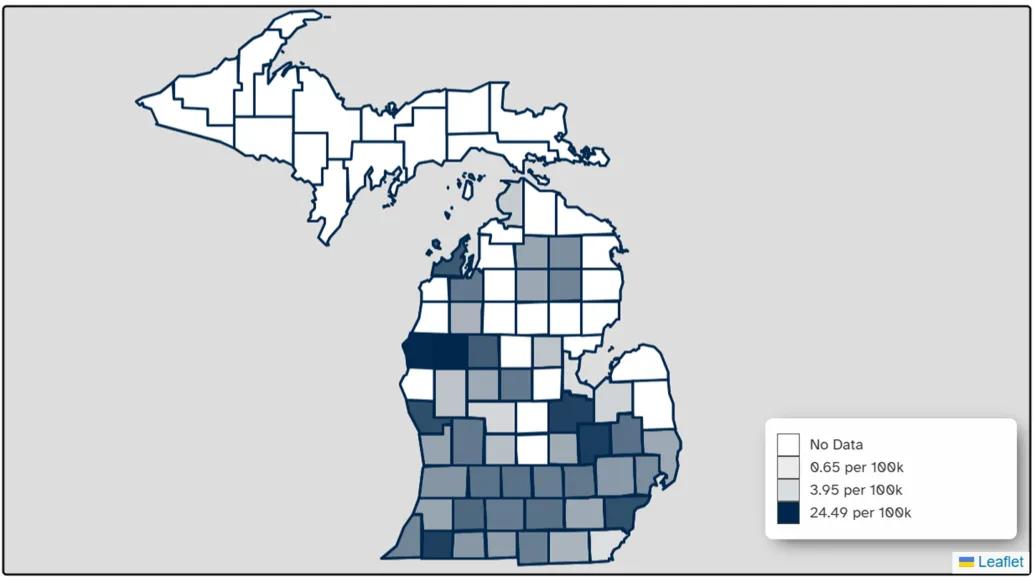
County-level data, which includes a running total of incidents involving firearms for the year as well as the number of incidents in each county per 100,000 people and incident counts by date, is available to the public on the dashboard.
Approval is required for access to below-county-level detailed data and will be granted to authorized public safety and public health practitioners.
Those users can also view county- and state-level firearm fatality summaries, use the interactive dashboard that maps firearm incidents in near real-time, or daily, and provides demographic briefs and select timeframes to observe spatial and temporal trends in firearm-related injuries.
The state funding of the new system “gives communities the visibility they need to understand what’s happening in their own backyards and to respond in ways that reflect their unique need,” said Natasha Bagdasarian, M.D., M.P.H., Chief Medical Executive for the state of Michigan.
“Gun violence affects every type of community in Michigan—rural and urban, large and small—and it shows up in different ways depending on where you live. As a public health professional, I know that we can’t prevent what we can’t see clearly,” she said.
“This kind of timely, accessible data is empowering. It allows us to move from reacting to acting. It allows us to develop strategies that are thoughtful and targeted.
“Addressing gun violence and firearm injury is a public health responsibility, and it will take all of us, working together with shared information to continue to build and serve and live in safer, healthier communities across the state.”
Sign up for Health Lab newsletters today. Get medical tips from top experts and learn about new scientific discoveries every week.
Sign up for the Health Lab Podcast. Add us wherever you listen to your favorite shows.

Health Lab
Explore a variety of health care news & stories by visiting the Health Lab home page for more articles.
Media Contact

Public Relations
Department of Communication at Michigan Medicine
In This Story

Jason Goldstick, PhD
Research Professor

Patrick M Carter, MD
Professor
Stay Informed
Want top health & research news weekly? Sign up for Health Lab’s newsletters today!
Featured News & Stories

Michigan’s Medicaid expansion improved both health and finances

Stopping Ewing sarcoma relapses where they start

Rx Kids linked to reductions in preterm births and low birthweights, fewer NICU admissions

LGBTQ+ people over 50 face more aging-related challenges

Researchers identify a potential “Achilles heel” of psoriasis