Pop-Up Eye Clinic in a Shipping Container Targets Underserved Communities
Researchers at the University of Michigan have crafted a unique solution to pressing vision problems.
1:00 PM
Authors |
It was inside-the-box thinking that led a team of architects and eye specialists to reimagine a shipping container as an ophthalmology clinic.
MORE FROM MICHIGAN: Sign up for our weekly newsletter
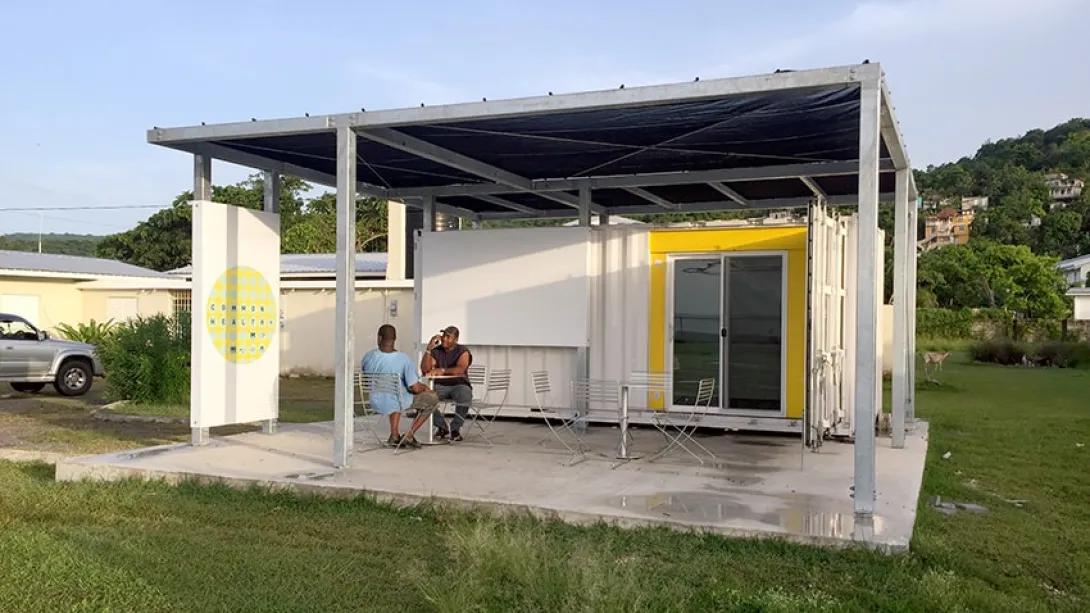
Located in a 20-by-8-foot customized shipping container, the new facility is the product of collaboration between the University of Michigan Health Service and faculty members at the Michigan Medicine Kellogg Eye Center and the U-M College of Architecture.
A uniquely self-contained clinic environment — something that could be outfitted in the U.S., shipped complete and unpacked with minimal setup as a functional health center anywhere in world — was the goal. In this case, the container landed in Sandy Bay, a small beachside community on Jamaica's northwest shore.
"Early trips showed us just how great the area's needs were," says Joseph Myers, O.D., an optometrist at University Health Service. "It's said 80 percent of the population has never had an eye exam."
Since co-founding the Eye Health Institute on the island in 2001, Myers and his remarkable mission to improve access to eye care led to a relationship with the Kellogg Eye Center. Kellogg sent a team of eye care providers and low-vision specialists to the area in May.
"No matter how many exams we performed or pairs of glasses we made, we could help only a fraction of the hundreds who lined up for our services," Myers says.
The challenge was shared with Geoffrey Thün, associate dean for research and creative practice at the Taubman College of Architecture.
"We hadn't done a lot of work in the kind of low-cost, large-impact design space that this project demanded," says Thün. "All of the projects we get involved in are interesting, but this one combined a particularly inspiring mission with a unique set of technical challenges, and we were up for it."
The container would be the perfect dimension to provide a full eye care experience, from vision screening to remote monitoring of diabetic eye disease.
The notion is that if we can make this work in Jamaica, we can make it work anywhere.
The ARC lands in Jamaica
The container clinic, called an architecturally repurposed container (ARC), is part of a larger Third Century Initiative grant project under professor and interim Chair of Human Genetics David Burke, Ph.D., who is developing easy-to-use technology to help patients in underserved regions monitor chronic conditions without having to travel to a doctor.
The long-term vision of Burke's Deep Monitoring project calls for fully automated technology that patients with chronic conditions can use independent of a doctor or even a medical technician. His team has been exploring potential autonomous devices across several medical disciplines and areas of world, including new eye imaging technology in Jamaica.
That's how he learned that Myers was planning to ship some new eyeglass lens grinding equipment to a partner clinic on the island.
"The thinking was, if we're sending the container down there anyway, can we add value to the container itself?" Burke says. "For a relatively modest amount of money, can we make the container into an attractive clinic where the stuff can be used?"
SEE ALSO: Rare Eye Condition Inspires Parents to Create Cool Glasses for Kids
It turns out they could.
Thün's team modified a recycled shipping container with a sliding door entry, a solar array and electrical storage batteries, insulation and climate control, a fold-out shade structure and more. The container, including the equipment, was shipped in June nearly 1,700 miles to Jamaica, where Myers and a small team of local volunteers unpacked and set it up in about three days.
"There's a large surplus of these empty shipping containers around, and the logistics are built in because they are designed specifically to be shipped. So the idea is that this would be more cost-effective than building a new building," says Myers.
Site prep consisted largely of pouring a level concrete pad, which becomes an outdoor waiting room, thanks to the container's built-in shade awning. Thün's team also incorporated a screen for image projection on the exterior of the container so the space can be used for events, such as medical education workshops and community occasions.
The prototype container clinic, which project leaders are calling CommonHealth+, will bring a new service to the residents of Sandy Bay.
Transforming the future
The optometrists and opticians who will use the equipment inside to make eyeglasses for locals will man the prototype. Future iterations will house diagnostic machines, including a high-resolution retinal imaging system to monitor diabetic retinopathy.
Meanwhile the clinic affords Kellogg a unique platform to teach, learn, train and conduct research, say ophthalmologists Maria Woodward, M.D., M.S., and Paula Anne Newman-Casey, M.D., M.S., who are collaborators in Deep Impact Monitoring.
"We are developing protocols to train local residents in ocular testing and imaging, and are studying the impact the project is having on the health of the community," says Newman-Casey, assistant professor of ophthalmology and visual sciences.
Designers hope the container and its contents can be refined for use elsewhere.
"The notion is that if we can make this work in Jamaica, we can make it work anywhere," says Burke. "Location independence is really the driving factor. The experience remains consistent and the quality remains high, independent of where the thing gets set down."

Health Lab
Explore thousands of health news & research stories by visiting the Health Lab homepage for more.
Media Contact
Public Relations
Department of Communication at Michigan Medicine
Stay Informed
Want top health & research news weekly? Sign up for Health Lab’s newsletters today!
Featured News & Stories

What’s the latest on 7-OH and kratom availability and addiction care?
Innovative children’s vision research gets a boost from the Knights Templar Eye Foundation
Nerf gun accident causes retinal detachment in pediatric patient

Rabies is on the rise: Experts offer advice

E-Bikes are everywhere, but most parents say they don’t know enough about them