Nearly every child at U-M Health C.S. Mott Children Hospital gains access to iPads at bedside thanks to $240K grant
More than 150 iPads distributed at Mott, allowing children to play more than 50 age-appropriate games, make music and art or connect with friends and school in digitally safe way
9:00 AM
Author |
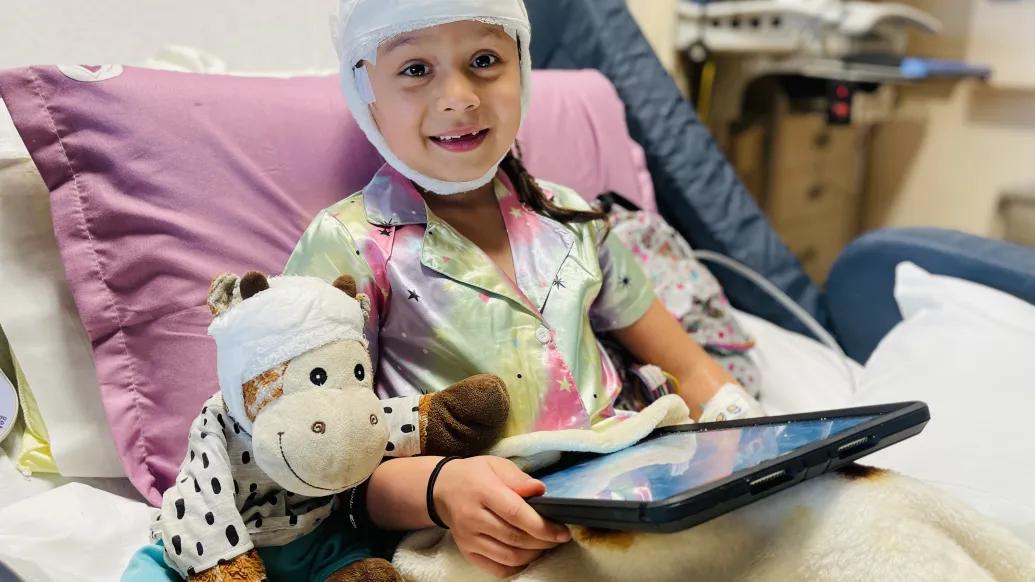
ANN ARBOR, Mich. – Children who need dialysis, treatment for a chronic condition or an overnight stay at University of Michigan Health C.S. Mott Children’s Hospital now have a new coping tool available.
Individual, hospital-provided iPads will allow children and teens on nearly every floor to choose from dozens of games like Minecraft and TocaBoca, create music or art projects, talk to families and friends through Zoom and more easily access school materials to help them keep up with classes during treatment.
Thanks to a $240,000 grant from Child's Play Charity, the Therapeutic Gaming and Patient Technology program at Mott was able to implement the Bungie Foundation Little Lights program. After a two year process to ensure digital safety and hospital compliance – more than 150 iPads have been distributed throughout the hospital.
Each iPad has more than 50 apps that have been reviewed by the hospital’s Child and Family Life services team to ensure they’re developmentally appropriate and engaging. Mott patient technology staff also worked with developers to customize some of the apps to remove adds or add accessibility features to promote a more inclusive game experience for children in the hospital.
“Our teams have been working diligently to bring this technology to our hospital in an engaging, safe and thoughtful way to enhance our patients’ experiences,” said Luanne Thomas Ewald, M.H.A., F.A.C.H.E, chief operating officer of Mott and Von Voigtlander Women’s Hospital.
“We’re thankful for our staff’s incredible devotion to this project and the generosity of the donors who helped make it happen.”
Addressing an inequity issue
While talks of improving technology access for children and teens receiving care at the hospital had been ongoing, the need became most glaring during the pandemic, says J.J. Bouchard, manager of the Mott patient technology program.
Some kids brought in personal tablets and other devices but not every child had one to use from home. And because of certain security permissions, even those with access to devices couldn’t always connect with their school when many classes went virtual.
With visitor limitations during COVID-19 precautions, some families also sought Zoom access to help them connect with loved ones who couldn’t visit their child but the hospital didn’t have enough tablets available.
“We knew that some kids didn’t have the same access to technology as others, but this became even more obvious during the pandemic when there was an increased interest in virtual interactions with loved ones, schools and communities,” Bouchard said. “By providing iPads to everyone, we can help ensure patients all have access to resources that may help address social isolation during hospital stays.”
He added that being at the hospital can be a stressful experience for children and families and teams are always searching for new sources of entertainment and distraction.
“The Therapeutic Gaming and Patient Technology program is dedicated to integrating recreational and educational technology into the hospital environment, to help patients and families reach their therapeutic goals,” Bouchard said.
“We work with donors, staff, patients and families to optimize the recreational technology kids are familiar with for the hospital environment. We knew by teaming up with Child’s Play Charity and Bungie Foundation’s Little Lights Program that we could help address some of these inequaties and improve the hospital experience.”
Nursing staff and child life specialists have been trained to use the devices and only certain apps are allowed on the iPads, blocking any content that isn’t deemed appropriate. Some features, such as the camera, are also limited to use in only certain apps like Zoom to ensure patient safety.
Devices are charged at charging stations in each unit and not in individual rooms and once a battery dies, children are encouraged to move on to another activity to help set screen time limits.
“This program provides opportunities to promote positive interactions with medical staff and nurses and empowers the child in many ways. They can choose what they do, from being creative with art or music projects, to playing a favorite game,” said Connor Rivera, patient technology specialist at Mott.
“Our donors were on board to fund this project right away but we needed to make sure we had the right management system in place to ensure digital safety,” he added. “We’re thankful to the donors, partners and staff who helped us launch this program to help children cope with their hospital stay.”
Featured News & Stories

More babies with hypoplastic left heart syndrome surviving critical period between surgeries

Distance, insurance, social factors may hinder access to lifesaving heart monitoring for children

High dose oxytocin protocol linked to lower postpartum hemorrhage rates

Paralyzed from waist down as a child, patient walks across stage at high school graduation

U-M-led consortium to receive up to $52 million in NIH funding to study why viral respiratory infections affect children differently