Meng Wang, PhD

Manage Your Profile
Qualifications
-
Research scientistStanford University School of Medicine, Stanford, United States
2020 - 2023
-
Postdoctoral researcherStanford University School of Medicine, Stanford, United States
2016 - 2019
-
Postdoctoral researcherUniversity of California, San Diego, San Diego, United States
2014 - 2016
-
PhDUniversity of California, San Diego, San Diego, United States
2010 - 2014
Center Memberships
-
Center MemberFrankel Institute for Heart and Brain Health
Research Overview
Our current research focuses on developing new machine learning (ML) and deep learning (DL) methods with statistical analysis from a data-driven approach using multiomics data and wearable sensor data to study multi-tissue responses to exercise and under disease model, to provide insights for therapeutic benefits. We use ML and DL methods to model the complexity and heterogeneity of multiomic data and wearable data. For multiomics data, in our ongoing work, we use network analysis and graphical neural network (GNN) to study how tissues communicate with each other in response to exercise. For the wearable data, we use signal processing and signal detection techniques and recurrent neural network (RNN) to track and evaluate the exercise responses in different individuals under various disease statuses. Finally, we will take advantage of ML and DL to link biomarkers at the molecular level with digital markers from wearable sensors to optimize training programs and to improve exercise efficiency.
Links
Meng Wang Lab
Recent Publications
-
Alavi A, Bogu GK, Wang M, Rangan ES, Brooks AW, Wang Q, Higgs E, Celli A, Mishra T, Metwally AA, Cha K, Knowles P, Alavi AA, Bhasin R, Panchamukhi S, Celis D, Aditya T, Honkala A, Rolnik B, Hunting E, Dagan-Rosenfeld O, Chauhan A, Li JW, Bejikian C, Krishnan V, McGuire L, Li X, Bahmani A, Snyder MP. Nature Medicine, 2022 Jan 1; 28 (1): 175 - 184.Journal ArticleReal-time alerting system for COVID-19 and other stress events using wearable data
DOI:10.1038/s41591-021-01593-2 PMID: 34845389 -
Mishra T, Wang M, Metwally AA, Bogu GK, Brooks AW, Bahmani A, Alavi A, Celli A, Higgs E, Dagan-Rosenfeld O, Fay B, Kirkpatrick S, Kellogg R, Gibson M, Wang T, Hunting EM, Mamic P, Ganz AB, Rolnik B, Li X, Snyder MP. Nature Biomedical Engineering, 2020 Dec 1; 4 (12): 1208 - 1220.Journal ArticlePre-symptomatic detection of COVID-19 from smartwatch data
DOI:10.1038/s41551-020-00640-6 PMID: 33208926 -
Jiang L, Wang M, Lin S, Jian R, Li X, Chan J, Dong G, Fang H, Robinson AE, Aguet F, Anand S, Ardlie KG, Gabriel S, Getz G, Graubert A, Hadley K, Handsaker RE, Huang KH, Kashin S, MacArthur DG, Meier SR, Nedzel JL, Nguyen DY, Segrè AV, Todres E, Balliu B, Barbeira AN, Battle A, Bonazzola R, Brown A, Brown CD, Castel SE, Conrad D, Cotter DJ, Cox N, Das S, de Goede OM, Dermitzakis ET, Engelhardt BE, Eskin E, Eulalio TY, Ferraro NM, Flynn E, Fresard L, Gamazon ER, Garrido-Martín D, Gay NR, Guigó R, Hamel AR, He Y, Hoffman PJ, Hormozdiari F, Hou L, Im HK, Jo B, Kasela S, Kellis M, Kim-Hellmuth S, Kwong A, Lappalainen T, Li X, Liang Y, Mangul S, Mohammadi P, Montgomery SB, Muñoz-Aguirre M, Nachun DC, Nobel AB, Oliva M, Park YS, Park Y, Parsana P, Reverter F, Rouhana JM, Sabatti C, Saha A, Skol AD, Stephens M, Stranger BE, Strober BJ, Teran NA, Viñuela A, Wang G, Wen X, Wright F, Wucher V, Zou Y, Ferreira PG, Li G, Melé M, Yeger-Lotem E, Barcus ME, Bradbury D, Krubit T, McLean JA, Qi L, Robinson K, Roche NV, Smith AM, Sobin L. Cell, 2020 Oct 1; 183 (1): 269 - 283.e19.Journal ArticleA Quantitative Proteome Map of the Human Body
DOI:10.1016/j.cell.2020.08.036 PMID: 32916130 -
Zhong Y, Zheng C, Wang Z, Zhang W, Wu H, Luo J, Zhang H, Wang C, Zhang C, Hu H, Yuan Z, Wang M, Zhang Q, Wang G. Communications Biology, 2026 Dec 1; 9 (1):Journal ArticleOSBPL3 drives colorectal cancer progression via Hippo-YAP signaling and modulates MEK inhibitor sensitivity
DOI:10.1038/s42003-026-09811-8 PMID: 41794997 -
Qian H, Wu C, Li B, Rosenzweig A, Wang M. Med, 2026 Aug 14; 7 (8):Journal ArticlePlasma proteomics linking primary and secondary diseases: Insights into molecular mediation from UK Biobank data
DOI:10.1016/j.medj.2026.101232 PMID: 42551443 -
Wang C, Wu H, Zheng C, Zhang H, Wu X, Wang J, Chang Z, Xiang J, Liu Y, Zhang C, Wang Y, Jiang H, Zhong Y, Luo J, Chen Y, Zhang NN, Zhang W, Yuan Z, Zou CX, Tan W, Wang M, Hu H, Bing T, Wang G. Advanced Science, 2026 Aug 13; 13 (45):Journal ArticleAptamer-Targeted PrPC Drives Colorectal Cancer Metastasis via a LYN-STAT3 Complex and Enables Liquid Biopsy Detection
DOI:10.1002/advs.75758 PMID: 42154443 -
Yue L, Jiang W, Li S, Luo M, Fan N, Zhan X, Sun R, Cheng H, Xue Z, Liu T, Zhou Q, Chen K, Lu T, Guo F, Li D, Ge W, Nie Z, Lyu M, Jun A, Wang Y, Chen Y, Fu Z, Xiang N, Li L, Yu F, Teo GC, Nesvizhskii AI, Wang M, Snyder MP, Collins BC, Xiao Q, Aebersold R, Xu F, Yang H, Zhang S, Han Y, Zhu Y, Ji Y, Li Y, Guo T. Nature, 2026 Aug 6; 656 (8126): 227 - 236.Journal ArticleSpatial distribution of the proteome in the human body and in cancers
DOI:10.1038/s41586-026-10660-y PMID: 42310461 -
Wu C, Li D, Khetarpal SA, Yuan Z, Huang S, Guerra JRB, Li C, Zhou Q, Quan M, He J, Wang M, Liang H, Rosenzweig A. Nature Cardiovascular Research, 2026 Apr 1; 5 (4): 351 - 365.Journal ArticleLarge-scale identification of protein biomarkers and therapeutic targets in heart and brain disease
DOI:10.1038/s44161-026-00799-2
Featured News & Stories
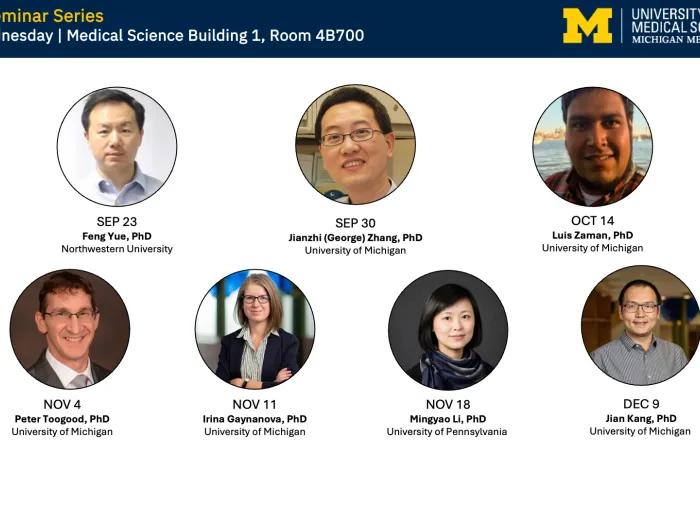
Announcing CCMB/DCMB Fall 2026 Seminar Series