
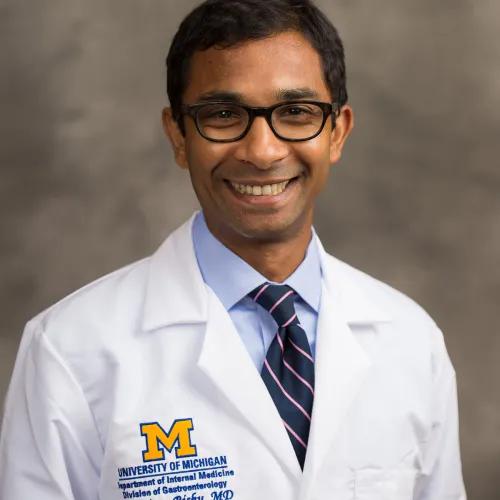
Shrinivas Bishu, MD, FACG
Manage Your Profile
About
Dr. Shrinivas Bishu received his bachelor’s degree from the University of Pennsylvania, and a medical degree from the University of Nebraska Medical Center. He completed internal medicine residency at the University of Kentucky, and a fellowship in gastroenterology at the University of Pittsburgh Medical Center. In addition to clinical training, Dr. Bishu has extensive expertise in immunology and has completed basic science post-doctoral fellowships at the National Institutes of Health, and the University of Pittsburgh. Dr. Bishu’s research focuses on understanding the underlying immunology of Inflammatory Bowel Disease, the microbiota-disease interactions, and in the mechanisms of immune therapies. He is clinically interested in patients that have active endoscopic disease despite optimized anti-TNF therapy who may be candidates for new and investigational immune therapies.
Qualifications
-
T32 Postdoctoral research fellowUniversity of Pittsburgh, Rheumatology/Immunology, Pittsburgh, United States
2011 - 2023
-
Post-doctoral research fellowNational Institutes of Mental Health, United States
2006 - 2009
-
Neuro-immunology research fellowshipUniversity of Nebraska, College of Medicine, Omaha, NE, United States
2000 - 2001
-
MDUniversity of Nebraska Medical Center, Omaha, NE, 68198, United States
1998 - 2003
-
BAUniversity of Pennsylvania, Philadelphia, PA, United States
1996 - 1998
Research Overview
The over-arching goals of my work are to determine the mechanisms that drive inflammatory bowel disease (IBD) and to develop therapies tailored to the dys-regulated pathways. Within this framework, we are focused on how the tissue microenvironment regulates a special class of T-cells termed tissue-resident memory T-cells (TRM). TRM are tissue-restricted, closely aligned with the microbiota, and are the most abundant T-cell subset in the intestine. These properties make TRM cells excellent candidates to link gut dysbiosis with dys-regulated host immune responses that drive IBD. My clinical practice at the University of Michigan is highly specialized in IBD, and I have expertise in immunology and IBD patient care, so I am well suited to translate basic findings into usable treatments. Our lab is proficient in the techniques of modern immunology, and we have access to and expertise in processing human biospecimens.
The core of our lab is to understand how the gut microenvironment regulates intestinal TRM and how TRM impact intestinal injury and restitution in the context of IBD. We are focused on CD4+ TRM, and have developed murine models of CD4+ TRM, and have examined them in human intestinal specimens. We have built off our data to examine the role of IL-15 on CD4+ TRM in IBD and have found that IL-15 promotes inflammatory Th17 TRM. We have also observed that some types of transient GI inflammation can protect from subsequent epithelial injury, via pathway involving restitutive TRM, the inflammation trained microbiota, and intestinal epithelial cells, all of function in a protective feedback loop.
Clinically, I have a large IBD practice, and am actively involved in clinical operations in the IBD group, including the primary contact for education and training of PAs and APPs. I am also very interested in medical education evidenced by my positions as Associate Program Director for the GI fellowship, Director of IBD Education, Director of the Internal Medicine GI outpatient rotation, and Director of GI Grand Rounds. I have won several fellow-elected teaching awards in my capacity as a clinical and professional mentor to the GI fellows.
Recent Publications
-
Goyal MK, Bishu S. Inflamm Bowel Dis, 2026 Oct 14;Journal ArticleThe right dose for the right patient: Toward precision infliximab therapy in acute severe ulcerative colitis.
DOI:10.1093/ibd/izag204 PMID: 42872599 -
Dhooria B, Kumar S, Goyal MK, Chatterjee A, Jena A, Pahil S, Bishu S, Sebastian S, Sharma V. Frontline Gastroenterology, 2026 Sep 13; flgastro-2026-103846Journal ArticleFaecal multiplex PCR testing and its clinical utility in inflammatory bowel disease: a systematic review and meta-analysis
DOI:10.1136/flgastro-2026-103846 -
Herran R, Wilcox S, Hodish G, Hassan SA, Mertens H, Almario CV, Gu P, Kayal M, Cohen-Mekelburg S, Regal RE, Bishu S, Siegel CA, DeJonckheere M, Higgins PDR, Berinstein JA. Dig Dis Sci, 2026 Jun 24;Journal ArticleNavigating Treatment Selection in Acute Severe Ulcerative Colitis: A Prospective Mixed Method Analysis of Factors Influencing Patient Decision-Making.
DOI:10.1007/s10620-026-10046-0 PMID: 42340521 -
Dhooria B, Kumar S, Goyal M, Chatterjee A, Jena A, Pahil S, Bishu S, Sebastian S, Sharma V. 2026 Jun 28; a100 - a102.Proceeding / Abstract / PosterIDDF2026-ABS-0093 Fecal multiplex PCR testing and its clinical utility in inflammatory bowel disease: a systematic review and meta-analysis
DOI:10.1136/gutjnl-2026-iddf.66 -
Devi J, Patel A, Quraishi B, Dev B, Tan T, Kline M, Chowla N, Ramesh PR, Ballard DH, Huang L, Jaiprada F, Samaan S, Stone M, Khan A, Seeraj AA, Alanazi S, Xu A, Maas L, Jajoo A, Parian A, Altinmakas E, Ehman EC, Davenport MS, Li S, Chithriki M, Shukla R, McCurdy J, Yarur AJ, Bishu S, Johnson AM, Benjamin M, Dulaney D, Serre-Yu W, Deepak P. Clin Gastroenterol Hepatol, 2026 May 15;Journal ArticleReal-World Effectiveness of Upadacitinib for Perianal Crohn's Disease: A Multi-Center Retrospective Study.
DOI:10.1016/j.cgh.2026.05.003 PMID: 42142719 -
Chowdhary R, Goyal MK, Arora K, Sehgal T, Dawer P, Anirudh FNU, Berinstein J, Bishu S, Matt-Amaral L. JGH Open, 2026 May; 10: e70409Journal ArticleGut Microbiota and Extraintestinal Cancers: Mechanistic Insights and Microbiome-Targeted Interventions.
DOI:10.1002/jgh3.70409 PMID: PMC13150064 -
Wilcox S, Herran R, Ardente L, Shah AM, Hassan SA, Hodish G, Palazzolo B, Gu P, Tedesco NR, Goyal MK, Bishu S, Cohen-Mekelburg S, Regal R, Higgins PD, Kayal M, Berinstein J. Gastrointestinal Endoscopy, 2026 May 6; 103 (5): s-1179-s-1180Proceeding / Abstract / PosterMo1543 COMPARATIVE EFFECTIVENESS OF TOFACITINIB AND UPADACITINIB FOR PATIENTS WITH ACUTE SEVERE ULCERATIVE COLITIS: A MULTICENTER UNITED STATES EXPERIENCE
DOI:10.1016/s0016-5107(26)02913-5 -
Wilcox S, Herran R, Ardente L, Shah AM, Hassan SA, Hodish G, Palazzolo B, Gu P, Tedesco NR, Goyal MK, Bishu S, Cohen-Mekelburg S, Regal R, Higgins PD, Kayal M, Berinstein J. Gastroenterology, 2026 May 7; 170 (6): s-1179-s-1180Proceeding / Abstract / PosterMo1543 COMPARATIVE EFFECTIVENESS OF TOFACITINIB AND UPADACITINIB FOR PATIENTS WITH ACUTE SEVERE ULCERATIVE COLITIS: A MULTICENTER UNITED STATES EXPERIENCE
DOI:10.1016/s0016-5085(26)02982-3
