Idse Heemskerk, PhD
Manage Your Profile
About
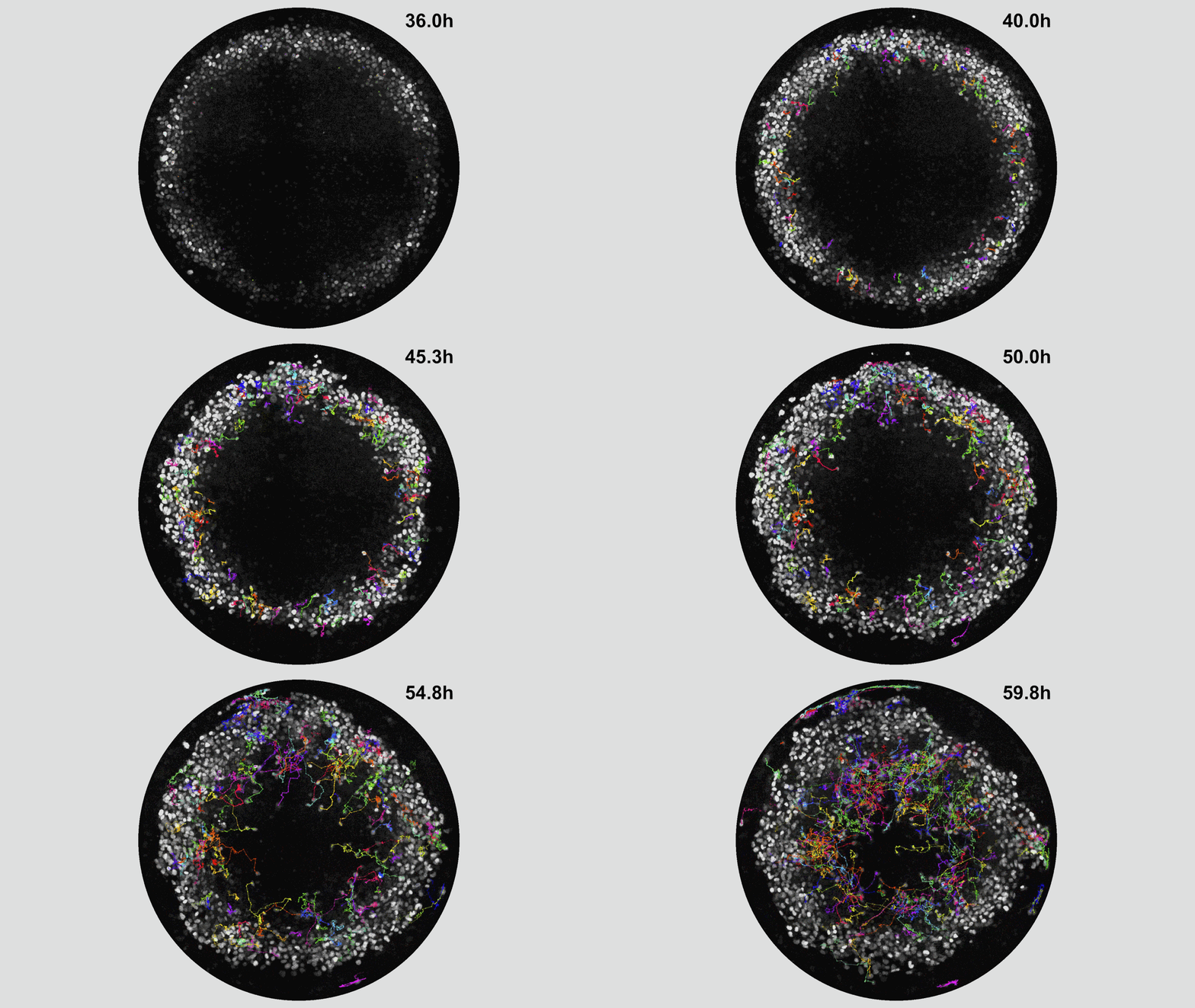
The goal of the Heemskerk lab is to understand how human pluripotent stem cells generate and interpret the chemical and physical signals that allow them to self-organize into spatial structures consisting of multiple cell types in vitro, and, by extension to the embryo, in vivo. By combining quantitative live-cell measurements and engineering tools such as micropatterning with predictive mathematical models we can answer currently intractable questions in developmental and stem cell biology.
Links
Heemskerk Lab Google Scholar
Qualifications
-
Postdoctoral FellowRice University, United States
2015 - 2018
Postdoctoral Research
-
Postdoctoral FellowUniversity of California, Santa Barbara, Kavli Institute for Theoretical Physics, Santa Barbara, United States
2012 - 2015
Postdoctoral Research
-
PhD in Theoretical PhysicsUniversity of California, Santa Barbara, CA, United States
2007 - 2012
-
MS in Theoretical PhysicsUniversiteit van Amsterdam, Amsterdam, Netherlands
2004 - 2007
-
BSc in Computer ScienceUniversiteit van Amsterdam, Amsterdam, Netherlands
2002 - 2007
-
BSc in PhysicsUniversiteit van Amsterdam, Amsterdam, Netherlands
2001 - 2005
Center Memberships
-
Center MemberCenter for Computational Medicine and Bioinformatics
-
Center MemberBiosciences Initiative
-
Center MemberCenter for Cell Plasticity and Organ Design
Research Overview
What are the mechanisms through which stem cells give rise to self-organized embryonic structures and organs? How is the information required to form these structures encoded in highly dynamic signals? What is the role of the physical forces and geometric constraints in reproducible tissue patterning and morphogenesis?
Recent Publications
-
Fijabi A-B, Teague S, Freeburne E, Khan HA, Johnson C, Brückner DB, Heemskerk I. 2026 May 18;PreprintInterpretable decoding of cell fate from a snapshot of combinatorial signaling.
DOI:10.64898/2026.05.17.725652 PMID: 42239294 -
Jo K, Liu ZY, Patel G, Yu Z, Yao LA, Teague S, Johnson C, Spence J, Heemskerk I. Development Cambridge, 2026 Feb 1; 153 (3):Journal ArticleEndogenous FGFs drive ERK-dependent cell fate patterning in 2D human gastruloids
DOI:10.1242/dev.205459 PMID: 41521789 -
Teague S, Yu Z, Heemskerk I. 2026 Jan 1; 3048: Methods in Molecular Biology, 181 - 210.ChapterLinking Single-Cell Dynamics to Cell Fate in Differentiating hPSCs
DOI:10.1007/7651_2025_638 PMID: 40397280 -
Jo K, Liu Z-Y, Patel G, Yu Z, Yao L, Teague S, Johnson C, Spence J, Heemskerk I. eLife, 2024 Jul 15;Journal ArticleEndogenous FGFs drive ERK-dependent cell fate patterning in 2D human gastruloids
DOI:10.1101/2024.07.08.602611 -
Chen B, Khan H, Yu Z, Yao LA, Freeburne E, Jo K, Johnson C, Heemskerk I. Nature Methods, 2025 Jun 1; 22 (6): 1355 - 1365.Journal ArticleExtended culture of 2D gastruloids to model human mesoderm development
DOI:10.1038/s41592-025-02669-4 PMID: 40335707 -
Stapornwongkul KS, Hahn E, Poliński P, Salamó Palau L, Arató K, Yao LA, Williamson K, Gritti N, Anlas K, Osuna Lopez M, Patil KR, Heemskerk I, Ebisuya M, Trivedi V. Cell Stem Cell, 2025 May 1; 32 (5): 744 - 758.e7.Journal ArticleGlycolytic activity instructs germ layer proportions through regulation of Nodal and Wnt signaling
DOI:10.1016/j.stem.2025.03.011 PMID: 40245870 -
Teague S, Primavera G, Chen B, Liu ZY, Yao LA, Freeburne E, Khan H, Jo K, Johnson C, Heemskerk I. Nature Communications, 2024 Dec 1; 15 (1):Journal ArticleTime-integrated BMP signaling determines fate in a stem cell model for early human development
DOI:10.1038/s41467-024-45719-9 PMID: 38368368 -
Heemskerk I. 2024 Dec 17;PresentationInsights into human gastrulation from stem cell-based models
Featured News & Stories
Congratulations to our Exceptional Team!
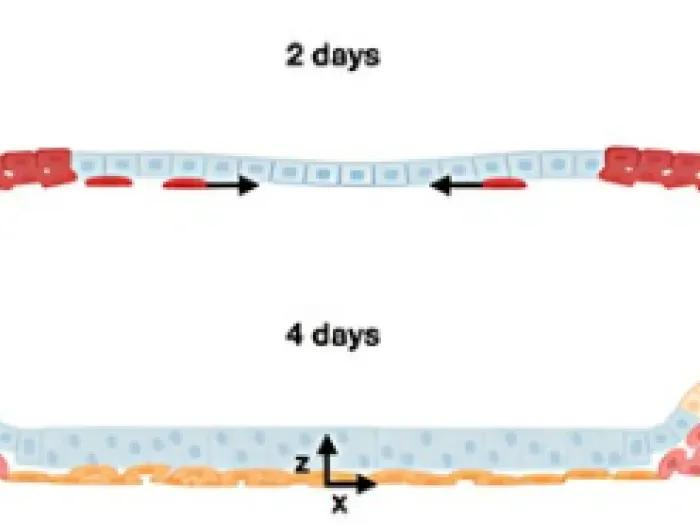
New Publication by Bohan Chen (Heemskerk Lab)!