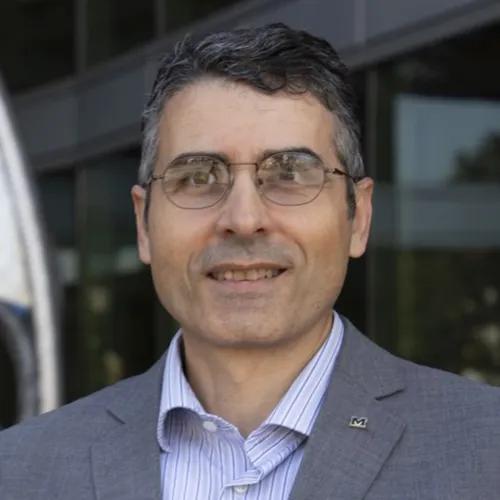
Ivo Dinov, PhD
Statistics Online Computational Resource (SOCR)
426 N. Ingalls Street
Ann Arbor, MI 48109-2003
Manage Your Profile
About
Ivo D. Dinov is the Henry Philip Tappan Collegiate Professor at the University of Michigan. He is SOCR Director and professor of Health Behavior and Biological Sciences, and Computational Medicine and Bioinformatics. Dr. Dinov is an expert in mathematical modeling, complex time (kime) and spacekime theory, statistical analysis, computational processing, scientific visualization of large datasets (Big Data), and predictive ML/AI health analytics. His applied research is focused on the STEM foundations of artificial intelligence, biomedical informatics, multimodal biomedical image analysis, and distributed genomics computing. Dr. Dinov is a member of the Michigan Center for Applied and Interdisciplinary Mathematics (MCAIM) and a core member of the University of Michigan Comprehensive Cancer Center. He is an elected member of the International Statistical Institute (ISI).
Links
SOCR Dinov Bio Dinov Pubs SOCR Research DInov GoogleScholar SOCR News
Qualifications
-
Ph.D.Florida State University, Tallahassee, United States
-
M.S.Florida State University, Tallahassee, United States
-
M.S.Michigan Technological University, Houghton, United States
-
B.S.Sofia University, Sofia, Bulgaria
Center Memberships
-
Center MemberInstitute for Healthcare Policy and Innovation
-
Center MemberWeil Institute for Critical Care Research
-
Center MemberCenter for Global Health Equity
-
Center Membere-Health and Artificial Intelligence Initiative
-
Center MemberAI and Digital Health Innovation
Research Overview
In addition to his core STEM scholarly activities, specific artificial intelligence (AI) research projects led by Dr. Dinov include spacekime analytics using longitudinal morphometric studies of development (e.g., Autism, Schizophrenia), maturation (e.g., depression, pain) and aging (e.g., Alzheimer’s disease, Parkinson’s disease). He also studies the intricate relations between genetic traits (e.g., SNPs), clinical phenotypes (e.g., disease, behavioral and psychological test) and subject demographics (e.g., race, gender, age) in variety of brain and heart related disorders. Dr. Dinov is developing, validating, and disseminating novel methods (e.g., spacekime analytics) and technologies (e.g., CBDA, DataSifter, TCIU) for mathematical modeling, statistical computing, biomedical applications, scientific education, and active learning.
Recent Publications
-
Ognjanovski N, Ghimire A, Hale PJ, Kim DS, Cerda IH, Goldiez E, Marino S, Green A, Fitzgerald PJ, Vijayakumar P, Kirca D, Tong M, Muscat N, Knopf K, Cook M, Tang M, Chen Y, Junior LSB, Weston R, Liu T, Hartner JP, Dinov ID, Watson BO. 2026 Apr 19; Research Square,PreprintMouse Bio-behavioral Phenotyping Using a Digital Homecage Framework for Long-timescale, High-resolution, and Multi-factor Data Collection and Analytics
DOI:10.21203/rs.3.rs-9152533/v1 -
Guha S, Rodriguez-Acosta J, Dinov I. 2026 Mar 25; arXiv,PreprintMultiview Graph Fusion with Covariates
-
Weigard AS, Hicks B, Molloy MF, Paige K, McCurry K, Cope L, Hardee J, Martz M, Sripada C, Zucker R, Dinov I, Heitzeg M. 2026 Apr 16; PsyArXiv,PreprintMachine learning reveals two key dimensions of developmental risk for substance use disorders in young adulthood
DOI:10.31234/osf.io/g46nh_v1 -
Robinson-Lane S, Qin L, Johnson F, Dinov I, Giordani B. Innovation in Aging, 2026 Jan 4; 9 (Supplement_2): igaf122.521Journal ArticleAdaptive Coping and Caregiving Self-Efficacy Among Black Family Caregivers of Persons with Dementia
DOI:10.1093/geroni/igaf122.521 PMID: PMC12760025 -
Niraula D, Cuneo KC, Dinov ID, Gonzalez BD, Jamaluddin JB, Jin JJ, Luo Y, Matuszak MM, Ten Haken RK, Bryant AK, Dilling TJ, Dykstra MP, Frakes JM, Liveringhouse CL, Miller SR, Mills MN, Palm RF, Regan SN, Rishi A, Torres-Roca JF, Yu HHM, El Naqa I. Nature Communications, 2025 Dec 1; 16 (1):Journal ArticleIntricacies of human–AI interaction in dynamic decision-making for precision oncology
DOI:10.1038/s41467-024-55259-x PMID: 39881134 -
Marino S, Cassidy R, Nanni J, Wang Y, Liu Y, Tang M, Yuan Y, Chen T, Sinha A, Pandian B, Dinov ID, Burns ML. Npj Digital Medicine, 2025 Dec 1; 8 (1):Journal ArticleMedical data sharing and synthetic clinical data generation – maximizing biomedical resource utilization and minimizing participant re-identification risks
DOI:10.1038/s41746-025-01935-1 -
Uranga RM, Nishii A, Maung JN, Mori H, Desrosiers B, Jacobs J, Hoose KS, Schill RL, Bagchi DP, Guak H, Crewe C, Dinov ID, Giles ED, Lumeng CN, MacDougald OA. Molecular Metabolism, 2025 Oct 1; 100:Journal ArticleEffects of β-catenin deficiency on adipose tissue physiology
DOI:10.1016/j.molmet.2025.102226 PMID: 40759324 -
Kalinin AA, Llanos P, Sommer TM, Sestini G, Hou X, Sexton JZ, Wan X, Dinov ID, Athey BD, Rivron N, Carpenter AE, Cimini B, Singh S, O'Meara MJ. 2025 Jul 10; arXiv,PreprintForeground-aware Virtual Staining for Accurate 3D Cell Morphological Profiling
DOI:10.48550/arxiv.2507.05383
Featured News & Stories