Anthony Rosenzweig, MD

Manage Your Profile
About
Dr. Rosenzweig, MD graduated from Harvard College, where he majored in biochemistry and molecular biology. He received his medical degree from Harvard Medical School and completed his residency in internal medicine and fellowship in cardiovascular medicine at the Massachusetts General Hospital (MGH). Additional research training included a one-year predoctoral fellowship in neurosciences at the University of Pennsylvania and postdoctoral training in the laboratories of Drs. Jonathan and Christine Seidman, as well as Dr. Michael Gimbrone, all at Harvard Medical School.
Dr. Rosenzweig is the inaugural Director of the Stanley and Judith Frankel Institute for Heart and Brain Health (Frankel IHBH) at the University of Michigan Medical Center. Previous leadership roles include having served as Chief of Cardiology, Co-Director of the Corrigan Minehan Heart Center and Director of Cardiovascular Research at MGH as well as the Paul Dudley White Professor of Medicine at Harvard Medical School (2015-2022). He also has served as the inaugural Director of the Program in Cardiovascular Gene Therapy at MGH, a Trustee of the Harvard Clinical Research Institute (an academic clinical research organization), an Executive Committee member of the Harvard Stem Cell Institute and its Cardiovascular Program Leader, as well as the Director of Cardiovascular Research and Associate Chief of Cardiology at the Beth Israel Deaconess Medical Center in Boston. Dr. Rosenzweig is also a member of the Leducq Foundation Scientific Advisory Committee and the American Heart Association Basic Sciences Council leadership.
Links
Rosenzweig Lab
Qualifications
-
Residency in Internal MedicineMassachusetts General Hospital, Boston, United States
Residency
-
Fellowship in Cardiovascular MedicineMassachusetts General Hospital, Boston, United States
Other
-
Postdoctoral Research FellowshipHarvard Medical School, Genetics, Boston, United States
Postdoctoral Research
-
Postdoctoral Research FellowshipBrigham and Women's Hospital, Vascular Biology, Boston, United States
Postdoctoral Research
-
M.D.Harvard Medical School, Boston, USA
Center Memberships
-
Center MemberBiointerfaces Institute
-
Center MemberAI and Digital Health Innovation
-
Center MemberFrankel Institute for Heart and Brain Health
-
Center MemberSamuel and Jean Frankel Cardiovascular Center
Research Overview
Dr. Rosenzweig’s research has focused on identifying novel mechanisms and therapeutic targets in heart failure, using the exercised heart to understand what keeps hearts healthy. Of particular interest is how dysregulation of common pathways, such as those involved in metabolism, cellular senescence, or inflammation, can drive disease in multiple organs, including the brain and heart, since targeting such pathways could have broad clinical benefits. Dr. Rosenzweig is deeply committed to realizing the translational potential of basic science discoveries. His work has led to multiple patent awards, licensed approaches to mutation detection, and new therapeutic strategies being investigated in clinical trials. He has led successful partnerships with industry, served on industry advisory panels, and co-founded a recently funded biotech start-up focused on small molecule therapies for Long QT Syndrome. Dr. Rosenzweig has been a principal investigator for multiple successful research consortia including an international Leducq Foundation Network of Research Excellence, multiple NIH U-awards, an AHA Strategically Focused Research Network Center, and multiple NIH T32 training grants. His research has been continuously funded by the NIH for over 30 years.
Recent Publications
-
Li SS, Michaud B, Osho AA, D’Alessandro DA, Tessier SN, Rosenzweig A, Alireza Rabi S, Guseh JS. Npj Cardiovascular Health, 2026 Dec 1; 3 (1):Journal ArticleEx vivo heart perfusion induces time dependent inflammatory activation in human donor hearts
DOI:10.1038/s44325-026-00137-2 -
Bei Y, Zhong D, Lu J, Qiu Y, Bowen TS, Chen N, Dun Y, Gao F, Huang Y, Li G, Li J, Li J, Liu F, Liu W, Ma X, Rosenzweig A, Spanos M, Tian Z, Yin P, Wang R, Wang Y, Xu D, Xu L, Zhang L, Zhang J, Zhang X, Zhou Q, Qiao Y, Xu M, Xiao J. Journal of Sport and Health Science, 2026 Dec 1; 15:Journal ArticleExpert consensus statement for basic research of animal exercise intervention studies in chronic disease prevention and treatment: A joint position paper of the Exercise Science branch of the Biophysical Society of China and the Metabolism and Genetics branch of the Genetics Society of China
DOI:10.1016/j.jshs.2025.101103 PMID: 41276165 -
Li SS, Michaud B, Osho AA, D'Alessandro DA, Lewis GD, Rosenzweig A, Rabi SA, Guseh JS. JACC Heart Fail, 2026 Aug 28; 103298Journal ArticleEx Vivo Perfusion Unmasks a Proteomic Signature of Primary Graft Dysfunction in Donor Hearts.
DOI:10.1016/j.jchf.2026.103298 PMID: PMC13534981 -
Qian H, Wu C, Li B, Rosenzweig A, Wang M. Med, 2026 Aug 14; 7 (8):Journal ArticlePlasma proteomics linking primary and secondary diseases: Insights into molecular mediation from UK Biobank data
DOI:10.1016/j.medj.2026.101232 PMID: 42551443 -
Li H, Xiao X, Zhou Y, Zhang Y, Kang J, Yuan Z, He J, Guerra J, Lerchenmüller C, Margulies KB, Aguirre AD, Roh JD, Rosenzweig A. Eur Heart J, 2026 May 19;Journal ArticleLong noncoding RNA SALTe1, microvascular ageing, and cardiac dysfunction.
DOI:10.1093/eurheartj/ehag356 PMID: 42155043 -
Zhang Y, Chi X, Zhou Q, Huang S, Chen HZ. Physiology, 2026 May 1; 41 (3):Journal ArticleCellular Senescence and Interorgan Communication in Health and Disease
DOI:10.1152/physiol.00017.2025 PMID: 41138217 -
Wu C, Li D, Khetarpal SA, Yuan Z, Huang S, Guerra JRB, Li C, Zhou Q, Quan M, He J, Wang M, Liang H, Rosenzweig A. Nature Cardiovascular Research, 2026 Apr 1; 5 (4): 351 - 365.Journal ArticleLarge-scale identification of protein biomarkers and therapeutic targets in heart and brain disease
DOI:10.1038/s44161-026-00799-2 -
Yang T, Zhou Q, Bei Y, Meng D, Ai S, Zhang Y, Zhang J, Liu L, Chen H, Pan X, Yin X, Spanos M, Li G, Cretoiu D, Sluijter JPG, Rosenzweig A, Xiao J. EMBO Reports, 2026 Feb 25; 27 (4): 1023 - 1056.Journal Articlep16INK4a promotes myocardial ischemia-reperfusion injury by regulating bile acid transport via Slco1a4
DOI:10.1038/s44319-025-00688-y PMID: 41526719
Featured News & Stories
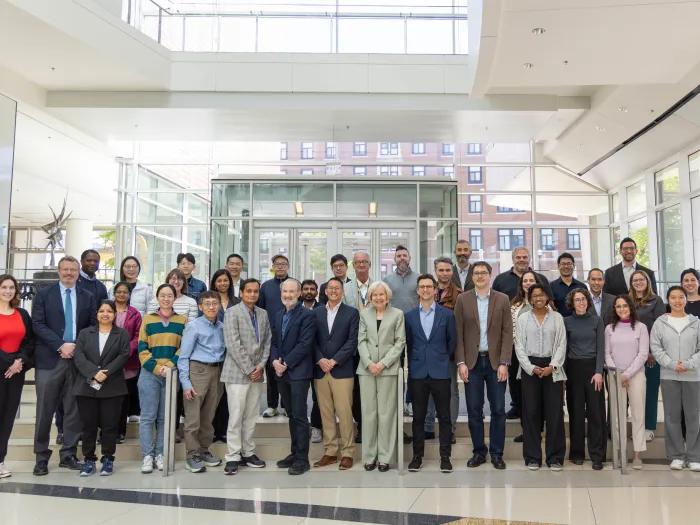
American Heart Association SFRN Spring Meeting hosted at the University of Michigan

Neuroscience Graduate Student Scholars Program FY25
Frankel IHBH and M-BoCA Present: Innovative Multidisciplinary Research Pilot Award 2025

Can preventing inflammation improve heart and brain health?