Michael Cianfrocco
Life Sciences Institute
210 Washtenaw Ave.
Ann Arbor, MI 48109
Manage Your Profile
About
Our research team is trying to understand the molecular details determining how, where, and when motor proteins transport intracellular cargo. The past thirty years of cell biology research have set the stage for us to determine the general principles that underlie the complex process of intracellular transport.
Overarching questions we are trying to answer: How is motor protein activity turned ‘on’ and ‘off’? How do viruses hijack motor protein activity?
How do microtubule structure and post-translational modifications affect motor protein activity?
We are approaching these questions from several angles, using cryo-electron microscopy, single molecule TIRF, and biochemistry to relate protein structure to its activity in a cell.
Links
Cianfrocco Lab Google Scholar
Qualifications
-
Damon Runyon HHMI Post-doctoral fellowUniversity of California - San Diego, Cellular & Molecular Medicine, San Diego, CA, United States
2015 - 2017
Postdoctoral Research
-
Damon Runyon HHMI Post-doctoral fellowHarvard University, Molecular and Cellular Biology, Cambridge, MA, United States
2013 - 2015
Postdoctoral Fellowship
-
Damon Runyon HHMI Post-doctoral FellowHarvard Medical School, Cell Biology, Boston, MA, United States
2013 - 2015
Postdoctoral Research
-
PhDUniversity of California - Berkeley (Advisor: Eva Nogales), Berkeley, CA, United States
2007 - 2012
-
BSProvidence College, Providence, RI, United States
2003 - 2007
Research Overview
Kinesin regulation: Kinesins are a ubiquitous motor protein that has been intensively studied over the past 30 years, yet a key question remains: How do you turn off kinesin activity? In the lab, we study two regulatory strategies for turning off kinesin in cis (via autoinhibition) and trans (via kinesin-binding protein). As we develop models of kinesin inhibition, we are extending our work into kinesin activation by cargos and cargo adaptors.
Viral hijacking of motor proteins: Many viruses exploit the microtubule cytoskeletal network to access the host cell nucleus. These viruses include HIV-1, rabies virus, herpes virus, SV40 and adenovirus. In the laboratory, we are using reconstitution biochemistry, single-molecule imaging and cryo-EM to understand how motor protein activity is hijacked by viral pathogens.
Microtubule post-translational modifications: Microtubules are dynamic cytoskeletal filaments that undergo rapid growth and shrinkage. On top of these dynamics, specific modifications alter microtubule structure and affect motor protein activity. In the lab, we work on several microtubule modifications and ‘readers’ of the microtubule post-translational modification ‘code.’
Tool Development for Cryo-Electron Microscopy: As a fast-growing part of structural biology, cryo-EM is determining new and exciting macromolecular structures on a seemingly daily basis. Despite its power, cryo-EM is a field that needs to undergo rapid maturation to allow new users to come into the fold to determine structures. Our laboratory designs new algorithms and builds computational infrastructure to implement streamlined, intelligent cryo-EM workflows.
Algorithm development: Cryo-EM data collection remains bespoke, cumbersome, and inefficient. We are leveraging databases of 350,000+ micrographs in the laboratory to determine optimal path planning across cryo-EM grids. Navigating on a cryo-EM grid is akin to exploring an unknown landscape without prior knowledge of ‘good’ and ‘bad’ areas. We believe incorporating artificial intelligence will enable high-quality, automated cryo-EM data collection to remove human users from microscope operations. Beyond data collection, we are constructing data processing pipelines that capture human expertise into trained neural networks. We believe that early steps in cryo-EM must become automated and robust so that automation in data collection will be coupled with higher throughput processing.
Building cyberinfrastructure for structural biology: Cryo-EM requires access to high-performance computing capabilities, unlike other structural biology tools. The large computational workload will limit the throughput and spread of cryo-EM due to users 1) waiting for cluster time or 2) finding a cluster amenable to cryo-EM. To address these problems, we have built cloud computing resources on Amazon Web Service and the San Diego Supercomputer Center to help give users access to cryo-EM, so they can focus on understanding biology instead of dealing with Linux.
COSMIC² Science Gateway: The COSMIC² science gateway(cosmic2.sdsc.edu) is a public resource for determining cryo-EM structures and predicting protein structure using AlphaFold. COSMIC² provides a simple web interface to access National Science Foundation ACCESS supercomputing resources. As of July 2023, 3800+ worldwide users had submitted 15,000+ jobs to the Expanse Supercomputer.
Recent Publications
-
Vangos N, DeLear P, Thomas EC, Verhey KJ, DeSantis ME, Zanic M, Sept D, Cianfrocco MA. 2026 May 19;PreprintTaxol exploits molecular switches within tubulin to stabilize microtubules.
DOI:10.64898/2026.05.17.725690 PMID: 42239324 -
Badieyan S, Lichon D, Andreas MP, Gillies JP, Peng W, Shi J, DeSantis ME, Aiken CR, Böcking T, Giessen TW, Campbell EM, Cianfrocco MA. 2023 Dec 2;PreprintHIV-1 binds dynein directly to hijack microtubule transport machinery.
DOI:10.1101/2023.08.29.555335 PMID: 37693451 -
Tan Z, Yue Y, Leprevost F, Haynes S, Basrur V, Nesvizhskii AI, Verhey KJ, Cianfrocco MA. 2023 Nov 3; 12:Journal ArticleAutoinhibited kinesin-1 adopts a hierarchical folding pattern
DOI:10.7554/elife.86776.3 -
Li Y, Cianfrocco MA. Trends in Biochemical Sciences, 2022 Feb 1; 47 (2): 103 - 105.Journal ArticleCloud computing platforms to support cryo-EM structure determination
DOI:10.1016/j.tibs.2021.11.005 PMID: 34895958 -
Solon AL, Tan Z, Schutt KL, Jepsen L, Haynes SE, Nesvizhskii AI, Sept D, Stumpff J, Ohi R, Cianfrocco MA. Science Advances, 2021 Nov 1; 7 (47):Journal ArticleKinesin-binding protein remodels the kinesin motor to prevent microtubule binding.
-
Li Y, Cash JN, Tesmer JJG, Cianfrocco MA. Structure, 2020 Jul 7; 28 (7): 858 - 869.e3.Journal ArticleHigh-Throughput Cryo-EM Enabled by User-Free Preprocessing Routines.
DOI:10.1016/j.str.2020.03.008 PMID: PMC7347462 -
Cianfrocco MA, Kellogg EH. Journal of Chemical Information and Modeling, 2020 May 26; 60 (5): 2458 - 2469.Journal ArticleWhat Could Go Wrong? A Practical Guide to Single-Particle Cryo-EM: From Biochemistry to Atomic Models
DOI:10.1021/acs.jcim.9b01178 PMID: 32078321 -
Alagha T, Arin A, Vangos N, Goodey-Parfitt H, Ngo HN, Dau NN, Nguyen MH, Legal T, Cianfrocco MA, Bui KH. Acta Crystallogr D Struct Biol, 2026 Nov 1;Journal ArticleCsMT: a robust and streamlined CryoSPARC workflow for cryo-EM reconstruction of microtubules.
DOI:10.1107/S2059798326010144 PMID: 42872405
Featured News & Stories
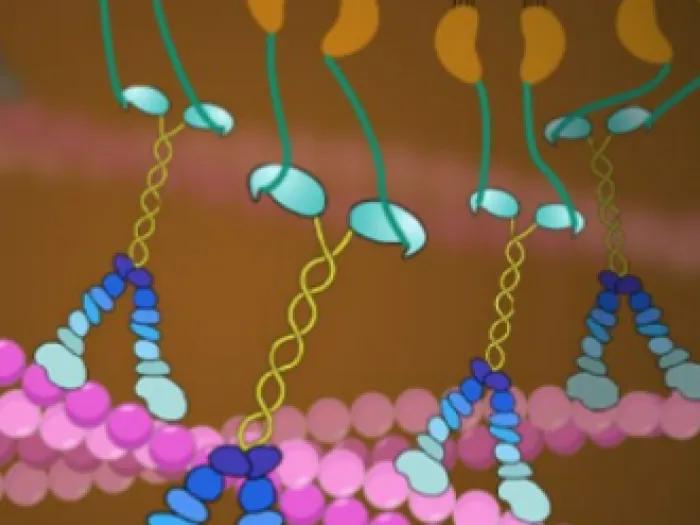
New view of cellular delivery trucks reveals unexpected hitch