2022 UM-SBDRC Annual Symposium
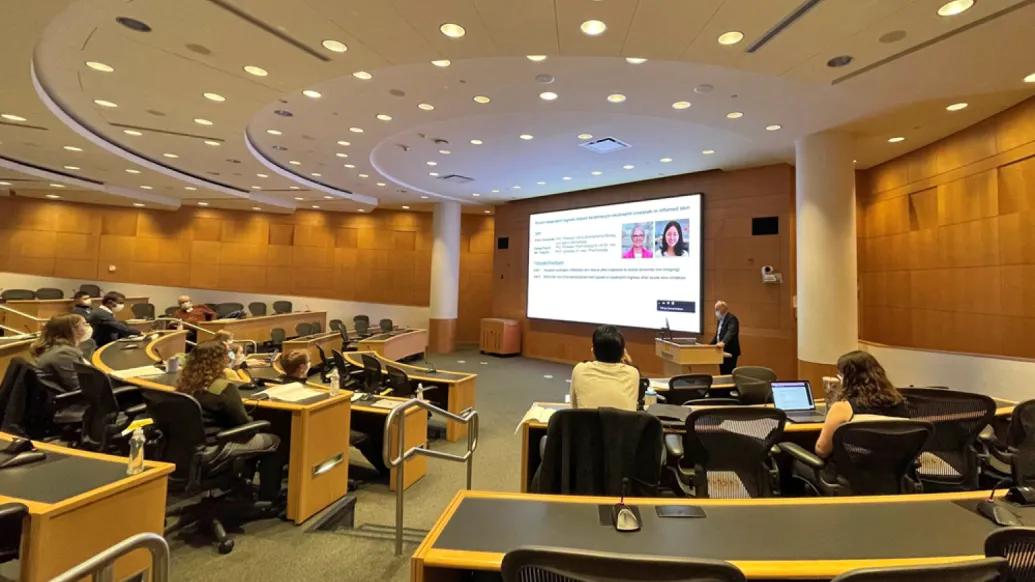
The UM Skin Biology and Diseases Resource-based Center (UM-SBDRC) hosted its 3rd Annual Symposium on March 3, 2022. Held as a "hybrid virtual" event, about 100 participants including Center members, other UM faculty researchers, postdoctoral research fellows, graduate students, house officers, medical school students and others, attended either in-person at Danto Auditorium or virtually via Zoom.
Robert L. Modlin, M.D., delivered the keynote address on "Acne: A Disease of Lipid Metabolism." Dr. Modlin is the Klein Professor of Dermatology in the Division of Dermatology, and Professor of Microbiology, Immunology and Molecular Genetics, at the David Geffen School of Medicine at UCLA. The Modlin lab is interested in the immunology of microbial infection, and focuses on the identification of novel mechanisms by which the innate and adaptive immune system combat microbial pathogens.
Symposium presentations also highlighted ongoing research sponsored by UM-SBDRC Pilot and Feasibility funding, and offered a preview of the UM-SBDRC Skin Genes Query, an online genomic database that will be made available to Center members in coming weeks.
In addition, 14 researchers presented their work via virtual poster sessions with breakout room Q&A discussion. Several posters were awarded 1st, 2nd, 3rd, and 4th place recognitions for outstanding work (see below).
Supported by a NIH NIAMS P30 award, the UM Department of Dermatology and Medical School, the UM-SBDRC fosters new and established investigators in their pursuit of innovative skin research. Those interested in cutting edge skin research are invited to join us at an upcoming Speaker Series lecture and to learn more about the Center’s resources and members.
Poster Presentation Winners:
1st Place: Enze Xing (Immunology Program Graduate Student Candidate, University of Michigan): "Investigating OX40L and its role in mediating cutaneous and systemic autoimmune disease"
2nd Place: Mrinal K. Sarkar, Ph.D. (Assistant Research Scientist, Dermatology, University of Michigan): "Keratinocytes sense and eliminate CRISPR DNA through STING induced expression of IFN-κ and induction of the cytidine deaminase APOBEC3G"
3rd Place: Grace Hile, M.D. (PGY-4 Resident, Dermatology, University of Michigan): "The Hippo pathway component WWC1 is a key regulator of apoptosis and photosensitivity in lupus keratinocytes"
4th Place: Shannon Estadt (Immunology Program Graduate Student Candidate, University of Michigan): "Interferon alpha promotes ultraviolet light-mediated keratinocyte apoptosis in a caspase-8 dependent manner"
4th Place: Suzanne Shoffner-Beck (Graduate Student Research Assistant, Biomedical Engineering, University of Michigan): "Lupus Fibroblasts exhibit exaggerated responses to inflammatory cytokines and upregulate pro-fibrotic collagens in patients who scar"
4th Place: Olesya Plazyo, Ph.D. (Research Investigator, Dermatology, University of Michigan): "Biologic Differences Between Preterm and Term Preeclampsia Revealed by Transcriptomic Analyses"
4th Place: Rachael Wasikowski (Research Area Specialist, Dermatology, University of Michigan): "Functional Analysis of lncRNAs within Psoriasis using Single Cell RNAseq"
4th Place: Ranjitha Uppala (Immunology Program Graduate Student Candidate, University of Michigan): "HERC6 negatively regulates type I interferon activity in keratinocytes through modulation of STING-IRF3 signaling"
Downloads
Featured News & Stories

Michigan Alzheimer’s Disease Research Center at AAIC 2026
Explore the Department of Human Genetics Annual Newsletter
How AI is helping emergency physicians learn from their patients
Research may help better predict outcomes in kids with congenital cytomegalovirus

A link between e-cigarettes and oral cancer