The Burden of Diabetic Peripheral Neuropathy
A review in one of the world’s top journals explores the impact of neuropathy and what steps need to be taken to alleviate its burden.
Author |
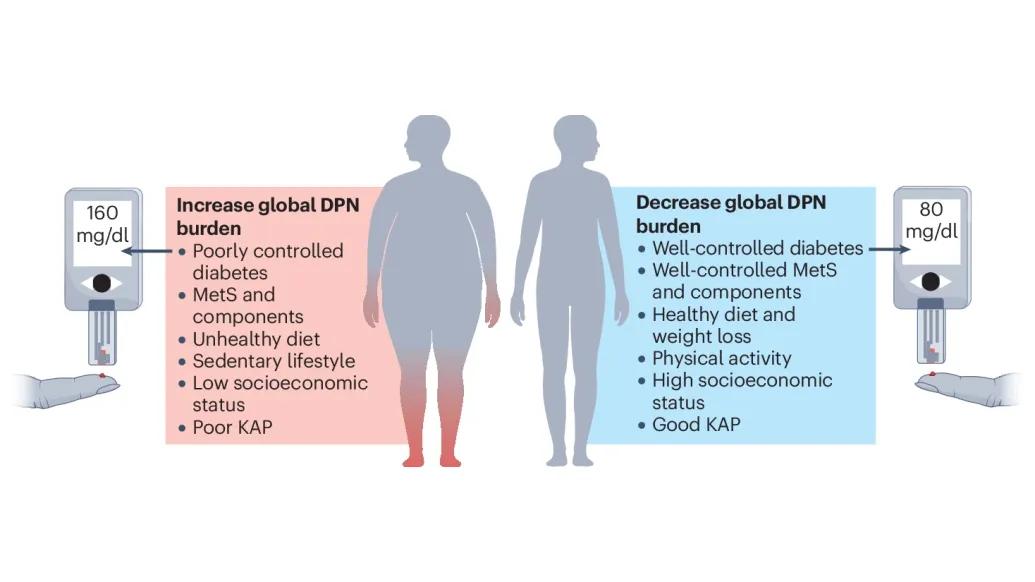
In 2021, 38.4 million people of all ages were estimated to have diabetes in the United States. That is more than 10% of the population. This number is only expected to grow. With diabetes comes a host of debilitating complications, including diabetic peripheral neuropathy (DPN), which strikes up to 50% of diabetes patients.
In this review in Nature Reviews Neurology, one of the world’s leading journals, a team led by Eva L. Feldman, M.D., Ph.D., James W. Albers Distinguished University Professor, highlights the global impact of neuropathy and steps that need to be taken to alleviate it.
Here are the key points from the review:
DPN is peripheral nerve damage arising as a complication of type 1 or type 2 diabetes.
DPN imposes a substantial clinical burden on patients, including impaired gait and neuropathic pain, as well as diabetic foot ulcers, which can necessitate lower-limb amputation if they become non-healing and infected.
From a socioeconomic perspective, patients with DPN incur substantially greater direct and indirect costs than patients with diabetes alone.
Determining the prevalence of DPN, including country-specific and region-specific variations, is crucial to inform public health policy and resource allocation.
Understanding DPN risk factors can guide treatment and prevention strategies, pivoting from purely glycemic (blood sugar) control to more multi-targeted metabolic control through diet and exercise lifestyle changes.
DPN education and awareness campaigns are needed to disseminate knowledge and encourage best clinical practice.
“As obesity and diabetes grow to near pandemic levels, so increases the burden of their complications, like diabetic peripheral neuropathy,” explains Dr. Feldman. “It’s paramount that efforts be made to understand risk factors and take steps to treat and prevent this debilitating condition.”
Additional authors: Masha Savelieff, M.D., from the University of North Dakota, Melissa Elafros, M.D., Ph.D., from the University of Michigan, Vijay Viswantathan, M.D., Ph.D., from the MV Hospital for Diabetes (India), Troels Jensen, M.D., from Aarhus University Hospital (Denmark), and David Bennett, MBBS, Ph.D., from the University of Oxford.
Funding from the National Institute of Diabetes and Digestive and Kidney Diseases, National Institute of Neurologic Disorders and Stroke, the Andrea and Lawrence A. Wolfe Research Professorship, the Wellcome Trust, the UK Medical Research Council, the European Union’s Horizon 2020 research and innovation programme, the Oxford Health for Medical Research Centre, the Norvo Nordisk Foundation, the John H. Doran Neuropathy Research Initiative, the Richard and Jane Manoogian Foundation, the Nathan and Rose Milstein Research Fund, the Sinai Medical Staff Foundation, and the A. Alfred Taubman Medical Research Institute.
Paper cited: Savelieff MG, Elafros MA, Viswanathan V, Jensen TS, Bennett DL, Feldman EL. The global and regional burden of diabetic peripheral neuropathy. Nat Rev Neurol. 2025 Jan;21(1):17-31. doi: 10.1038/s41582-024-01041-y. Epub 2024 Dec 5. PMID: 39639140.
In This Story

Eva L Feldman, MD, PhD
Professor

Melissa A Elafros, MD, PhD
Assistant Professor
Featured News & Stories

Family’s gift honors wife and mother, supports nephrology nurses

Regents approve Urology acting chairs, Cell and Developmental Biology interim chair

Comprehensive DNA sequencing reveals hidden drivers of cancer

First national survey by U-M clinician-researchers finds nearly all family medicine residencies teach menopause care

Many older adults make Medicare decisions quickly and most don’t change plans, poll finds