Can your diet improve brain health?

Author | Erin Fox

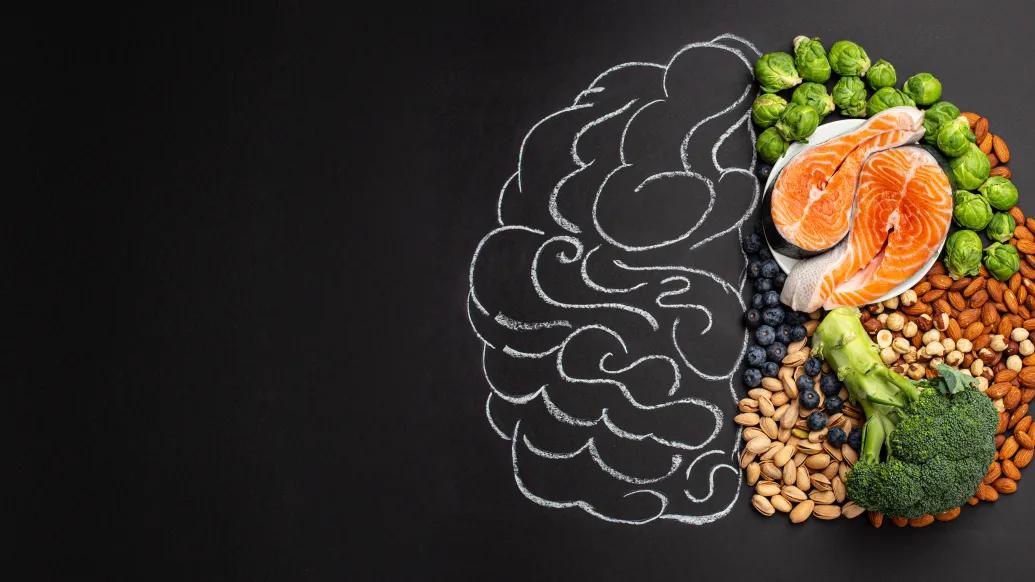
a chalk drawing of a brain with healthy food on one side
Adobe Stock

A healthy diet is key to maintaining a healthy lifestyle. And a healthy lifestyle is the foundation of taking care of your brain. But what foods make a diet healthy? And how do these foods impact your brain? 

In recent years, the research community has come to identify the MIND diet as the foundation to brain health. The MIND diet is a combination of the Mediterranean diet and the DASH diet (also known as Dietary Approaches to Stop Hypertension), both of which have been found to reduce the risk of cardiovascular conditions. Martha Clare Morris, PhD, a nutritional epidemiologist of Rush University and her colleagues developed the MIND diet based on information from years of past research about what foods and nutrients have positive and negative effects on the functioning of the brain over time. 
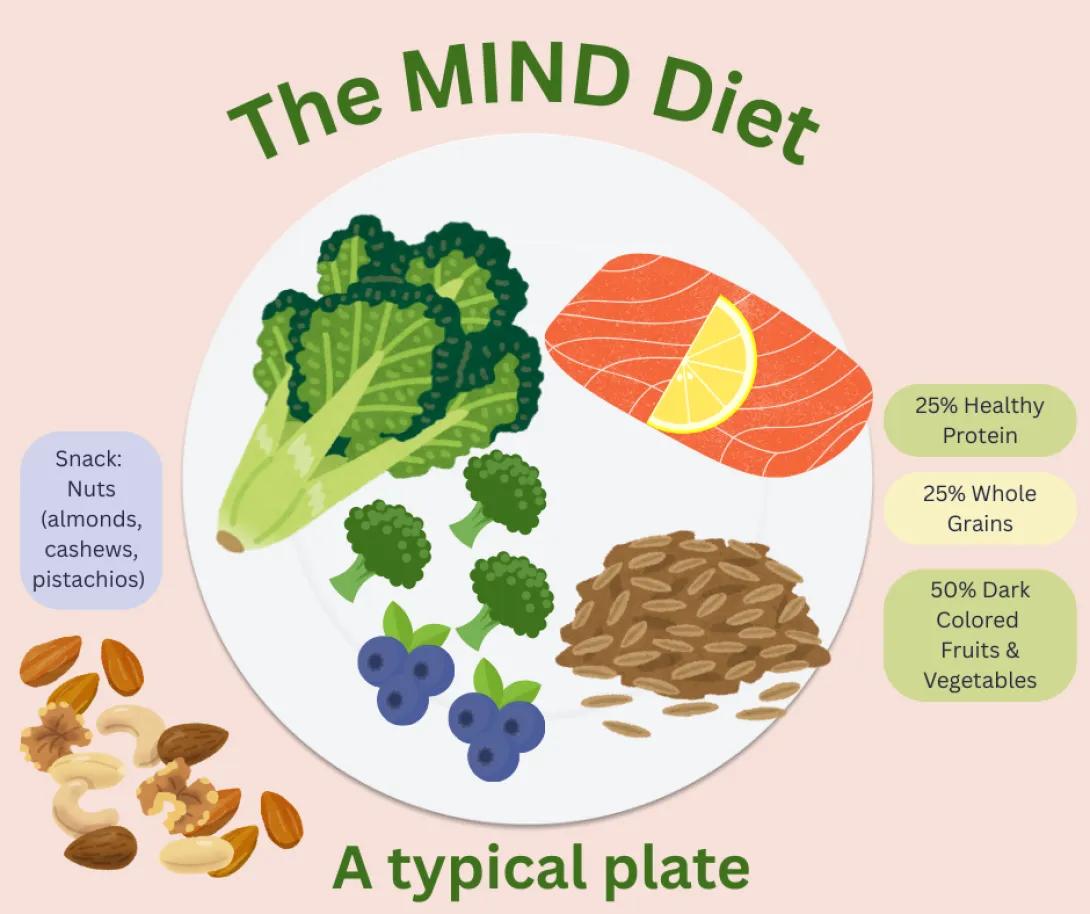
a graphic of a typical mind diet plate


The MIND diet includes at least three servings of whole grains, a salad and one other vegetable each day. It also involves snacking on nuts and eating beans every other day. Poultry and berries are recommended at least twice a week and fish at least once a week. Dieters are also recommended to limit eating designated “unhealthy foods” to avoid the devastating effects of Alzheimer's disease. 

The MIND diet has 15 dietary components, including 10 “brain-healthy food groups:”

  • Green leafy vegetables
  • Other vegetables
  • Nuts
  • Berries
  • Beans
  • Whole grains
  • Fish
  • Poultry
  • Olive oil
  • Wine 

The five unhealthy groups are:  

  • Red meats
  • Butter and stick margarine (less than one tablespoon a day)
  • Cheese (less than one serving a week)
  • Pastries and sweets
  • Fried or fast food (less than one serving a week)

But is there a specific food that is considered “the golden ticket” in supporting your brain? “Blueberries are one of the more potent foods in terms of protecting the brain,” said Morris. She also shared that strawberries have performed well in past studies of the effect of food on cognitive function.

According to Morris, Alzheimer’s disease is not unlike heart disease in that there appear to be “many factors that play into who get the disease,” including behavioral, environmental and genetic components. “Past studies have yielded evidence that suggests that what we eat may play a significant role in determining who gets Alzheimer’s disease and who doesn’t,” she said.

This is especially exciting because people who adhered, even moderately, to the MIND diet had a reduction in their risk of Alzheimer’s disease. Also, the longer someone adhered to this diet, the lower their risk of developing the disease. 

This means that people have the power to improve their brain health, and thereby reduce their risk of Alzheimer's disease, by making healthier food choices. 

As is the case with many health-related habits, including physical exercise, Morris said, “You’ll be healthier if you’ve been doing the right thing for a long time.” 

Get started today. Visit the resources below for MIND diet meal planning ideas and other healthy eating suggestions. 


Get started with MIND diet meal planning ideas at the link below: 

https://www.everydayhealth.com/diet-and-nutrition/diet/mind-diet-can-this-diet-plan-help-reverse-alzheimers-disease/


Other older adult healthy eating tips are available at the resources below: 

https://www.nia.nih.gov/health/healthy-eating-nutrition-and-diet/healthy-meal-planning-tips-older-adults

https://www.myplate.gov/life-stages/older-adults


Reference: 

https://www.rush.edu/news/diet-may-help-prevent-alzheimers

https://pubmed.ncbi.nlm.nih.gov/25681666/


More Articles About:

Neuroscience Brain Health Dementia Alzheimer's Disease

Related

Health Lab

Is everything you know about Alzheimer's wrong?

Amyloid’s role in Alzheimer’s disease and other forms of dementia doesn’t tell the whole story; other molecules and prevention via cardiovascular, social and cognitive.

Featured News & Stories

Health Lab Podcast in brackets with a background with a dark blue translucent layers over cells
Health Lab Podcast

Could preeclampsia become a thing of the past?

The findings position VGLL3 as a promising novel treatment target for the pregnancy-related condition.
Minding Memory with a microphone and a shadow of a microphone on a blue background
Minding Memory

Addressing Senior Social Isolation in the Community

In this episode, Matt & Lauren build off their previous conversation with Ashwin Kotwal about social isolation by speaking with Eve Lefkowitz, the Executive Director of the non-profit organization, A Conversation to Remember, which connects older adults – including those who live with cognitive decline – with young adult college students to combat the epidemic of social isolation and loneliness. Lauren & Matt learn about the populations this non-profit serve as well as perspectives on how to address social isolation with older adults.
Minding Memory with a microphone and a shadow of a microphone on a blue background
Minding Memory

The Impact of Social Isolation and Loneliness on Cognitive Health

In this episode we're going to discuss a topic that's increasingly recognized as central to cognitive health and social connection. We'll define what it is and what happens when it's missing. Social isolation and loneliness are now widely discussed as public health concerns, and evidence has really mounted that social disconnection has profound effects on health, including cognitive decline and dementia risk. To help us think through this, we're joined by Dr. Ashwin Kotwal, a geriatrician and health services researcher at UCSF and the director of the Social Connections and Aging Lab. His work examines how social relationships shape aging related outcomes, including cognitive health, disability, and mortality.
Minding memory above a microphone on a blue background
Minding Memory

Convoys of Caregiving: Arab American Families Living with Dementia

In this episode, Matt & Lauren speak with Kristine Ajrouch, PhD - a new member of our CAPRA leadership team. Kristine is a Research Professor at the Institute for Social Research whose work focuses on aging, health, immigration and family in the United Statues and the Middle East; social networks over the life course; and Arab American identity and well-being. Kristine discusses a recent article that examined an intervention to improve outcomes among Arab American caregivers who provide care to a family member living with dementia. She also shares what this work teaches us about caregiving as a family system rather than the responsibility of a single individual.
Minding Memory with a microphone and a shadow of a microphone on a blue background
Minding Memory

Neighborhood Income and Cognitive Health

Welcome back to Minding Memory! In today’s episode, Lauren & Matt speak with Dr. Laura Zahodne – a professor of psychology at the University of Michigan and an affiliate of the Institute for Social Research. She's a clinical neuropsychologist by training and studies how psychosocial experiences shape late life, cognitive health, and risk of neurodegenerative disease. Also, a new member of our CAPRA leadership team! In this episode, we’ll get to know Laura a little better and talk with her about one of her research studies, the Neighborhood Racial Income Inequality in Cognitive Health, which looks at the association between racial income differences and a variety of cognitive measures.
a brain with a heart on top on a red background
Research News

How is blood pressure connected to brain health?

Learn more about how blood pressure is connected to brain health. Also, hear Lenette Jones, PhD, RN, FAHA, FNAP discuss three strategies for maintaining healthy blood pressure.