
CDI Staff Spotlight: Abbey Tomlinson
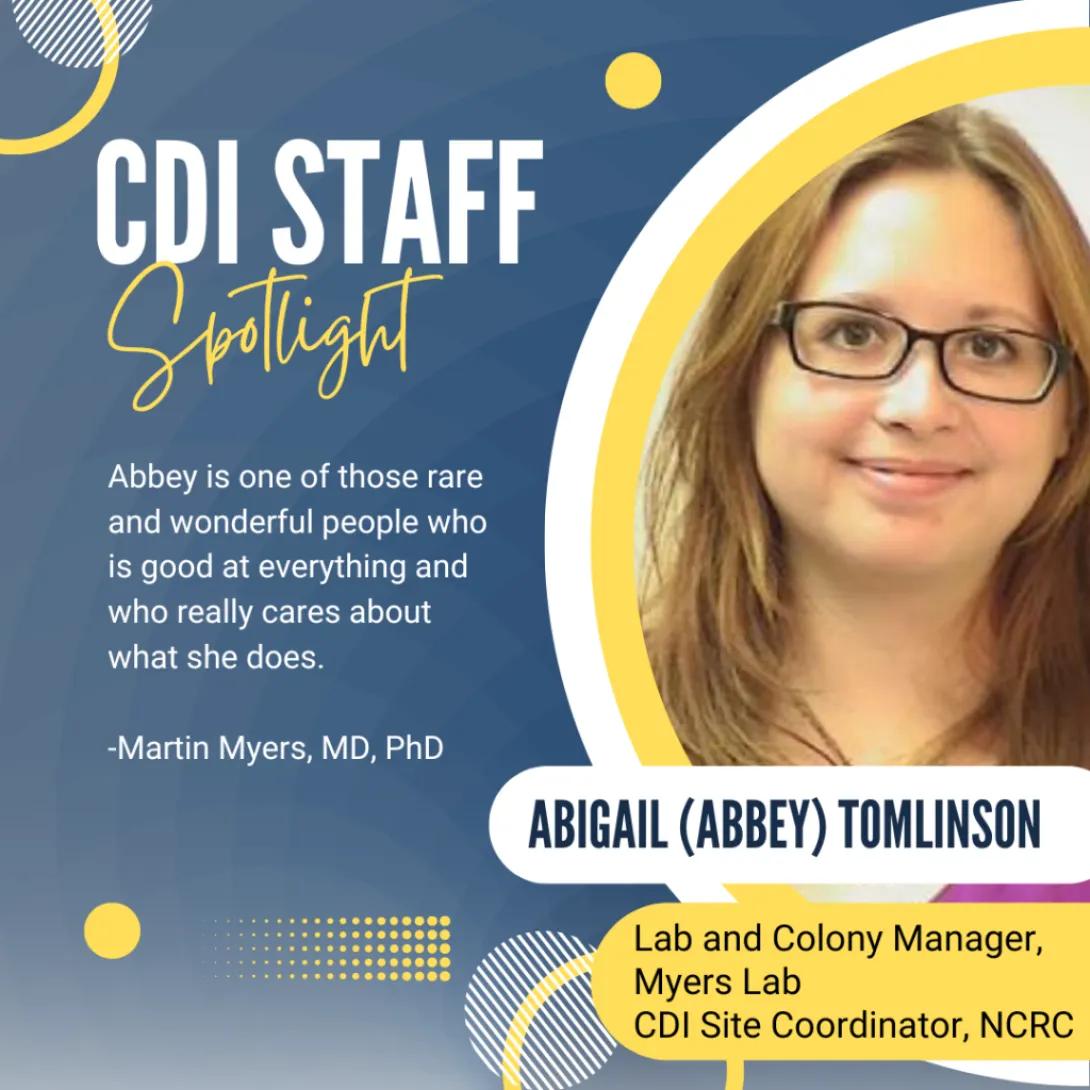
Abbey is one of those rare and wonderful people who is good at everything and who really cares about what she does. In addition to making sure that the common NCRC CDI resources work for everyone, she keeps the Myers lab running AND is an amazing scientist. Not only is she a fantastic experimentalist, but also she’s super-smart and -quick and somehow keeps the details of about a billion experiments straight. Abbey is a wonderful and interesting person; it’s a real delight to talk with her (and not just about science)! -Martin Myers, MD, PhD
Meet, Abbey Tomlinson, research-loving scientist with a passion for the arts. Abbey currently works as the lab and colony manager for the Myers Lab and CDI site coordinator for NCRC. We had the pleasure of chatting with Abbey to learn more about her role, what she enjoys most about her work, and her intriguing interests outside of research.
CDI: Can you share a little about yourself?
Abbey: I grew up in Portland, OR, which I think kind of fuels a lot of my creative background. Growing up, I always had two interests- science, particularly biology, and the arts, so painting, theater, those types of things. I pursued both interests throughout undergrad. Then, I got my first research job as an undergraduate at MSU working in plant pathology and entomology. That first experience in the lab really decided for me that science was the way I wanted to go, and research, specifically, was where I wanted to be.
About a year into that role, I started applying for grad school. My bachelor's is in microbiology, so I wanted to follow that theme. But, instead of focusing on how microbes cause disease, I wanted to look at how the body responds to disease. I started applying to immunology-based programs and was accepted to King's College in London where I did my master’s in immunology.
CDI: How did you find yourself here, at the University of Michigan?
Abbey: Right before I moved to London, I started dating my now husband who is from Michigan. So, I was trying to find a job relatively close to him as he was working in Detroit, at the time.
My interest for the longest was intestinal diseases and disorders. U-M got my on radar because Dr. Peter Higgins works here with the GI clinic at Michigan Medicine and runs his own research lab. In 2016, I started working as a lab manager in Deb Gumucio’s lab. Once she retired in 2019, I learned of someone in MEND who was looking for a lab manager and that’s how I met Martin.
CDI: What do you think sparked your interest in science in general, or your more specific interest in intestinal diseases?
Abbey: I always loved my science classes in grade school. I was the kid always playing in the mud or field trying to see what animals were out there. What really decided my interest in immunology and autoimmunity was when I was a freshman in high school and diagnosed with Crohn’s disease. At the time, there wasn’t a lot of understanding and very limited treatments available. In the process of learning about the disease and my own symptoms and care, I started reading more about the mechanisms of the disease and undergoing research on various treatments. I became absolutely fascinated with that.
CDI: What’s a typical day like for you as a lab and colony manager?
Abbey: All of our research is essentially done in mouse models or rodent models. So, the colony manager keeps tabs on the mouse colony and rodent colony that we have for our research. This used to entail setting up breeding, genotyping all of the animals, and the day-to-day maintenance of it. We now have two fantastic colony managers to handle the in-room stuff. So, a lot of the tagging, tailing, and setting up of the breeding schemes to generate experimental animals for the lab is done by Kelli Rule and Katrina Fox. I could not do my job without them.
Now, I have transitioned to more of a troubleshooting, supervisory role. I make sure the breeding schemes are set up to get the most efficient generation of experimental animals, looking at any inconsistencies with genotypes.
I also help design and create new animal models based on genes that we want to investigate with the assistance of Dave Olson in the molecular genetics core. I love being a resource for people in the lab and CDI; being able to troubleshoot and problem-solve.
CDI: Now that we know more about your role, we’re interested to learn more about you. What job would you enjoy if you weren’t working in the lab?
Abbey: I just recently had this conversation with a friend and the two things I came up with are carpentry and botany. I would love to work in carpentry, making functional but beautiful wooden pieces like bowls…that kind of thing. I also love to do preliminary gardening. I go on hikes and can identify every plant I see. It’s something I’ve always been interested in. I turned my entire backyard into a landscape that's beneficial to bees and birds.
CDI: What do you enjoy doing in your downtime?
Abbey: Gardening is a huge one. But I am also a bookworm. I tend to have 3 books going at once. I also paint, mostly acrylics and watercolors. Although I haven’t in a while, I love to sew. I like to make costumes and clothing. Lastly, I love to travel.
CDI: What is your favorite place you have traveled to so far?
Abbey: Definitely Copenhagen. I’ve been there 4 or 5 times.
CDI: Last question. What is something that most people don’t know about you?
Abbey: Probably the one thing we haven’t covered yet is that I used to be in theater. I used to act, stage manage, and design sets and costumes. In fact, if I didn’t get into MSU, I would have gone to NYU to major in theater.
Special thanks to Abbey for the fun interview (and the opportunity to meet her cat, Artemis)! If there is someone you would like to see featured in the CDI Staff Spotlight, please send their name and email to Ericka Hudson-Thomas at [email protected].
Featured News & Stories

A method to prevent falls before they happen

Weil researchers' AI-integrated smart CPR device named honorable mention in Fast Company’s 2026 World Changing Ideas Awards

What is looksmaxxing?
The Power of Mattering

