Collaboration Scholar completes yearlong research experience at Michigan Medicine
A visiting physician’s experience studying kidney disease at Michigan Medicine is set to benefit his patients back home in China and has paved the way for future collaborations.
Author |
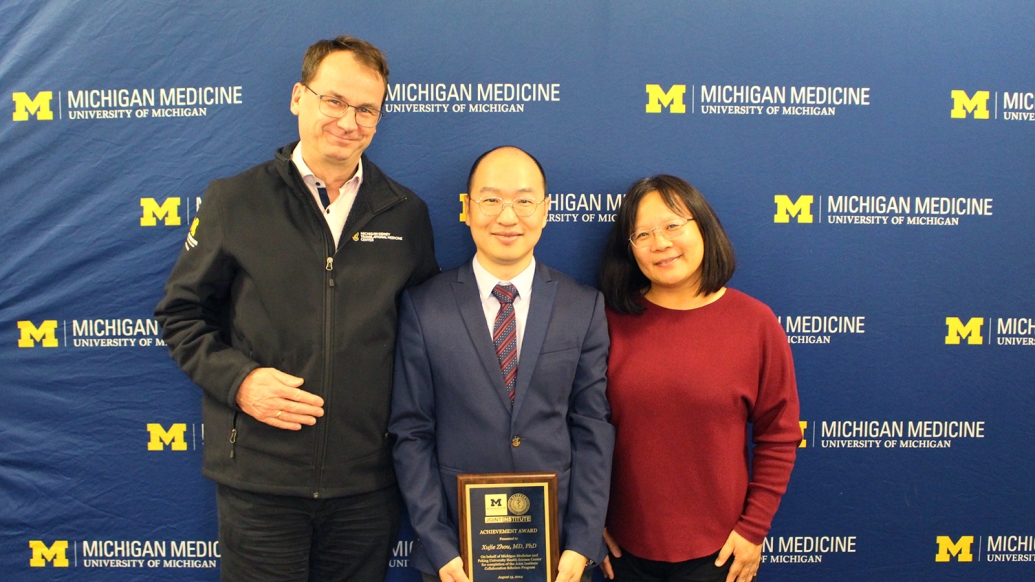
Xujie Zhou, an Associate Chief Physician in the Renal Division at Peking University First Hospital, spent much of the past year in Ann Arbor as a Collaboration Scholar through Michigan Medicine’s longstanding institutional partnership with Peking University Health Science Center (PKUHSC).
“All of the people I met were so full of passion. They inspired and encouraged me greatly,” Zhou said. “Having this time to focus on research was very refreshing.”
Zhou worked in the lab of Professors of Internal Medicine Matthias Kretzler and Wenjun Ju on a project exploring IgA nephropathy. Specifically, Zhou compared U.S. and Chinese patient datasets to understand how ethnicity plays a role in disease progression and the effectiveness of treatments.
He is the third researcher to spend time in Ann Arbor through the Collaboration Scholars program, which aims to bolster the partnership with Peking University Health Science Center, a longstanding institutional collaborator.
“We are not just training scholars but developing lifelong collaborations,” said Professor of Internal Medicine and Learning Health Sciences Joseph Kolars, who leads the collaboration with PKUHSC. “I’m really grateful for the people who believe in this program, not only the mentors, but the trainees who leave their work and their families back home to come and spend time with us.”
During his program, Zhou was also able to attend and showcase his work at prominent nephrology conference in San Diego and human genetics conference in Denver, and he has been invited to participate in an international IgAN symposium in Europe next year. Importantly, PKUHSC and Kretzler’s team have worked to develop drug candidates targeting kidney disease and international precision clinical trials that include large cohorts of Asian patients.
“It is important to understand and recognize how differently the disease is presenting itself around the world,” said Kretzler. “The drugs work differently in China than they do elsewhere. Focusing on the genetic reasons for that is very important.”
Featured News & Stories

Helping an employee-turned-patient overcome a brain tumor

Shipt gift helps address food insecurity
Family Medicine researchers find clinicians question Black expectant moms more about cannabis use than white moms
BRCF Flow Cytometry Service Enhancements Coming July 1
Celebrating outstanding teaching and research at the 2026 Endowment for Basic Sciences Awards