Fifth Eye’s AHI-PI Demonstrates Ability to Detect Patient Deterioration Prior to Rapid Response Team Events: New Study Published in PLOS Digital Health
Analytic for Hemodynamic Instability – Predictive Indicator (AHI-PI), from Weil Institute spin-off Fifth Eye, outperforms traditional vital sign measurements in early detection, offering a 26-hour lead time and expanding applications beyond the ICU.
Author |
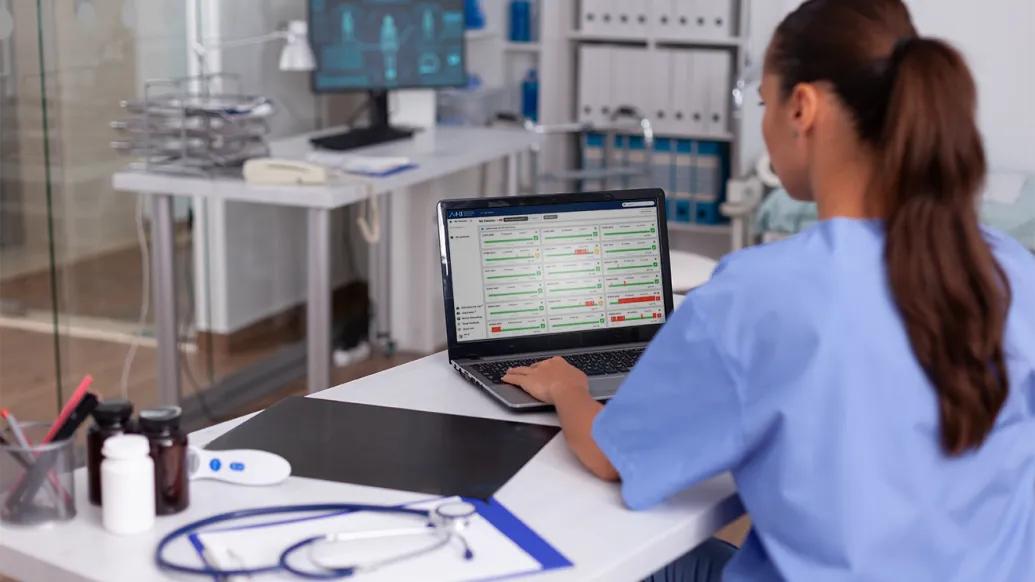
ANN ARBOR, MI – Fifth Eye, Inc., a spin-off of the Max Harry Weil Institute for Critical Care Research and Innovation, announced the publication of a new study in the peer-reviewed journal, PLOS Digital Health, demonstrating the power of the company’s Analytic for Hemodynamic Instability-Predictive Indicator (AHI-PI) in predicting patient deterioration before a Rapid Response Team (RRT) event. An RRT event occurs when a dedicated team of healthcare professionals is mobilized to respond to a patient's critical deterioration. Detecting patient deterioration early is crucial, as it provides clinicians with more time to intervene, potentially preventing crises, improving patient outcomes, and reducing hospital costs.
The AI-driven, FDA-cleared analytic, based on monitoring ECG waveforms from a single ECG lead, demonstrated that its capabilities not only excel in high-acuity environments like the ICU but also hold promise for broader application in step-down units and general hospital wards, where continuous patient monitoring is more limited. By potentially extending its use with wearable ECG technology, AHI-PI could offer continuous, non-invasive monitoring that proactively identifies at-risk patients, enabling earlier interventions and reducing the need for more intensive care.
Key Findings:
Superior Detection: AHI-PI identified risk in 93% of RRT events, significantly outperforming traditional vital signs (blood pressure, heart rate, respiratory rate), which detected risk in only 42% of cases.
Extended Lead Time: On average, AHI-PI provided over 26 hours of advanced warning before an RRT event, giving clinicians critical time to intervene and potentially prevent serious outcomes.
Versatile Application: Whether in high-acuity settings like the ICU or general hospital floors with less monitoring, AHI-PI consistently outperformed traditional methods, demonstrating its versatility and reliability.
Potential for Wearable Integration: The study opens up possibilities for leveraging validated wearable ECG patches to extend AHI-PI's continuous monitoring capabilities to patients in non-ICU settings, further enhancing early detection efforts.
The study’s lead author, Kevin Ward, MD, Executive Director of the Weil Institute and Professor in the Departments of Emergency Medicine and Biomedical Engineering at the University of Michigan, stated, “This study highlights the transformative potential of machine learning in patient care. AHI-PI’s ability to predict critical events well in advance could allow us to intervene earlier and more effectively, marking a major step forward in improving patient safety. Its performance even in the highly monitored ICU setting was significant and offers opportunities for improved decision making in the growing number of tele-ICUs.”
AHI-PI’s ability to predict critical events well in advance could allow us to intervene earlier and more effectively, marking a major step forward in improving patient safety. Its performance even in the highly monitored ICU setting was significant and offers opportunities for improved decision making in the growing number of tele-ICUs.
Kevin Ward, MD
Executive Director, Weil Institute
Professor, Emergency Medicine and Biomedical Engineering
Co-author Ashish K Khanna, MD, MS, FCCP, FCCM, FASA Professor & Vice Chair of Research, in the Department of Anesthesiology, Section on Critical Care Medicine, at Wake Forest University, School of Medicine, added, "In general wards, where patient monitoring often relies on periodic spot checks, there is a critical need for continuous, real-time insights to catch early signs of deterioration. The findings from this study reinforce the game-changing role of advanced analytics in clinical practice. By detecting patient deterioration well before traditional vital signs, real- time pattern analysis of a continuous streaming ECG waveform provides a critical window of opportunity for intervention, potentially preventing rapid declines. This not only improves patient outcomes but also enhances healthcare efficiency."
The full article can be found in PLOS Digital Health at the following link: https://journals.plos.org/digitalhealth/article?id=10.1371/journal.pdig.0000465
Disclosures
Dr. Ward is an inventor of AHI and has equity in Fifth Eye Inc.
About the Weil Institute
The team at the Max Harry Weil Institute for Critical Care Research and Innovation (formerly the Michigan Center for Integrative Research in Critical Care) is dedicated to pushing the leading edge of research to develop new technologies and novel therapies for the most critically ill and injured patients. Through a unique formula of innovation, integration and entrepreneurship that was first imagined by Weil, their multi-disciplinary teams of health providers, basic scientists, engineers, data scientists, commercialization coaches, donors and industry partners are taking a boundless approach to re-imagining every aspect of critical care medicine. For more information, visit weilinstitute.med.umich.edu.
About Fifth Eye
Fifth Eye Inc. based in Ann Arbor, MI develops intuitive, real-time clinical analytics based on physiologic waveforms to improve outcomes and reduce costs. The AHI System™ is the only FDA-cleared clinical decision support software that continuously predicts the risk of hemodynamic instability earlier than vital signs. Using real-time, continuous ECG lead II data feed or a validated wearable patch, AHI automatically performs a series of advanced signal processing analyses, extracting HRV patterns that indicate a patient’s hemodynamic status. AHI System helps hospitals prevent adverse events, improve patient throughput, and better allocate valuable clinical staff resources to avoid nursing burnout. Fifth Eye's machine-learning technology is licensed from the University of Michigan. For more information, visit fiftheye.com.
In This Story

Kevin Ward, MD
Professor
Featured News & Stories
Nerf gun accident causes retinal detachment in pediatric patient
PMOS is the New PCOS
Couples’ Snoring Solutions Guide: Here’s What Causes Snoring and How to Stop It Disrupting Your Sleep
MNI Leadership Message: September 2026
FDA-approved drug offers hope for patients with polycythemia vera, a rare bone marrow disorder