New from the Mott Poll: Kids increasingly exposed to noise health risks via earbuds and headphones
ANN ARBOR, Mich. – While it’s not surprising to spot teens wearing headphones and earbuds, it’s also becoming a widespread trend among younger children, a national poll suggests.
Elementary and middle school-aged kids are commonly exposed to noise exposure, with two in three parents saying their child ages 5-12 uses personal audio devices.
Among parents whose children use headphones and earbuds, half say kids spend at least an hour a day using them while one in six say a typical day for their child includes at least two hours of use, according to the University of Michigan Health C.S. Mott Children’s Hospital National Poll on Children’s Health.
“Over recent years we’ve mostly been concerned about teens overusing audio devices. But earbuds have become increasingly popular and prevalent among younger kids, exposing them to more intense noise on a regular basis,” said Susan Woolford, M.D., M.P.H., Mott pediatrician and co-director of the Mott poll.
“Noise exposure risks to young children have historically involved loud singular events like concerts or fireworks, but parents may underestimate the potential harm from excessive use of listening devices. It may be difficult to know whether their child’s exposure to noise is healthy.”
Children are most likely to use these devices at home, school and in the car, report findings show. About a fourth of parents also say children occasionally use audio devices on airplanes while less than 10% say kids use them on the bus, outside or in bed.
Half of parents agree that headphones or earbuds help keep their child entertained.
The American Academy of Pediatrics released a statement in 2023 on the need to reduce noise risks to children, with increasing evidence that children and teens may be more exposed through personal listening devices.
Prolonged or extreme exposure to high volumes of noise can result in long term health issues, including hearing loss or tinnitus, Woolford says.
“Young children are more vulnerable to potential harm from noise exposure because their auditory systems are still developing. Their ear canals are also smaller than adults, intensifying perceived sound levels,” Woolford said.
“Tiny hair cells inside the inner ear pick up sound waves to help you hear. When these get damaged or die, hearing loss is irreversible.”
Noise exposure among children can also affect their sleep, academic learning, language, stress levels and even blood pressure, she adds.
More parents of children aged 9-12 years than 5-8 years report their child uses headphones or earbuds and daily use was also more likely to be higher among the older age group, the poll suggests.
But only half of parents share they’ve tried to limit their child’s audio device usage, citing strategies such as asking the child to take a break, having set hours for use and using a timer.
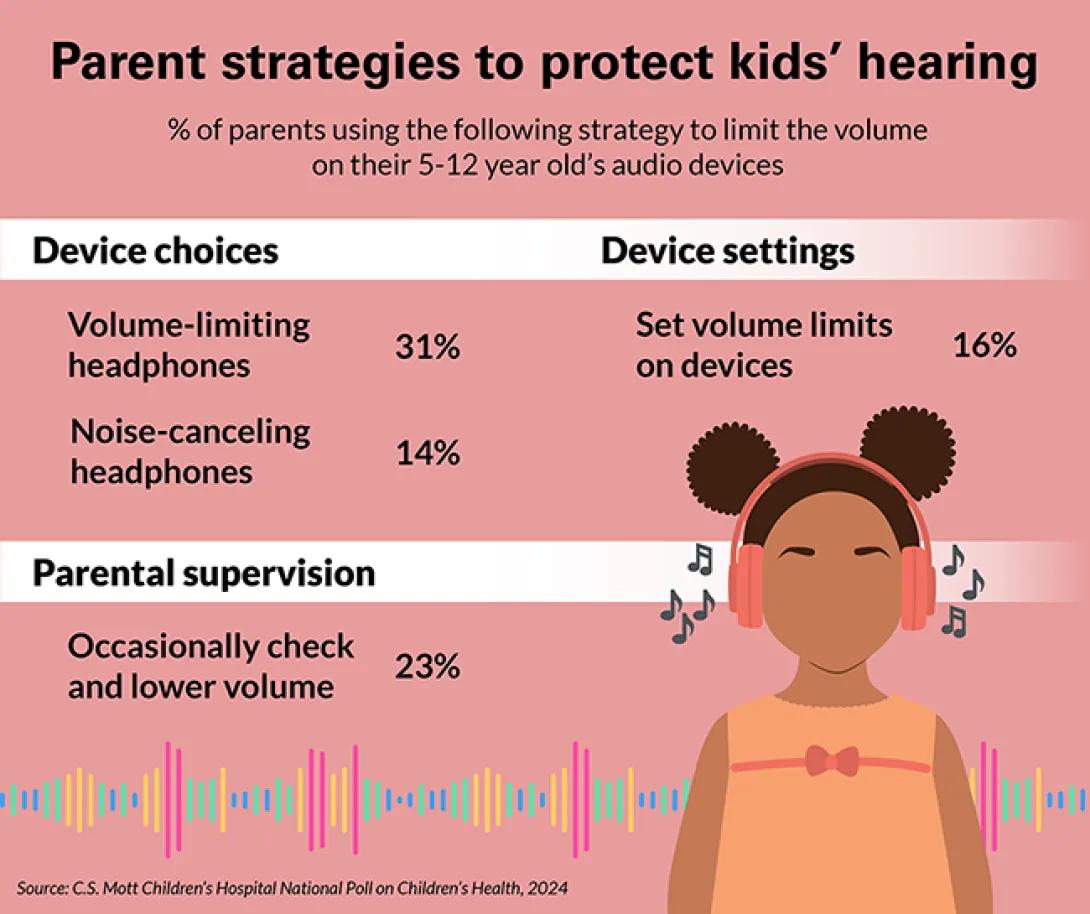
Parents whose child uses headphones for more than two hours a day are also less likely to set time or volume limits, compared to parents who report less headphone use for their child.
Woolford offers four tips to reduce risks of noise exposure to children through headphones and earbuds:
1. Monitor volume levels
Parents can minimize the negative impact of audio device usage by monitoring and adjusting the child’s volume and time on devices, Woolford says.
She recommends parents follow the 60/60 rule – children should be limited to no more than 60 minutes of audio devices a day at no more than 60% of the maximum volume.
The sound level on listening devices that are less than 70 dBA (relative loudness of decibels heard) are very unlikely to cause noise-related damage.
“A good way to tell if an audio device is too loud is if a child wearing headphones can’t hear you when you’re an arm’s length away,” she said.
Parents can also limit their child’s risk by setting specific hours for audio device use or using a timer to keep track.
2. Use noise cancelling or volume limiting headphones
Parents should consider the risk of noise exposure when purchasing audio devices for their child by checking the information on device packages to identify products that limit the volume.
But some products marketed as ‘kid safe,’ Woolford warns, do not limit the volume to 70 decibels.
However, children should avoid using noise-cancelling listening devices in situations when perception of sounds is crucial for safety.
“Noise-cancelling devices may help prevent children from increasing the volume to levels that are too high,” Woolford said. “But these devices shouldn’t be used when a child is engaged in activities where it’s important to hear their surroundings for their safety, such as walking or bike riding.”
3. Ensure kids take breaks from personal listening devices
Parents should help children intentionally have daily “device-free” time, Woolford says. This may involve putting away or locking the child’s audio devices when time limits are up.
They may also encourage kids to enjoy things like music on a low volume in their rooms instead of using earbuds to reduce noise intensity.
Personal audio devices should also be avoided when children are sleeping or at bedtime, Woolford says.
4. Be mindful of early signs of hearing loss
If parents feel their child may be at risk of hearing loss due to using audio devices, Woolford recommends checking with a pediatrician, an audiologist, or an ENT (ear, nose and throat) specialist.
“Early signs of hearing loss may include asking for repetition, hearing ringing noises often, speaking loudly to people nearby, delayed speech, or lack of reaction to loud noises,” Woolford said.
“Healthcare providers may be of assistance to parents by offering a simple explanation about hearing loss to help the child understand the reasons for limiting their use of audio devices.”
Featured News & Stories

Dean Wang Receives Council on Genomic and Precision Medicine Medal of Honor

Welcoming Colleen McLaughlin, assistant professor, to CDB

Patient with rare form of diabetes finds answers in genetic testing, clinical trials

How have diagnostic and treatment decisions for prostate cancer changed in recent years?

Small comforts make a world of difference