A New Study of Light Sensitivity in Prechter Participants
A new study in collaboration between the Prechter Program and the Sleep and Circadian Research Lab, "Light Sensitivity in Bipolar Disorder: A Potential Driver of Variability in Sleep, Mood and Energy."

There is some evidence that people with bipolar disorder, particularly those with bipolar I disorder, are more sensitive to light. For example, it is generally recognized that mania is more likely to occur in spring when the days become longer. In some rarer cases, morning light therapy, which is sometimes used as an antidepressant, can elicit mania. Since the 1980s, 10 studies have examined light sensitivity in people with bipolar disorder by monitoring how much their melatonin secretion at night is suppressed by nighttime light exposure. Seven out of the 10 studies found that people with bipolar I disorder are more sensitive to light, regardless of the medications they’re taking.
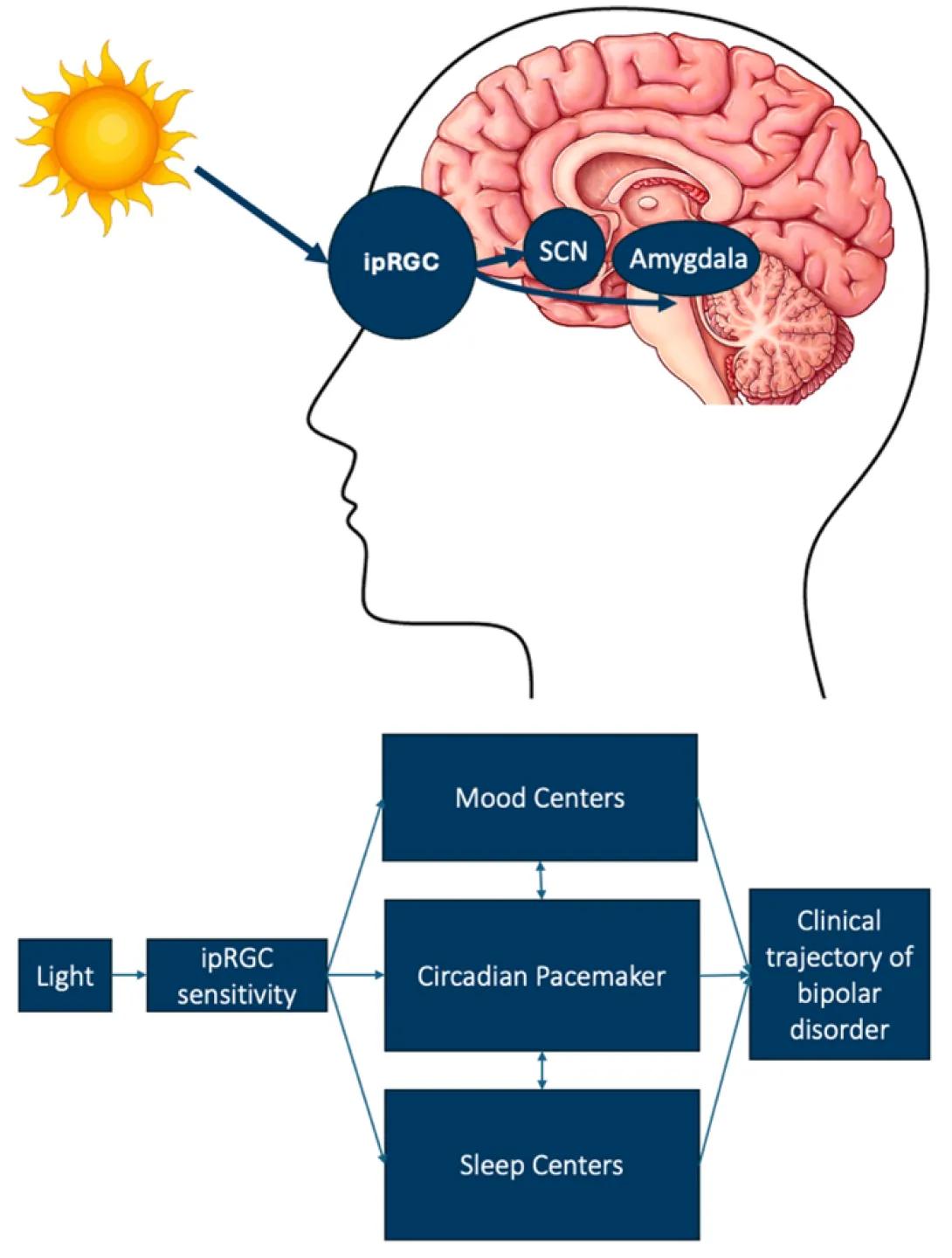
Since these earlier studies were conducted, our understanding of the circadian photoreceptor in the eyes and how to best measure its sensitivity has markedly improved. In the early 2000s, specialized cells in the retina, called intrinsically photosensitive retinal ganglion cells, or ipRGCs, were discovered. Later research showed that separately from rods and cones— the photoreceptors in the eye used for vision — the ipRGCs transmit the light signal to many different areas of the brain, including to circadian, sleep, and mood centers (see Figure 1).
In addition, a newer measure called the post-illumination pupil response (PIPR) is now considered a more direct measure of ipRGC sensitivity to light. This measure looks at how much the pupil constricts after a brief flash of light. No study to date has measured PIPR in people with bipolar disorder in the time period around usual nighttime sleep. Light exposure, and thus light sensitivity just before and just after the nighttime sleep period, has an impact on circadian rhythms, sleep, and mood — all important factors in bipolar disorder. As such, there is a need to assess PIPR in bipolar disorder and determine whether it impacts sleep, mood, and energy.
Drs. Helen Burgess and Sarah Sperry were recently awarded a research grant from the National Institute of Mental Health for a study titled Light Sensitivity in Bipolar Disorder: A Potential Driver of Variability in Sleep, Mood and Energy. The researchers aim to measure PIPR in Prechter participants, and they are specifically looking for people with bipolar I disorder and unaffected controls — people who do not have bipolar disorder — to participate. They determine if light sensitivity is higher in people with bipolar I disorder versus unaffected controls, and examine how light sensitivity affects subsequent variability in sleep, mood, and energy — key clinical targets in the treatment of bipolar disorder (see Figure 1).
This study takes three weeks and includes four visits to the Sleep and Circadian Research Laboratory at the Rachel Upjohn Building.
- Visit 1: Eligibility check and tour of lab
- Visit 2: Receive Fitbit and start daily logs
- Visit 3: Overnight in the sleep lab (no wires or sleep recording), start daily surveys
- Visit 4: Return equipment, review data
Staying overnight in the Sleep and Circadian Research Laboratory is necessary for measurement of light sensitivity just before and after participants’ usual sleep times. The lab bedrooms are designed to be welcoming and comfortable in order to provide participants with the best possible experience. These findings will also inform future therapeutic trials aimed at testing practical light exposure recommendations (including use of blue light blocking glasses) to shift circadian timing earlier and reduce sleep and mood variability in bipolar disorder.
Special appreciation to Karen Glorio, Bill Zirinsky, and Ruth Schekter who provided generous gifts to expand the grantfunded research in bipolar disorder and circadian rhythms.
Featured News & Stories
Scott Pranger ALS Center Symposium celebrates hope, innovation, and a commitment to ending ALS
Rebecca Nause-Osthoff, MD, named Associate Chair for Pediatric Anesthesiology

Prechter Program featured on Michigan Medicine’s ‘The Wrap’ podcast

Sarah Sperry, Ph.D., featured on ‘Healthy Minds’ to discuss managing bipolar disorder

Commentary: Global health research makes America richer and healthier