Rhythm and Blues: Changing the Clock to Breakthrough in Bipolar Disorder
Learn about a new project from the Prechter Program that looks at sleep and mood instability in bipolar disorder.
It is increasingly recognized that many individuals with bipolar disorder have disrupted circadian rhythms. Circadian rhythms can be thought of as the body’s internal clock — it helps us to know when to go to bed and wake up by controlling various biological processes in the body that promote energy or sleepiness. Researchers with the Prechter Program have found that a high proportion of individuals with bipolar disorder are characterized by a delayed sleep phase. People with a delayed sleep phase tend to have difficulty falling asleep, often not until 2 or 3 a.m. or later, and have difficulty waking up at the times required for work or school, which can cause disruption to their lives. Their sleep-wake cycle is essentially shifted to undesirable times. Individuals with bipolar disorder and a delayed sleep phase are at greater risk for experiencing depressive episodes and day-to-day mood instability.
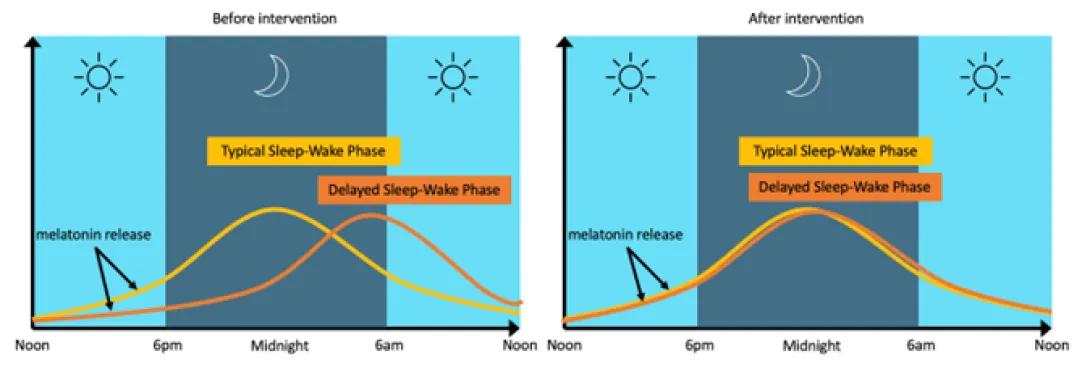
Drs. Leslie Swanson, Sarah Sperry, Helen Burgess, and Melvin McInnis recently won third place ($50,000) at the inaugural Psych Tank Funding Competition launched by the Eisenberg Family Depression Center to conduct a pilot project, “Rhythm and Blues: Changing the Clock to Breakthrough in Bipolar Disorder.” The goal of this project is to test whether a strategic intervention that targets delayed sleep phase will improve depression and mood instability in bipolar disorder. The intervention involves taking a low dose of a safe and affordable supplement, melatonin, in the afternoon alongside a prescribed bedtime schedule. Drs. Swanson and Sperry have been working over the last three months to develop the pilot project, which will enroll participants in the intervention for approximately one month. Participants will meet with study clinicians virtually to monitor progress and adjust the time that they take their melatonin and get in bed. During the intervention, they will answer daily questionnaires about their sleep and mood on a smartphone app. They will also provide saliva samples so that the researchers can determine whether the circadian rhythm is actually shifting biologically. Drs. Swanson and Sperry began recruitment of participants in August 2023.
Featured News & Stories
Research may help better predict outcomes in kids with congenital cytomegalovirus

A link between e-cigarettes and oral cancer

Celebrating the Anesthesiology Residency Class of 2026

LGBTQ+ Aging in America

MyVoice poll finds youth have mixed perceptions of oral nicotine pouches