Type 2 Diabetes Increases the Risk of Serious and Life-Threatening Conditions Among Adults with Traumatic Spinal Cord Injury
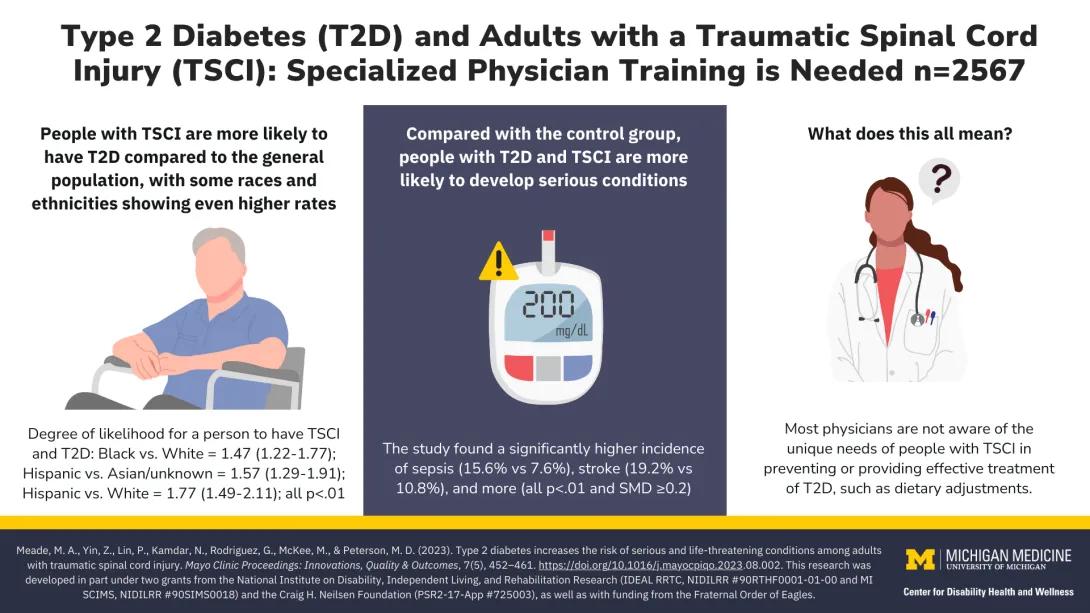
About 38 million adults in the United States have type 2 diabetes (T2D), a complex metabolic disease that impairs the body’s ability to produce or respond to the insulin hormone. For adults with a traumatic spinal cord injury (TSCI), T2D has been linked to a delayed healing of pressure sores, higher incidence of microvascular and macrovascular conditions, and higher health care costs. Adults living with TSCI have a 66% higher risk of developing T2D than the general population, and like the general population, having this disease carries an increased risk of developing serious and life-threatening conditions.
A study led by Michelle Meade, PhD, Director of the University of Michigan Center for Disability Health and Wellness and Principal Investigator of the Investigating Disability factors and promoting Environmental Access for healthy Living Rehabilitation Research and Training Center (IDEAL RRTC) and Michigan Spinal Cord Injury Model System (MI-SCIMS) research projects, found that adults with TSCI and T2D had a greater chance of developing a range of dangerous conditions. The research found significant higher rates of sepsis, heart attack, bone infection, and stroke. Black or Hispanic individuals were significantly more likely to have been diagnosed with T2D compared to adults who identified as White or Asian and were, therefore, more likely to develop any of the conditions associated with TSCI and T2D.
Implications
For adults living with SCI, this study highlights the importance of regular screening for T2D and attention to T2D management. Moreover, people with SCI need to be aware of their unique symptoms and concerns when identifying and managing the condition.
For health care providers, this study emphasizes the importance of identifying and partnering with patients with SCI to prevent and manage chronic health conditions for which they are at higher risk. Type 2 diabetes is a serious condition but one that can be prevented and managed. Doing so requires regular screening and tailoring clinical standards to this patient population. The authors cited two potential examples:
- A T2D diagnosis may be missed due to masked symptoms, such as excessive urination accounted for by catheter use.
- In terms of managing the condition, glucose monitoring tools built for individuals with reduced fine motor movements should be made available.
Physicians are invited to review the American Diabetes Association’s 2023 Standards of Care in Diabetes, which includes all of the ADA's current clinical practice recommendations for effective T2D care and management.
A patient-friendly version is available here.
For more information:
Meade, M. A., Yin, Z., Lin, P., Kamdar, N., Rodriguez, G., McKee, M., & Peterson, M. D. (2023). Type 2 diabetes increases the risk of serious and life-threatening conditions among adults with traumatic spinal cord injury. Mayo Clinic Proceedings. Innovations, Quality & Outcomes, 7(5), 452–461. https://doi.org/10.1016/j.mayocpiqo.2023.08.002
This research was developed in part under two grants from the National Institute on Disability, Independent Living, and Rehabilitation Research (IDEAL RRTC, NIDILRR #90RTHF0001, and MI SCIMS, NIDILRR #90SIMS0018) and the Craig H. Neilsen Foundation (PSR2-17-App #725003), as well as with funding from the Fraternal Order of Eagles.
Featured News & Stories

A concussion expert and football father discusses why he values teamwork over zero-risk

Foundation gift inspires additional gifts to strengthen youth mental health care

Talent show brings joy to kids at children’s hospital
Max Wicha set to retire after 46 years
Michigan Medicine Urology Earns Coloplast Titan Center of Excellence Designation