Honoring the lasting legacy of Mr. William K. Brehm
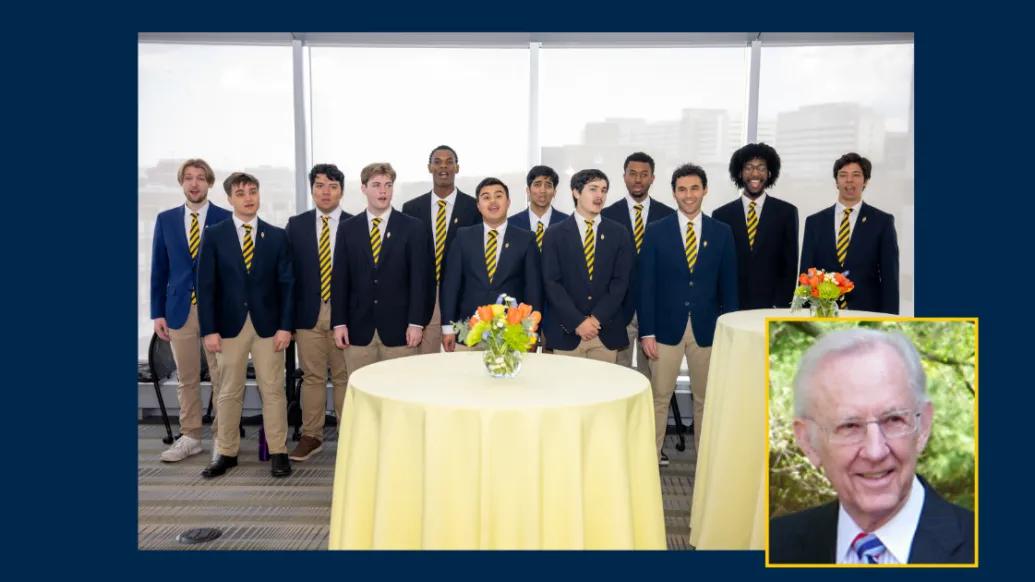
In April, the Brehm Center hosted a heartfelt Celebration of Life for Mr. Bill Brehm. Held at the Brehm Tower, the memorial event brought together his family, friends, colleagues, and members of the U-M community to honor a life defined by generosity, vision, multiple talents, and teamwork.
Dr. Martin Myers, director of the Diabetes Institute, and Molly Dwyer-White, director of the Brehm Center, opened the celebration with personal reflections on Mr. Brehm’s legacy and the meaningful relationships he built across the university. As Molly stated, “Although Bill and Dee literally built structures across campus…. they made one thing unmistakably clear – it was never about the buildings. It was about the people and teams inside of them and the limitless potential of what people can do when they work together.”
Mr. Brehm was remembered not only for his extraordinary philanthropy but also for the spirit behind it. His unwavering belief in collaboration and his deep commitment to giving back created lasting opportunity and impact.
Among the speakers was Dr. Peter Arvan, the William K. and Delores S. Brehm Professor of Type 1 Diabetes Research, who spoke about Mr. Brehm’s influence on his work and his decision to come to U-M. He highlighted the lasting role Mr. Brehm has played in advancing diabetes research and discovery across the country through his infectious vision.
Dr. Scott Soleimanpour, the Larry D. Soderquist Professor—a professorship named in honor of Dee Brehm’s late brother—shared insights into the future of diabetes research at the Brehm Center. He highlighted the center’s use of advanced technologies, including a shift from mouse to human-based models through the launch of a new human islet core with pseudoislet capabilities. Dr. Soleimanpour also discussed the use of stem cell-derived islet cells to study diabetes and explore new strategies to improve cell function or protect transplanted cells from immune system attack.
Dr. George Mashour, Senior Associate Dean for Faculty and Faculty Development, expressed gratitude for Mr. Brehm’s focus on research as a public good and his commitment to translation in order to improve human health.
Dr. Hussein Hamid, an orthopedic surgeon and former Brehm Scholar and Brehm Medical Scholar, also shared how the generosity of Mr. Brehm and his family shaped not only his life, but the lives of all the Fordson High students fortunate enough to receive the scholarship support. Dr. Hamid shared, “The Brehm Scholarship ignited something…it brought an opportunity to our community of untapped potential- allowed people to pursue their dreams and realize they could be amongst the leaders and best.”
Dr. Paul Lee, Chief Physician Executive of the U-M Medical Group and Vice Dean for Clinical Affairs at the medical school, reflected on the Brehms’ deep values and faith, and how those principles continue to inspire work across U-M and beyond through a shared commitment to “pay it forward.”
Mr. Brehm’s daughter, Lisa Ellis, moved those in attendance as she spoke of her father. “I love that you got my dad. You listened to him, learned from him…and that means a lot to my family,” she shared. Ellis also expressed appreciation for the team’s ongoing commitment to advancing diabetes research, work that gave her father a deep sense of purpose in the last twenty years of his life. She reflected that his involvement in the work was incredibly meaningful to him, and that the team’s continued dedication ensures his legacy will live on.
The evening concluded with a special performance by the U-M Men’s Glee Club, honoring Mr. Brehm’s time as a member of the a cappella Vaughn House Trio while a student at U-M. The fitting tribute served as a nice reminder of both his lifelong love of music and U-M.
The Brehm Center is deeply grateful for Mr. Brehm’s remarkable contributions, the continued generosity of the Brehm family, and all who joined in celebrating a legacy that will continue to inspire for years to come.
Featured News & Stories
Continuing the legacy of a doctor’s doctor
Human Rabies Exposures Growing Across the Country
Karsten Bartels, MD, earns Gladys Sessler Outcomes Research Consortium Award
Highlights from the 2026 Anesthesiology Annual Meeting