
Michigan Surgical & Health Optimization Program (MSHOP) | Analytic Morphomics
Preparing Patients for Surgery
The Michigan Surgical & Health Optimization Program, was developed at the University of Michigan to help patients prepare for surgery by understanding their risks through Morphomic Analysis and engaging them in an intervention program. The time between the decision to do surgery and the actual time of surgery provides the perfect opportunity for patients and clinicians to work together to "train" patients for surgery.
If you are interested in learning more about MSHOP, please visit the MSHOP Care Guide.
Which Patient will weather surgery better, and why?
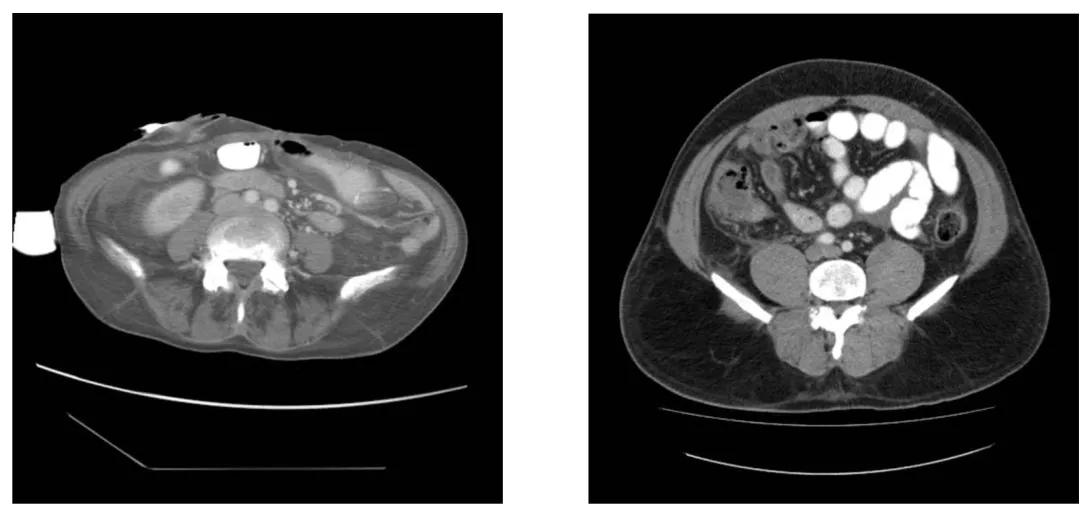
Patient A (left) & Patient B (right)
Axial CT scans of the abdomen showing the abdominal organs and blood vessels surrounding the lumbar spine, including both kidneys, portions of the intestines, and pelvic bones. Little fat tissue is visible on the first image, while more fat tissue is visible on the second image. The images are displayed in grayscale against a black background.
The patient on the right will have a better outcome
Based on the images above, Patient B likely has a higher BMI but has larger and better quality core muscles. Conversely, Patient A, while thinner, is lacking muscle and thus physical reserve to withstand the insult of surgery.
Why is "training" for surgery important?
While not yet a universally embraced concept, prehabilitation activities aim to strengthen and enhance a patient's ability to endure surgery, while also assisting in recovery, thereby lessening length of hospital stay and ultimately reducing costs. MSHOP focuses on moving, relaxing, eating well, and breathing in order to universally prepare patients for surgery.
Four Areas for Improvement = Patient Empowerment
- Move
increasing physical activity - Breathe
breathing exercise/smoking cessation - Eat
healthy eating before surgery - Relax
stress reduction
Does prehabilitation have an impact?
After a successful MSHOP pilot at the University of Michigan Health System, outcomes analysis indicated that there were in fact reductions in both costs and lengths of stay in the MSHOP group versus the control group.
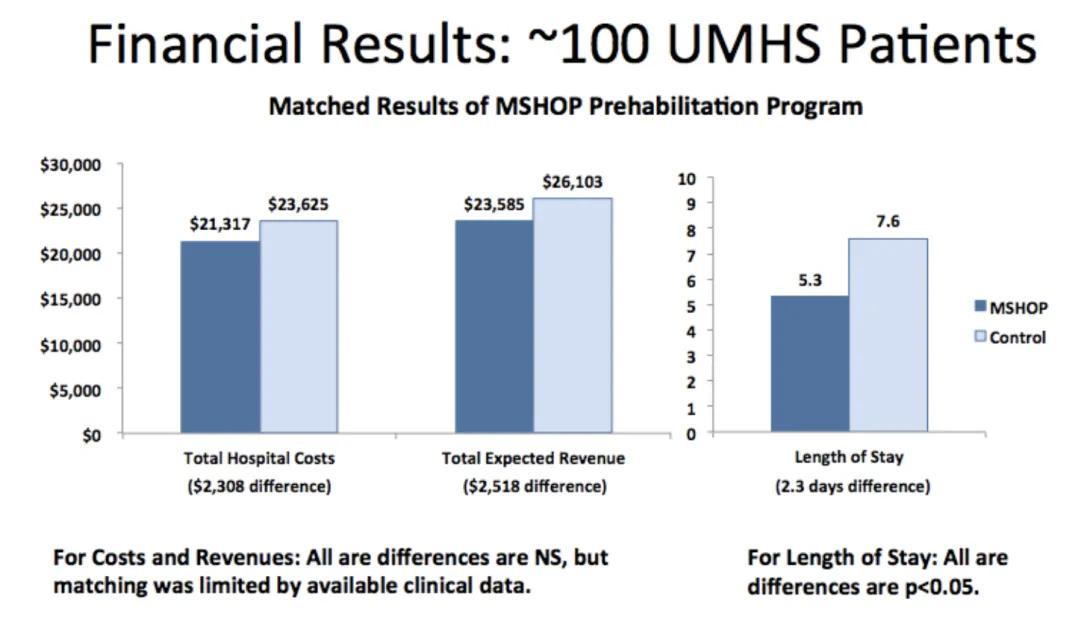
Bar chart titled “Financial Results: ~100 UMHS Patients” comparing matched results from the MSHOP prehabilitation program with a control group. MSHOP patients had lower total hospital costs ($21,317 vs. $23,625), lower total expected revenue ($23,585 vs. $26,103), and a shorter average length of stay (5.3 vs. 7.6 days). The differences were $2,308 for hospital costs, $2,518 for expected revenue, and 2.3 days for length of stay. Differences in costs and revenue were not statistically significant, while the difference in length of stay was statistically significant (p<0.05).
Want to know more?
Please visit the MSHOP careguide.
Morphomic Analysis
While the MSHOP program is focused on delivering a prehabilitation program augmented by cutting-edge technology, under the demonstration grant, Morphomics Analysis piloted in the Risk Assessment Tool on a limited set of patients.
Analytic Morphomics® was developed at the University of Michigan by Dr. Stewart Wang, and its impact on surgical outcomes has been studied extensively by our group. By using CT scans to take quantitative measurements of the human body, researchers are able to better predict surgical outcomes. The ultimate goal of this research is to compare these measurements to how well patients perform while undergoing different procedures.
Add Your Data
Let’s Collaborate
1150 W. Medical Center Drive
3328 Medical Science I, SPC 5677
Ann Arbor, MI 48109-5677
MAG is always interested in joint project work, by combining our innovative Analytic Morphomic research with discrete clinical data and medical imaging we have the unique opportunity to multiply and magnify existing data as well as generate novel clinical insights and improve patient care.
To explore how our research could support and advance your work, contact us.
