AI in Healthcare: Notification and Consent Preferences Based on U.S. National Survey

Background
A recent study has shown that patients want to be informed when artificial intelligence (AI) tools are used in their care.1 Evenmore, public preference for notification about AI use in healthcare is higher than the use of biospecimens or health information, reported in a similar study.2 However, important questions persist regarding which AI use cases ought to be disclosed to patients and the appropriate methods for doing so.
In November 2025, Verasight, a data company that provides market and survey data, invited attendees of the American Public Health Association (APHA) Annual Meeting, including the TIERRA team, to suggest questions to their APHA Omnibus Survey. The TIERRA team proposed three questions examining patient notification and consent preferences for AI tools in healthcare. Results from the survey, which is based on a nationally representative sample of U.S. adults, demonstrate that both notification and consent are essential when AI tools are used for clinical purposes whether in applications like diagnosing patients or lower-risk cases such as clinical notetaking as well as administrative functions including billing and scheduling.
Key Findings
Giving Permission Before Using AI
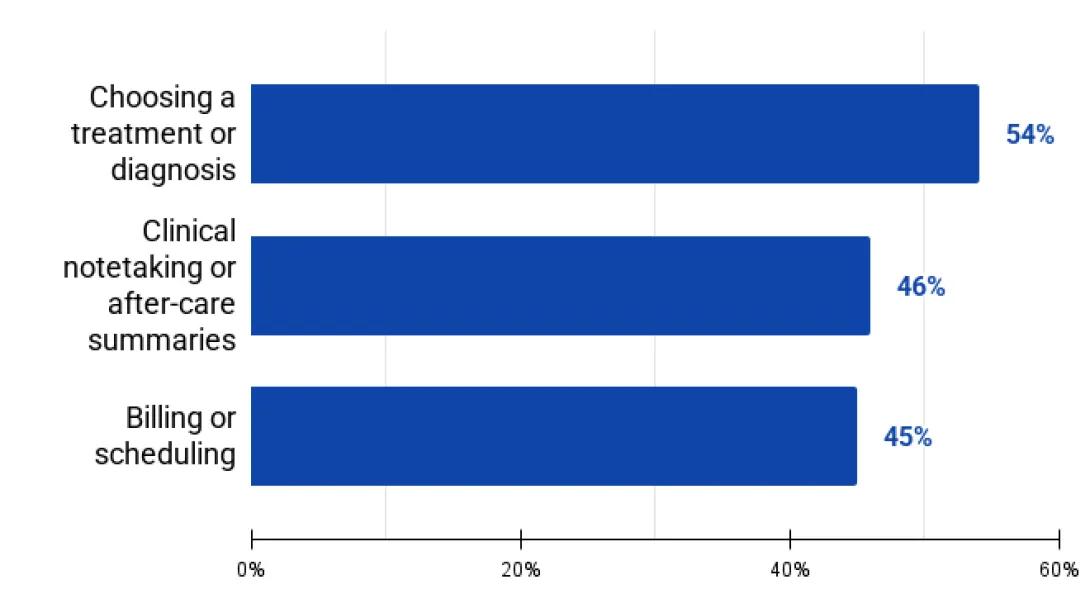
Survey results indicated that over half (54%) of U.S. adults prefer that their permission be asked each time AI tools are used for clinical purposes like choosing treatments or diagnosing patients. Meanwhile, slightly fewer adults want permission for AI use in clinical notetaking or producing after-visit summaries (46%) and administrative tasks such as billing or scheduling (45%). Overall, there is strong preference for gaining one’s permission before using AI in all three use cases.
Be Notified, But No Permission Needed
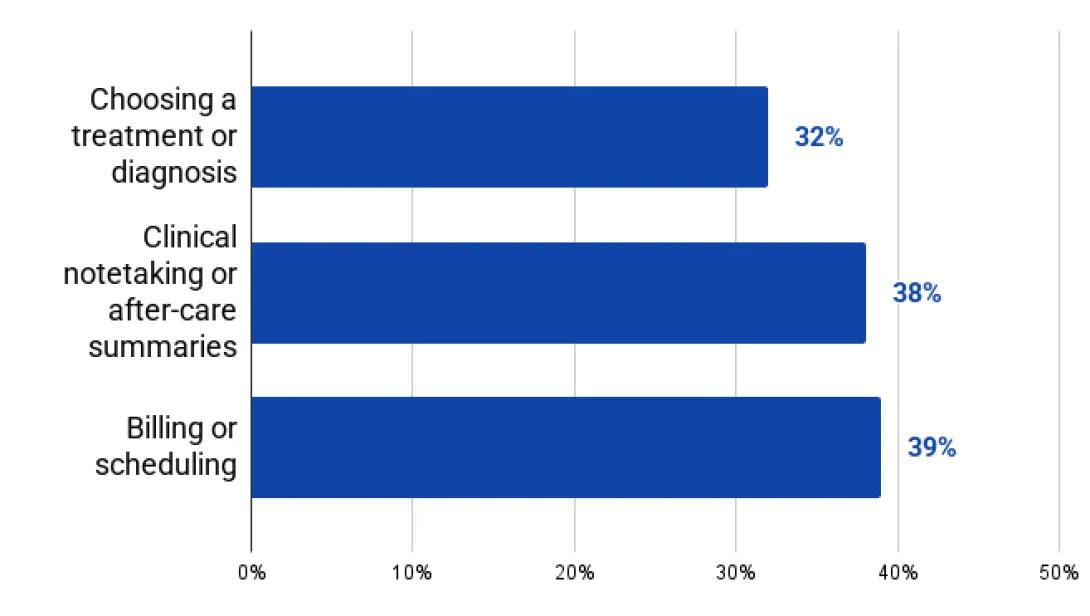
About a third (32%) of U.S. adults wanted to be notified each time AI is used, but did not require providing permission before AI tools are used for tasks such as choosing treatments or diagnosing patients. A slightly higher percentage of adults want to be notified each time AI is used for clinical notetaking or producing after-visit summaries (38%) or administrative tasks such as billing or scheduling (39%).
Do Not Want To Be Notified or Give Permission
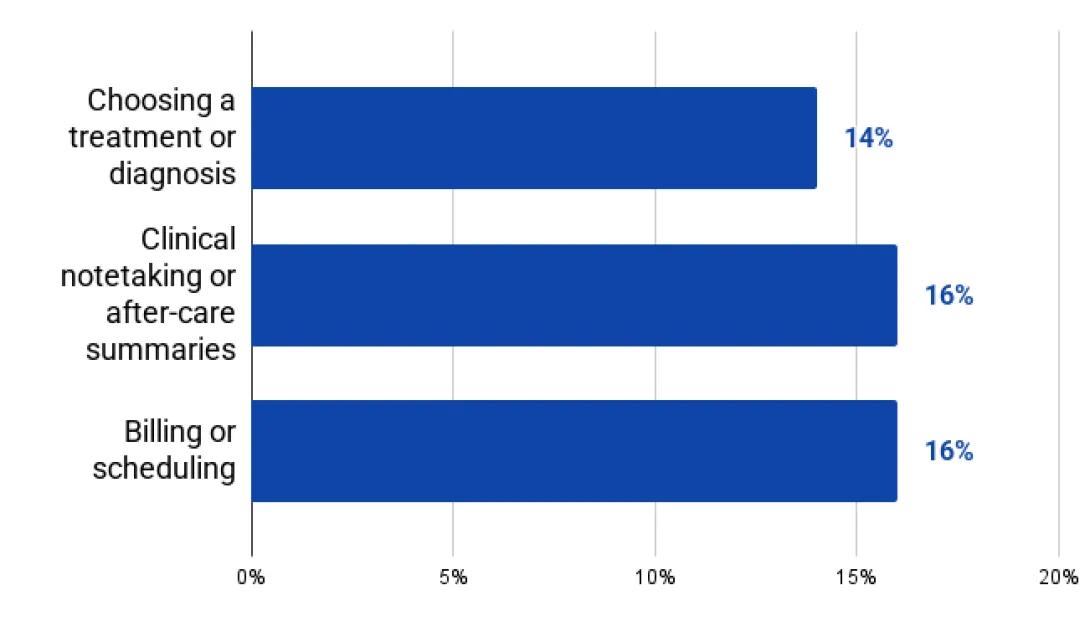
14% of U.S. adults do not want to be notified or give permission each time AI is used for clinical purposes. Similarly, 1 in 6 U.S. adults did not want to be notified or give permission when AI is used for clinical notetaking or producing after-visit summaries (16%) or administrative tasks (16%).
Policy Considerations and Conclusion
These results underscore the critical importance of developing robust consent frameworks and notification protocols as healthcare systems increasingly integrate emerging health technologies. Notification, which is a minimum standard in clinical and research ethics, is central to data privacy laws. As AI tool use increases across health systems, guiding protocols should highlight transparency via notifications as a component of appropriate AI use. Healthcare providers and policymakers should prioritize patient autonomy by implementing transparent AI disclosure practices that allow patients to understand when and how AI tools are being used in their care. While a small minority (14-16%) do not require notification or permission, the overwhelming majority of patients expect to be informed and involved in decisions about AI use in their care, suggesting that opt-out approaches may be insufficient to meet patient expectations. Moving forward, healthcare organizations should consider differentiated consent models that account for varying risk levels and use cases to maintain the trust and engagement of the patients they serve.
Methodology
Verasight collected survey data from November 14 to 20, 2025, from a sample of 3,000 U.S. adults (ages 18+). Survey participants were asked questions from one of three survey modules. The data were weighted to match August 2025 Current Population Survey demographics (age, race/ethnicity, sex, income, education, region, and metropolitan status), as well as partisanship distributions and 2024 presidential vote benchmarks, with a margin of sampling error of +/- 3.2%. Respondents were recruited from the Verasight Community through random address-based sampling, person-to-person text messaging, and dynamic online targeting, with multi-step authentication and quality control measures including duplicate detection, attention checks, and removal of respondents who completed the survey in less than 30% of the median completion time. For more information on Verasight, visit https://www.verasight.io/.
About TIERRA
The Trust, Innovation, and Ethics Research for Responsible AI (TIERRA) is a program of the University of Michigan Medical School. TIERRA aims to lead research and best practices on issues at the intersection of public trust and health information technologies. TIERRA was established in 2024 in partnership with the UM Department of Learning Health Sciences and the Institute of Healthcare Policy and Innovation (IHPI).
Disclaimer
The findings and conclusion in this factsheet are solely of the authors and do not necessarily represent the official views or positions of the University of Michigan Medical School and the Regents of the University of Michigan.
References
- Platt J, Nong P, Carmona G, Kardia S. 2024. Public attitudes toward notification of use of artificial intelligence in health care. JAMA Netw Open 7(12):e2450102. doi:10.1001/jamanetworkopen.2024.50102.
Spector-Bagdady K , Trinidad G , Kardia S , et al. 2022. Reported interest in notification regarding use of health information and biospecimens. JAMA 328(5):474-476. doi:10.1001/jama.2022.9740.
In This Story

Sean Tan
Lead Policy Researcher

Reema Hamasha
Research Area Specialist Intermediate

Gloria Carmona-Clavijo
Senior Research Specialist
Jodyn Platt
Associate Professor
Featured News & Stories
How exposure to bacteria may protect us

New grant targets gaps in care for mood and substance use disorders
Innovative children’s vision research gets a boost from the Knights Templar Eye Foundation

Winners of the 2026 Biological Chemistry Awards for Trainees
Pain, psychological factors and physical function closely linked in people with systemic sclerosis