
Myers Lab Research
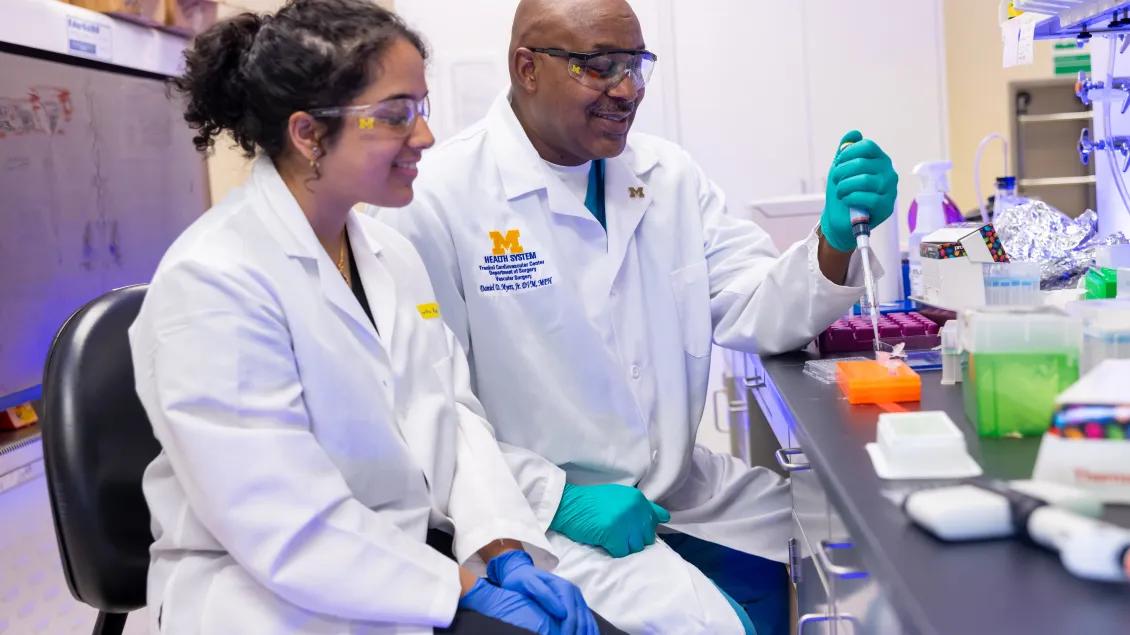
Discover Our Research
Learn more about the Myers Lab's work and impact.
Much of our work looks at the biology of selectins, cell adhesion molecules involved in signaling to the vascular epithelium. In particular, selectins signal platelets, monocytes and neutrophils, among other cell types, to move to the site of vascular injury, where clots are likely to form.
Other investigators in the Conrad Jobst Vascular Research Laboratories have shown that some of these cells — monocytes, for example — are in fact critical to clot resolution, but at later points in time. As a result, our work aims to find ways to interrupt, rather than turn off altogether, these signaling mechanisms.
To better understand the mechanisms underlying venous thrombosis, vascular inflammation, and thrombus resolution, and to develop safer and more effective therapies we employ a multidisciplinary translational research approach that includes:
Development and refinement of rodent and large-animal models of venous thrombosis and pulmonary embolism.
Investigation of cellular and molecular mechanisms that regulate thrombosis, inflammation, vascular remodeling, and post-thrombotic syndrome.
Identification and validation of novel therapeutic targets, including pathways involved in platelet, leukocyte, and endothelial cell function.
Preclinical evaluation of anticoagulants, anti-inflammatory therapies, and other emerging therapeutics.
Testing and optimization of innovative thrombectomy devices and vascular interventions in clinically relevant large-animal models.
Pharmacokinetic and pharmacodynamic studies to support the development and translation of novel therapeutics.
Development of sustained-release analgesics and other refinements that improve animal welfare and enhance the quality and reproducibility of biomedical research.
The Myers Laboratory collaborates extensively with investigators throughout the Conrad Jobst Vascular Research Laboratories, the University of Michigan, industry partners, and national and international research teams to translate scientific discoveries into improved therapies, medical technologies, and clinical outcomes.
Our research is advancing the understanding of venous thrombosis by defining the cellular and molecular mechanisms that regulate thrombus formation, resolution, and vein wall remodeling. A major focus of our work is the interplay between thrombosis and inflammation, including the roles of platelets, leukocytes, and immune signaling pathways in vascular injury and repair. These studies are helping to identify therapeutic targets that may reduce thrombotic disease while preserving the body's natural healing processes.
We are also evaluating novel anticoagulant and anti-inflammatory strategies designed to improve outcomes while minimizing bleeding risk and other adverse effects. By investigating the biological pathways that contribute to thrombosis, post-thrombotic syndrome, and chronic vascular inflammation, our laboratory is working to develop more precise and effective treatments for patients with venous thromboembolic disease.
In parallel, our large-animal translational models are being used to evaluate emerging thrombectomy technologies and vascular interventions, helping accelerate the development of new devices and treatment approaches for thrombotic disorders.
Our studies have also identified important sex-based differences in thrombus formation, inflammation, and vascular remodeling. Understanding these biological differences is essential for developing personalized treatment strategies and improving outcomes for both women and men affected by thrombotic disease.
Our research is focused on translating discoveries in thrombosis biology, pain management, and surgical innovation into therapies and practices that improve both human and animal health. New therapeutic approaches to venous thrombosis are increasingly within reach, and our laboratory is helping define the biologic mechanisms and translational pathways that can move these advances toward clinical application.
A major component of our work is the development of sustained-release analgesics and other innovations that improve animal welfare while strengthening the quality of biomedical research. Recent studies of a novel extended-release formulation of buprenorphine demonstrated prolonged pain control in laboratory animals, reducing physiological stress and minimizing confounding variables that can affect experimental outcomes. By improving consistency and reproducibility, these approaches enhance the translational value of preclinical research.
Our laboratory integrates expertise in surgery, pharmacology, and laboratory animal medicine to promote compassionate, evidence-based research. We are committed to refining experimental models and developing technologies that simultaneously advance scientific rigor and animal welfare.
Equally important is our role in training the next generation of physician-scientists. Medical residents and trainees in our program gain hands-on experience in basic and translational vascular research, helping shape a new cohort of vascular surgeons and surgical scientists. The porcine model of thrombosis developed in our laboratory is also widely used to train researchers and bioengineers in vascular device placement, endovascular techniques, and translational surgical methods.
Through these efforts, our laboratory continues to bridge discovery science and clinical impact, advancing innovations that benefit patients, researchers, and animals alike.
Our research is focused on developing safer and more effective therapies for venous thromboembolic disease. We continue to investigate novel anticoagulant strategies that reduce the risk of bleeding while maintaining therapeutic efficacy and explore how these treatments influence inflammation and vascular remodeling.
In parallel, we are evaluating innovative medical devices and interventional approaches to improve thrombus removal and restore vascular function. We are also committed to understanding the impact of sex as a biological variable, investigating gender-related differences in thrombosis, treatment response, and outcomes across our research models.
Together, these efforts support our mission to advance precision therapies and improve the translational impact of vascular research.
The unique collaboration between the Conrad Jobst Vascular Research Laboratories at U-M and the Jobst Vascular Institute at The Toledo Hospital, other academic institutions, and industry partnerships creates rare opportunities for Myers Laboratory investigators and trainees alike. In addition, the Myers Laboratory works closely with:
Peter K. Henke, MD on venous thrombosis and post thrombotic syndrome.
Andrea Obi, MD on venous thrombosis and medical device testing in large animal models.
Patrick Lester, RPh, DVM, MS, BCPS, DACLAM and the U-M Unit for Laboratory Animal Medicine on sustained pain relief.
Michael Holinstat, PhD, FAHA on thrombosis, pharmacology, 12-Lipoxygenase Inhibitors, platelet function, and biology.
Theodore Holman, PhD on thrombosis, pharmacology, and 12-Lipoxygenase Inhibitors.
Refinement and Enrichment Advancements Laboratory (REAL), analgesic efficacy assessment, and analysis
Stokes Healthcare, sustained released buprenorphine
Epicur Pharma, sustained released buprenorphine
Cerulean Scientific, novel therapeutics, and medical devices
Surmodics, novel medical devices
Medtronic, novel medical devices
Awarded 4 R44 HL172473 - 02 PI, Fast Track PVG STTR grant Name: McFarland, Todd (Cerulean Scientific). Phase II study. Assessment of conduit type on peripheral bypass patency in an ovine model. Andrea Obi, PI, Daniel Myers, PI
Medtronic Rat Stent Model Development Medtronic, Inc Andrea Obi PI, Daniel Myers, Co-PI
Integrated Dual-frequency Ultrasound Catheter for Accelerated Sonothrombolysis (iDUCAS) 23-PAF02460 Co-I with Effort (Principal Investigator: Zhen Xu)
The Role of Aging in Gal-3 Mediated Platelet Activation and Leukocyte Prothrombotic Mechanisms in Venous Thrombosis. Frankel Cardiovascular Center, Cardiovascular Research Network’s (CRN) Partnerships Grant. PI, Daniel Myers, Co-PI Michael Holinstat, Co-PI Patrick Lester
Comparing the Antiplatelet and Antithrombotic Effects of CCG263719 and SLUG001, Second Generation 12-Lipoxygenase Inhibitors, to ML355. Conrad Jobst Vascular Research Funds. PI Daniel Myers
Support Our Work
We greatly appreciate your support in further advancing our research. Please contact the Office of Development with any questions.
Explore Clinical Trials
The University of Michigan offers a wide range of clinical trials through the Michigan Institute for Clinical & Health Research (MICHR) in which volunteers can participate.
