
Explore Our Research | Woodward Lab
Our datasets, funded projects, and publications.
The Problem
Every year, millions of people worldwide suffer from severe, rapidly progressing eye infections called corneal ulcers. Left untreated or incorrectly diagnosed, these infections cause agonizing pain and lead to permanent blindness. The biggest challenge in preventing this sight loss is time: frontline doctors in rural clinics or emergency rooms rarely have specialist eye training or complex lab equipment to identify the specific organism causing the infection. Traditional telemedicine—sending images across the state or country to a human specialist—takes valuable time that patients simply don't have. Forced to guess while waiting, clinicians may prescribe treatments that don't work, leading to worse outcomes, unnecessary side effects, and permanent vision loss.
Our Solution
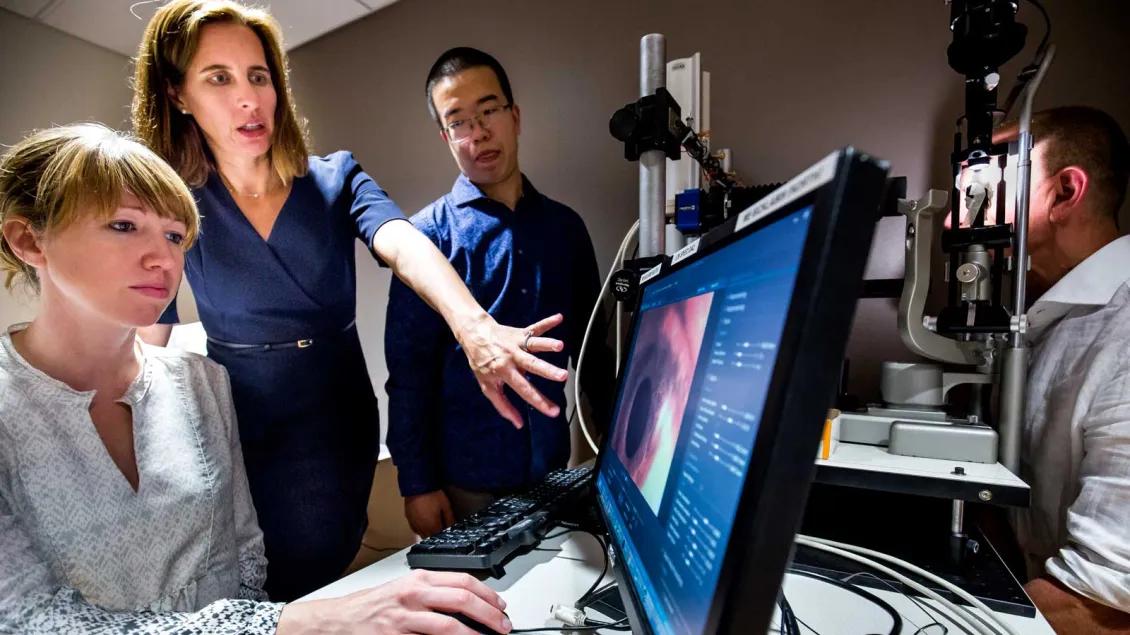
To solve this, our laboratory is pioneering a direct point-of-care solutions: putting automated, specialist-level software directly into the hands of frontline doctors. Our laboratory designs deep-learning algorithms that analyze photographs of the eye and patient history. We have embedded this AI engine into an intuitive online tool to be used by clinicians at the point of care. The concept is that a healthcare clinician could upload an image and receive immediate, expert-level clinical decision support—giving local doctors real-time support right when and where the patient needs it. Local clinicians face complex decisions for both establishing the correct diagnosis and for evaluating response to treatment. Our software helps support the clinician in both of these tasks.
The Impact
This technology fundamentally changes how acute eye infections are managed by providing diagnostic and monitoring decision support at the point of care. A local eye doctor can make rapid, accurate treatment decisions.
DISCLAIMER: The Woodward Lab is a clinical research group. This site provides information for educational and research purposes only. Our group does not provide patient care through this site, and its content is not a substitute for professional medical advice, diagnosis, or treatment. If you are experiencing a medical emergency, please call 911.
Funded Projects

Building Non-Communicable Eye Disease Research Capacity in India
Role: Co- Investigator
Principal Investigator: Musch, David
Automated Quantitative Ulcer Analysis (AQUA): Diagnosing Organism Types
Role: Principal Investigator
Quantifying Microbial Keratitis to Predict Outcomes: An Imaging Epidemiologic Approach
Role: Principal Investigator

Automated Quantitative Ulcer Analysis Study: Diagnosing Organism Type
Role: Principal Investigator

Developing Standardized Quality Metrics Following Corneal Transplantation Using a Delphi Technique
Role: Co- Investigator
Principal Investigator: Woreta, Fasika

Sustainable Community Clinic Telemedicine-Based Glaucoma Screening
Role: Co- Investigator
Principal Investigator: Newman-Casey, PA
NLP for Quantifying Microbial Keratitis Measures Dataset
The source code can be downloaded by clicking the link for data in the following format:
- NLP for Quantifying Microbial Keratitis Measures Dataset file (py)
- Abbreviation Extension Python file (py)
- Abbreviation Extension CSV file (csv)
- Data Cleaning Python file (py)
- DF All Visits Correction (csv)
- Word Correction (py)
- Wrongly Spelled Correctly Spelled Pair (py)
