AI in Healthcare Transparency: Building a U.S. Patient Notification Policy Tracker
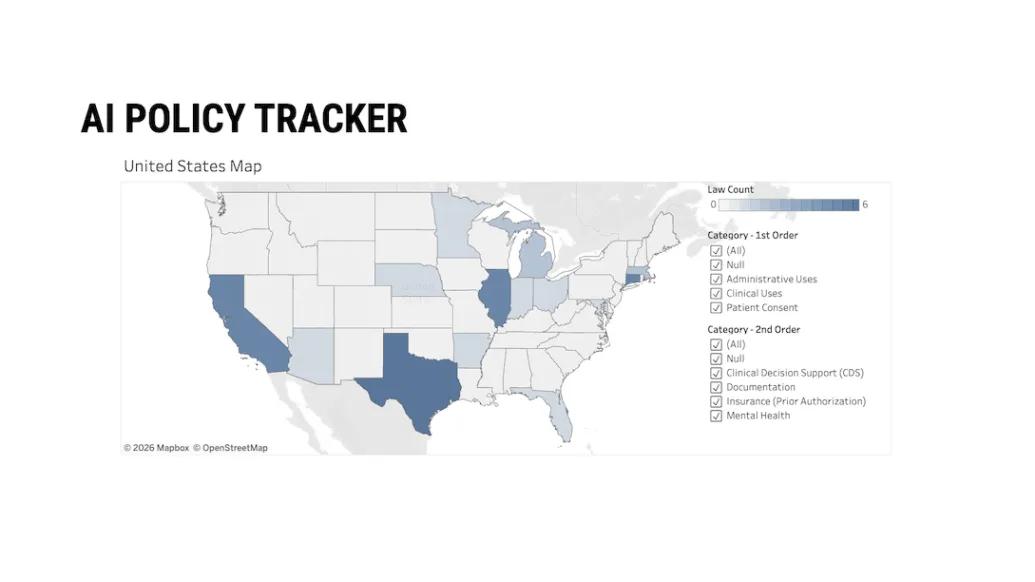
In September of 2025, I was given the unique opportunity to work with TIERRA as a research fellow as I pursued my Master’s in Health Informatics. As a graduate student, I was initially drawn to TIERRA because of the program’s focus on maintaining the ethical use of artificial intelligence in healthcare. Over the past six months, I assisted with examining policies pertaining to patient notification and disclosure whenever AI is used in healthcare and creating the Patient Notification and Disclosure Policy Tracker, which tracks state legislative proposals regarding the use of AI in healthcare between 2024 and 2025.
Creating a Policy Tracker
To create a comprehensive list of legislation, I reviewed the following trackers: The Brennan Center’s Artificial Intelligence Legislation Tracker1, Manatt Health’s Health AI Policy Tracker2, and the National Conference of State Legislatures’ Artificial Intelligence 2025 Legislation List3. For applicable legislation, I extracted information such as bill status, date of introduction, and date of last action to track the progression of bills throughout the legislative period. Next, I produced brief summaries of each bill to identify the specific regulatory gaps it addressed and the notification or disclosure each required. Finally, I categorized bills into two orders. The first-order categorization identified whether the bill targeted clinical or administrative usage. The second-order categorization determined whether the bill pertained to mental health services, clinical decision support tools, documentation aids, or insurance authorizations. The bills were also categorized based on whether they addressed administrative or clinical use of AI and whether they pertained to mental health services. These categories were used to identify key internal factors of legislation that had successfully passed.
For bills passed during their legislative sessions, I conducted additional research to determine who the bill sponsors are, voter breakdown, party affiliations, and registered support lists. This information was used to determine common external factors among successful legislation.
Key Themes of AI Legislation in 2024-2025
Once the tracker was constructed and the initial analysis was completed, we identified common themes between legislation that was passed. While investigating passed bills, we looked for thematic consistencies and determined themes that could potentially influence a legislation’s trajectory. My policy brief, 2025 AI State Legislations Across the Country: Trends in Notification, Consent and Disclosure Policies, written in conjunction with Sean Tan and Reema Hamasha, provides a deeper analysis of these themes and their implications on legislative success.
How States Are Shaping Regulation of AI Tools in the U.S.
State legislation regarding AI tools in healthcare comes at an especially critical time, given the absence of a national framework for responsible AI use, particularly in healthcare settings, which has left many AI tools post-market largely unregulated. Moreover, in December 2025, the federal administration signed Executive Order 14365 (December 11, 2025), “Ensuring a National Policy Framework For Artificial Intelligence,”4 into effect, which intended to weaken state-level regulation of AI. The executive order detailed that any current state AI legislation would be reviewed by the federal government within the next 90 days, and any legislation that was deemed to infringe on AI development would be flagged. Any states that had flagged legislation or continued to pass legislation that could be flagged would be at risk of losing federal funding or being denied future federal grants. However, even with these imposed restrictions, states remained committed to passing policies around the responsible use of AI during the 2025 legislative sessions and continued to introduce new legislation in 2026. As of March 2026, 45 of 50 states have introduced AI legislation, further emphasizing their commitment to regulation.5
What We Can Expect in 2026
Examining policies pertaining to the ethical use of AI in healthcare has been particularly rewarding for me as a graduate student in Health Informatics, studying how the intersection between healthcare and technology can be ethically integrated into our current system, ultimately supporting patients and their needs. As someone with a vested interest in understanding how technological developments in healthcare can be ethically included to support patients, rather than harm them, the construction of the policy tracker has acted as a real-world application of classroom theories, providing an irreplaceable learning experience. Further, as a student of a state-funded university in Michigan, this project has also been instrumental for me in understanding how Michigan, as a state, is approaching AI innovation and regulation compared to the rest of the nation. Michigan has stated its intention to be a leader in AI innovation. However, it has yet to be involved in the regulation of these emerging technologies and has not crafted meaningful policies to ensure that AI innovation is both ethical and beneficial to the people of the state. Currently, the state has introduced one bill, HB 4536 (2026), which is focused on mandating that any decisions made on the medical necessity of procedures by AI must be reviewed by a human entity, and that patients must be notified if AI is used in any step of the determination process. This bill is a step in the right direction as Michigan moves to be a leader in AI innovation, but it is only the tip of the iceberg when it comes to regulating the many ways in which AI is being leveraged in patient care, and it should look to the successful policies delineated in this tracker to better inform its future legislative approaches.
As the 2026 legislative session picks up, new developments in the federal space could influence the progression of not only newly introduced legislation but also recently passed legislation. As of March 20, 2026, the Trump Administration released its “National AI Legislative Framework”6 as a follow-up to Executive Order 14365 of December 2025, which details the specific cases and objectives that AI policies should address. Currently, none of these frameworks touch on health-related AI regulation, placing policy passage in a grey area that is not explicitly regulated by the framework. However, some innovation policies could be under fire due to the innovation and censorship clauses of the framework, which state that legislation must empower innovation without excessive restriction.
Ultimately, I could not be more grateful for the opportunity to have been involved in this project for the last six months and continue to be involved as this tracker progresses. Through this work, I hope to not only help states understand how to better regulate AI in their respective regions but also help patients better understand the future of their care with these rapid technological innovations. The healthcare industry is only as strong as the trust patients put into it, and I hope that this tracker can provide the transparency patients are looking for in these unique times.
References
Levinson-Waldman, R., Patel, F., Ayoub, E., Toomey, P. C., & Gutiérrez, J. G. (2023, October 24). Artificial Intelligence Legislation tracker. Brennan Center for Justice. https://www.brennancenter.org/our-work/research-reports/artificial-intelligence-legislation-tracker
Seigel, R., Augenstein, J., Shashoua, M., Slater, C., & Irlbeck, C. (2025, December 16). Manatt Health: Health AI policy tracker. Manatt, Phelps & Phillips, LLP. https://www.manatt.com/insights/newsletters/health-highlights/manatt-health-health-ai-policy-tracker
Artificial Intelligence 2025 legislation. National Conference of State Legislatures. (2025, July 10). https://www.ncsl.org/technology-and-communication/artifi pastcial-intelligence-2025-legislation
The United States Government. (2025a, December 12). Ensuring a national policy framework for Artificial Intelligence. The White House. https://www.whitehouse.gov/presidential-actions/2025/12/eliminating-state-law-obstruction-of-national-artificial-intelligence-policy/
State AI legislation tracker 2026: All 50 States. multistate.ai. (2026b). https://www.multistate.ai/artificial-intelligence-ai-legislation
The United States Government. (2026, March 20). President Donald J. Trump unveils national AI legislative framework. The White House. https://www.whitehouse.gov/releases/2026/03/president-donald-j-trump-unveils-national-ai-legislative-framework/
In This Story

Saahithi Kari
TIERRA 2025-2026 Intern

Sean Tan
Lead Policy Researcher

Reema Hamasha
Research Area Specialist Intermediate
Featured News & Stories

A pediatric epilepsy fundraiser that changes lives

Dr. Cornelius James and his team develop Physician Readiness Report for AI in Clinical Practice

New grant targets gaps in care for mood and substance use disorders
Faculty Spotlight - Neehar Parikh, MD, MS
Community Advisor Spotlight - Co-Chair, Tsu Yin Wu