Weil Institute researchers awarded $5.5 million for smart CPR device that aims to restart more hearts
AI-integrated sensor will give rescuers immediate feedback on CPR effectiveness, enabling them to personalize resuscitation strategies for each cardiac arrest patient.
Author |
ANN ARBOR – Researchers from the University of Michigan Max Harry Weil Institute for Critical Care Research and Innovation—together with global collaborators in resuscitation, data science, engineering, emergency medical services, and design thinking—have landed a 2-year, $5.5 million grant from the American Heart Association (AHA) to develop an AI-integrated wearable sensor aimed at helping rescuers save more sudden cardiac arrest (SCA) patients. The funding was awarded through the AHA’s highly competitive Novel AI Approaches to Advance Cardiovascular and Cerebrovascular/Brain Health mechanism, which supports up to three investigators and/or investigative teams exploring novel uses of AI to revolutionize cardiovascular and cerebrovascular/brain health.
Each year in the United States, approximately 600,000 people experience SCA, over 350,000 of which are out-of-hospital cardiac arrests (OHCA). Unfortunately, 3 out of 4 OHCA cases do not survive to hospital admission due to rescuers being unable to restart the patients’ hearts. According to Dr. Cindy Hsu, the project Principal Investigator and Division Chief of Critical Care, Associate Professor of Emergency Medicine and Surgery, and Weil Institute member, a critical barrier to successful cardiac arrest resuscitation is the challenge of assessing, in real-time, how well blood is flowing to the heart during cardiopulmonary resuscitation (CPR).
“To assess whether the heart is getting enough blood flow during CPR, we have to insert invasive catheters into the arteries to measure the patient’s diastolic blood pressure (DBP), which serves as a surrogate measurement,” said Dr. Hsu. “This is challenging to do during cardiac arrest and, depending on where the patient is located, may not be possible because of resource limitations.” Hsu states that even if the patient already has pre-existing arterial catheters in place, chest compressions can distort DBP measurement, leading to inaccurate assessment of blood flow to the heart by current bedside monitors. As a result, rescuers today have no real way of knowing whether their resuscitation approach is effective for cardiac arrest patients."
INSIGHT-CPR: Turning “One-size-fits-all” into a Personalized Approach
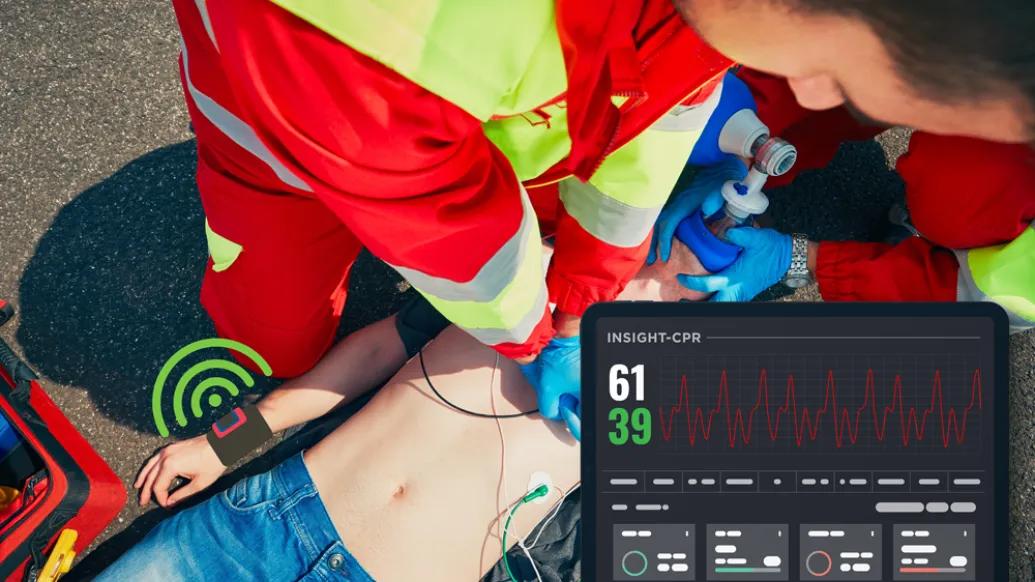
To address these challenges, Dr. Hsu and her team are developing “INSIGHT-CPR,” a technology that combines a non-invasive wearable sensor with an advanced neural network algorithm trained on arterial waveform data to accurately detect cardiac arrest patients’ DBP in real-time.
Worn around the patient’s wrist or finger, the sensor captures and then wirelessly transmits the patient’s DBP information to a mobile device or monitor, providing rescuers on the scene with accurate insight into how blood is flowing to the heart. This allows rescuers to assess and refine their resuscitation techniques—such as the best placement of their hands during chest compressions and the type and timing of medications given—providing every cardiac arrest patient the best chance at survival with good outcomes.

Our goal with INSIGHT-CPR is to fundamentally change how cardiac arrest is treated by removing the need for invasive monitoring, taking out the guesswork for rescuers and tailoring resuscitation strategies to the patient. Even if we can save an additional 10% of cardiac arrest patients, that’s over 60,000 more lives saved each year. But we’re hoping to achieve much more than that.
Cindy Hsu, MD, PhD, MS
Division Chief, Critical Care
Associate Professor, Emergency Medicine and Surgery
Member, Weil Institute
Zachary Sharpe, a Data Scientist at the Weil Institute’s Preclinical Critical Care Laboratory, is leading development of INSIGHT-CPR’s AI algorithms alongside Dr. Hsu. With a background as a paramedic and as an Army MEDEVAC flight medic, Sharpe sees this technology reshaping how first-responders treat SCA no matter where it occurs.
“Due to technology gaps and lack of personnel, prehospital systems can lag behind hospitals in their ability to provide personalized care,” said Sharpe. “By developing a device that can perform real-time analytics using embedded AI, it will help us to not only improve resuscitation outcomes in the field, but to also potentially deploy future AI-based methods in EMS or combat casualty care scenarios without the need for an internet connection.”
Combining Global Expertise
At the core of the INSIGHT-CPR project are a series of synergistic collaborations between the Weil Institute, (including members in Michigan Medicine and the U-M College of Engineering), the Children's Hospital of Philadelphia (CHOP), the East Anglian Air Ambulance (EAAA) in the United Kingdom, and consultancy group Blue Cottage of CannonDesign.
The Weil Institute Proposal Development Unit assisted Dr. Hsu and her team in the writing and submission of two successfully funded grants for INSIGHT-CPR, including the recent AHA award as well as a $100,000 grant facilitated through Weil’s Kahn Pediatric Critical Care Grand Challenge program.
The Weil Institute’s Data Science Team will manage the training and validation of the INSIGHT-CPR neural network models using diverse sets of adult and pediatric cardiac arrest waveform data provided by Michigan Medicine (adult in-hospital SCA), EAAA (adult out-of-hospital SCA), and CHOP (pediatric in-hospital SCA from the ICU-RESUS multicenter study). The EAAA dataset will be especially informative, as EAAA physicians place arterial catheters for OHCA patients in the prehospital setting—something that is not feasible for most emergency medical service agencies.
Dr. Hsu and team’s sensor will be adapted from previous iterations developed by project co-investigator Dr. Kenn Oldham, Professor of Mechanical Engineering and an Associate Director of the Weil Institute. Weil’s Preclinical Critical Care Laboratory will aid the team in testing prototypes of the sensor in a large animal model of cardiac arrest to gauge the device’s compatibility with defibrillation, determine its accuracy in detecting DBP during CPR and compare the effectiveness of DBP-directed CPR strategy guided by INSIGHT-CPR to current advanced cardiovascular life support protocol.
“While we designed our sensor to measure changes in arterial properties, we discovered some time ago that manipulating pressures applied to the sensor lets us measure underlying blood pressure with high accuracy,” said Dr. Oldham. “This project gives us a chance to use that capability to directly address a pressing challenge in emergency medicine, with direct input from clinicians and other healthcare providers on critical features needed to improve outcomes of CPR."
Blue Cottage of CannonDesign will facilitate design thinking workshops to iteratively refine the prototypes using human-centered design through end-user engagement. In addition, they will provide a go-to-market strategy to accelerate INSIGHT-CPR’s commercial launch.
Finally, INSIGHT-CPR also benefited from the fastPACE program available through the University of Michigan’s Fast Forward Medical Innovation (FFMI) initiative, which helped Dr. Hsu and her team craft a compelling pitch to the sponsors.
“For other big killers like cancer, we know the patients’ tumor genetics and can tailor their treatments accordingly. But for cardiac arrest, every patient gets the same exact resuscitation protocol regardless of their individual physiology,” said Dr. Hsu. “Our goal with INSIGHT-CPR is to fundamentally change how cardiac arrest is treated by removing the need for invasive monitoring, taking out the guesswork for rescuers and tailoring resuscitation strategies to the patient. Even if we can save an additional 10% of cardiac arrest patients, that’s over 60,000 more lives saved each year. But we’re hoping to achieve much more than that.”
Further Reading
- Official AHA Press Release: American Heart Association funds scientists at the Kaiser Permanente Division of Research and the University of Michigan to advance the use of artificial intelligence in cardiovascular health care
Project Team
PI: Cindy Hsu, MD, PhD, MS (Emergency Medicine, Surgery, Weil Institute)
Co-I’s: Kenn Oldham, PhD (Mechanical Engineering, Weil Institute); Kayvan Najarian, PhD (Computational Medicine and Bioinformatics, Emergency Medicine, Electrical Engineering and Computer Science, Weil Institute); Negar Farzaneh, PhD (Emergency Medicine, Weil Institute); Hakam Tiba, MD, MS (Emergency Medicine, Weil Institute); Ben Bassin, MD (Emergency Medicine, Weil Institute, Blue Cottage of CannonDesign); Robert Sutton, MD, MS (Critical Care Medicine, Clinical Resuscitation Science, Children’s Hospital of Philadelphia)
Advisors: Ryan Morgan, MD, MTR (Anesthesiology and Critical Care Medicine, Children’s Hospital of Philadelphia); Robert Neumar, MD, PhD (Weil Institute, Emergency Medicine); Drew Bennet (University of Michigan Innovation Partnerships)
Consultants: Paul Rees, MBBS (East Anglian Air Ambulance); James Price, MBBS (East Anglian Air Ambulance); Juliet Rogers, PhD, MPH, MPL (Blue Cottage of CannonDesign); Kimberly Silver (Blue Cottage of CannonDesign); Aaron Call (CannonDesign)
Research Staff: Zachary Sharpe, MS (Data Scientist, Weil Institute); Jennifer Fowler (Project Manager, Emergency Medicine); Jay Semerad (Product & Data Science Manager, Weil Institute); Peter Walczyk (Data Operations Engineer, Weil Institute); Nicholas Greer (Lab Supervisor, Weil Institute); Celina Gomez (Emergency Medicine, Lab Manager); Kyleigh Moll (Emergency Medicine, Lab Technician); Alexis Davis (Lab Technician, Weil Institute); Courtney Davis (Vet Technician, Weil Institute); Zixiao Zhang (Graduate Student, Mechanical Engineering); Lisa Coon (Events Manager, Weil Institute); Kate Murphy (Graphic Designer, Weil Institute)
Disclosures
Co-investigator Dr. Ben Bassin is an employee of Blue Cottage of CannonDesign.
The research team has filed a provisional patent on the AI algorithm used in this project:
- Provisional patent application 63/721,211: “Neural Network Automated Invasive Arterial Pressure Extraction” filed on November 15, 2024
Co-investigator Dr. Kenn Oldham has two patents through the University of Michigan on the sensor technology used in this project:
- 17/514,939: “Non-Invasive, Continuous, Accurate and Cuff-Less Measurement of Blood Pressure and Other Cardiovascular Variables by Pulse Wave Acquisition and Analysis Using Non-Invasive Sensors”
- 18/717,359: “Vascular Resistance and Blood Pressure Measurement Using Combined Piezoelectric and Photoplethysmogram Measurement”
About the Weil Institute
The team at the Max Harry Weil Institute for Critical Care Research and Innovation is dedicated to pushing the leading edge of research to develop new technologies and novel therapies for the most critically ill and injured patients. Through a unique formula of innovation, integration and entrepreneurship that was first imagined by Weil, their multi-disciplinary teams of health providers, basic scientists, engineers, data scientists, commercialization coaches, donors and industry partners are taking a boundless approach to re-imagining every aspect of critical care medicine. For more information, visit weilinstitute.med.umich.edu.
In This Story

Cindy H Hsu, MD, PhD, MS
Associate Professor
Featured News & Stories
Into the Current: Dr. Nate Hunt Brings Specialized Water Rescue Expertise Back to Michigan Medicine
U-M-led consortium to receive up to $52 million in NIH funding to study why viral respiratory infections affect children differently

Emergency room intervention pairs smartphone, telehealth counseling to reduce risky firearm behavior

Meet Our New Emergency Medicine Fellows and Faculty

E-Bikes are everywhere, but most parents say they don’t know enough about them