Cracking the Code of RNA
A perspective shift in college led Amanda Garner to chemistry. Now, her cutting-edge research explores RNA-targeted therapeutics for cancer and other diseases.
Author |
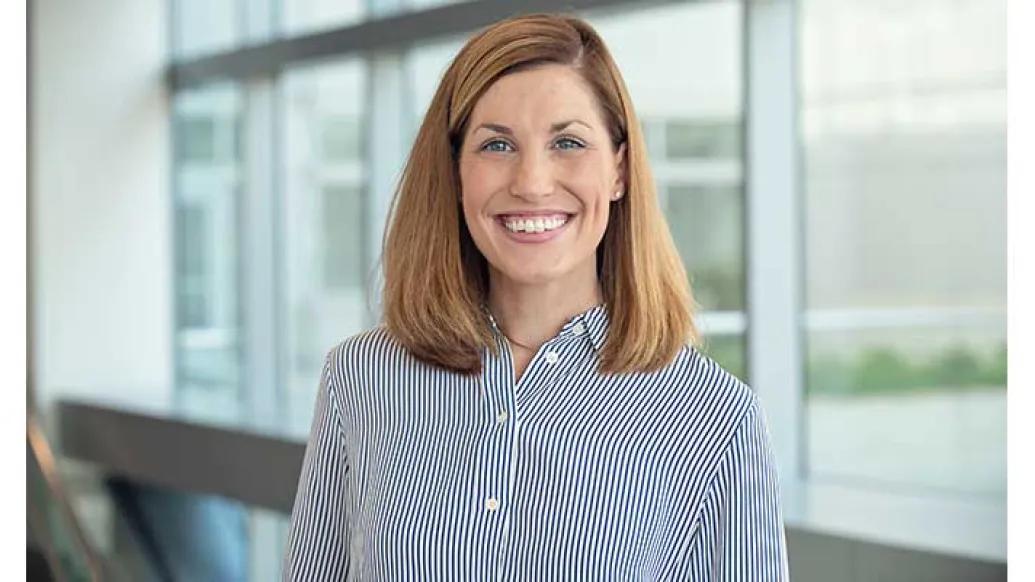
Growing up in rural St. Marys, Pennsylvania, where the high school science curriculum was lean, Amanda Garner, Ph.D., set her practical career sights on medicine or accounting. With no role models in her small town, it never occurred to her to think of becoming a scientist.
Things changed in college. A chemistry professor recognized the pre-med major’s potential and offered her an opportunity to work in a chemistry lab.
“I had never considered chemistry at all in my life,” Garner says. “But when I got to organic chemistry I thought, oh, this is what it’s all about!
“Because you see the structures of drugs, what a molecule looks like in three-dimensional space,” she continues. “It’s quite incredible to think about how that’s interacting with us once inside our bodies.”
Garner went on to earn her Ph.D. in chemistry from the University of Pittsburgh then spent time as a postdoctoral fellow and research associate at the Scripps Research Institute. There, her research interests moved into the emerging field of RNA biology. She joined the University of Michigan as an assistant professor in 2013.
Today, the Garner Lab at Rogel is celebrating its 10th year working at one of the final frontiers in drug discovery—the search for and development of RNA-targeted therapeutics for cancer and other diseases.
The lab’s core focus is exploring RNA biology. The Human Genome Project found that while a tiny percentage of the genome encodes for proteins—typically considered the building blocks of life—more than 98% of it encodes for non-coding RNAs which have been linked to nearly all diseases, from cancer to Alzheimer’s to diabetes.
“RNA biology is a great, wide-open space for a chemist to play because we can find molecules that can be developed as drugs or as probes to uncover the basic biology of what these molecules are doing in diseases like cancer, where RNA becomes dysregulated,” she explains.
“That is what the next generation of drug discovery looks like.” Garner’s interdisciplinary lab of 12 members uses chemical biology, medicinal chemistry, and molecular and cellular approaches to investigate targeting RNAs and RNA-protein interactions for probe and drug discovery. Current projects focus on validating and discovering new targets to promote the emerging field of RNA-targeted drug discovery.
An associate professor of medicinal chemistry and director of the Interdepartmental Program in Medicinal Chemistry within U-M’s College of Pharmacy, Garner enjoys teaching and mentoring graduate students. She pushes her students to use their imaginations, take risks and follow the science to the next big problems.
What does the future hold for Amanda Garner?
“Cracking the code of RNA,” she says, laughing. “As we’ve become more interdisciplinary, I’m optimistic that we’ll be able to answer the questions we didn’t at first have the tools for.” Working in cancer models, “we can now see the impact of the transcriptome and use that information to better patients’ lives. That’s the overall goal.”
Continue reading Illuminate 2024:
- A Path of Hope for Glioblastoma Treatment
- Histotripsy: Making the Impossible Possible
- Training Tomorrow's Cancer Leaders
- Uncovering Cancer's Roots in Chromatin
- The Importance of Being Flexible
- Collaborative Excellence
Learn more:
Illuminate
Articles showcasing the latest in cancer research underway at the Rogel Cancer Center
Featured News & Stories
Human Rabies Exposures Growing Across the Country

Continuing the legacy of a doctor’s doctor
Dr. Elafros Receives Global Achievement Award
Karsten Bartels, MD, earns Gladys Sessler Outcomes Research Consortium Award

Into the Current: Dr. Nate Hunt Brings Specialized Water Rescue Expertise Back to Michigan Medicine