Uncovering Cancer's Roots in Chromatin
Growing PARLAB looks to gene architecture for novel cancer therapies.
Author |
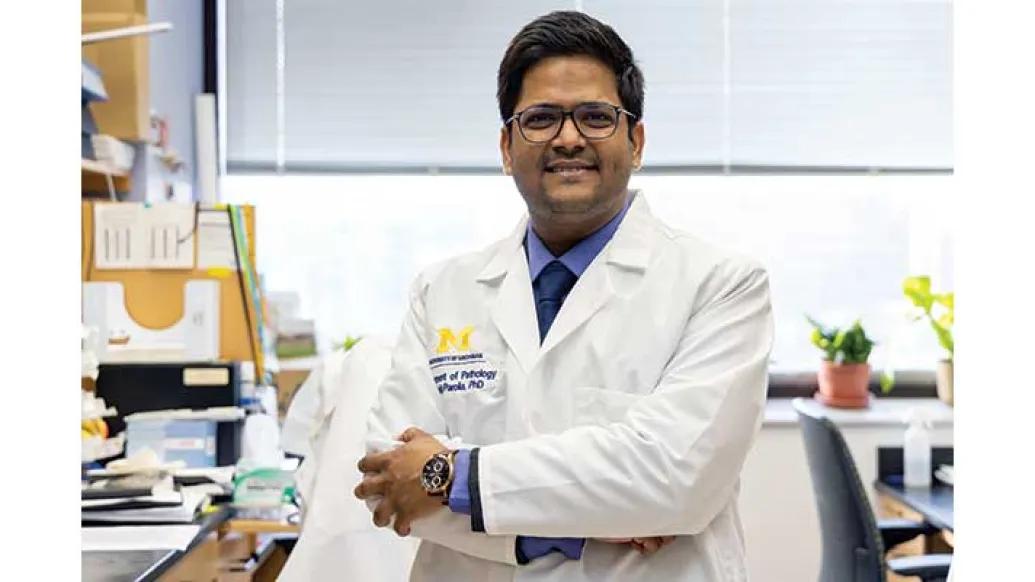
Abhijit Parolia, Ph.D., recalls the first moment he heard the question that would come to define his entire scientific career. One of 21 undergraduate students fortunate enough to have secured a place in the highly competitive joint honors biotechnology program at the University of British Columbia/British Columbia Institute of Technology, Parolia was intrigued when a professor asked, what is a gene?
In October, the molecular biologist launched his own independent lab as a tenure track assistant professor at the Rogel Cancer Center. The Parolia Lab—or PARLAB as he calls it—studies the role of chromatin in cancer and how its architecture may be exploited to develop new therapies. Chromatin is the tightly wound package of DNA and proteins in the nucleus of every human cell that drives transcription and gene expression.
"My work centers on uncovering cancer’s root in the chromatin," Parolia explains. "What are these roots, how deep are they, and how do we find ways to uproot this disease, starting from the soil, i.e., the DNA."
Parolia began his University of Michigan journey in 2015 as a graduate student in the laboratory of internationally renowned prostate cancer researcher Arul Chinnaiyan, M.D., Ph.D., director of the Michigan Center for Translational Pathology at Rogel.
In the Chinnaiyan Lab, Parolia studied FOXA1, a specialized transcription factor or protein essential for normal development of the prostate that is frequently mutated in prostate cancer. Parolia and colleagues defined the biological mechanisms through which FOXA1 initiates prostate cancer and causes it to grow and spread. The work, published in Nature and the foundation of Parolia’s dissertation, set the stage for the development of new cancer therapies targeting FOXA1’s activity. Parolia graduated the U-M Medical School in 2021 with a dual Ph.D. and master’s in molecular and cellular pathology and bioinformatics but didn’t follow the conventional route to a postdoctoral fellowship. Instead, he was offered a junior faculty position at U-M as a research investigator within the Department of Pathology under the mentorship of Weiping Zou, M.D., Ph.D., director of Rogel’s Center of Excellence for Cancer Immunology and Immunotherapy. For the next two years, he worked with Zou to understand how chromatin in immune system T cells changes when they recognize and attack cancer cells.
The growing Parolia Lab at Rogel focuses on the architecture of chromatin and transcriptional abnormalities in hormone-driven cancers, such as prostate and breast cancer.
Every cell in our bodies contains the exact same strands of DNA, tightly wound around proteins called histones into fundamental units called nucleosomes. This genetic package is collectively known as chromatin.
Lineage commitment determines whether a cell will function in vision as an eye cell or in sexual reproduction as a prostate cell. That commitment—the functional fate of any cell—is governed by enhancers, specialized non-coding regions on a strand of DNA that bind proteins to activate gene functions. These non-coding DNA elements get specifically opened in different cells to enable the gene transcription that ultimately determines the function of the cell.
“Think of enhancers as bookmarks,” Parolia says. “They mark pages in the genetic book that contain cell type-specific DNA information.”
Parolia, recently appointed as a Rogel fellow, says cancer hijacks and amplifies the normal enhancer pathway machinery of lineage commitment.
“We need to understand how these protein complexes that are binding on specific enhancers are different in cancer than in normal cells. What are the proteins at work, what is the sequence of their assembly?” he asks. “Most importantly, can these keystone proteins be targeted to break this hijacked cancer-specific enhancer pathway to have therapeutic benefit?”
As he pursues these questions in his own lab, Parolia continues to collaborate with his mentors at Rogel. “Modern day science is impossible to do alone. To be at the edge of the translational field, doing high impact research, you’ve got to have a multidisciplinary team that supports and enables the science. That’s what we have at Michigan and at Rogel.”
Continue reading Illuminate 2024:
- A Path of Hope for Glioblastoma Treatment
- Histotripsy: Making the Impossible Possible
- Training Tomorrow's Cancer Leaders
- The Importance of Being Flexible
- Cracking the Code of RNA
- Collaborative Excellence
Learn more:

Illuminate
Articles showcasing the latest in cancer research underway at the Rogel Cancer Center
Featured News & Stories
Human Rabies Exposures Growing Across the Country
Continuing the legacy of a doctor’s doctor
Dr. Elafros Receives Global Achievement Award
Karsten Bartels, MD, earns Gladys Sessler Outcomes Research Consortium Award

Into the Current: Dr. Nate Hunt Brings Specialized Water Rescue Expertise Back to Michigan Medicine