
AI Tool Label

Pioneering Ethical AI Policies for a Healthier Future
Designing a patient-facing label for Artificial Intelligence (AI) in healthcare
About the Health AI Label
TIERRA’s national surveys and community deliberations indicate that there is a strong public interest in knowing when and how AI is used in healthcare.
But, what might this look like?
Transparency by way of a label–along the lines of a nutrition or product information label–is one proposed strategy for communicating trustworthiness.
Development of the Health AI Label
In a series of community deliberations, Michigan residents emphasized the importance of transparency, human connection, and the role of healthcare providers in the use of AI tools.
Across these sessions, participants highlighted the need for a Health AI label to include key information about demonstrated health improvements, privacy protections, safety and efficacy, and whether the AI tool works for all patients.
For the AI tool I want to know... |
|
The small group discussions focused on options for information that could be presented on a label. Each participant was instructed to create their own label using the 10 given items below, categorizing them as “Most Important,” “Important,” and “Other Information.” In the discussion that followed, participants generated a consensus label for their small group. Figure 1 displays three images depicting the small group label development process.
Figure 1: Staged process of label development in small group discussions
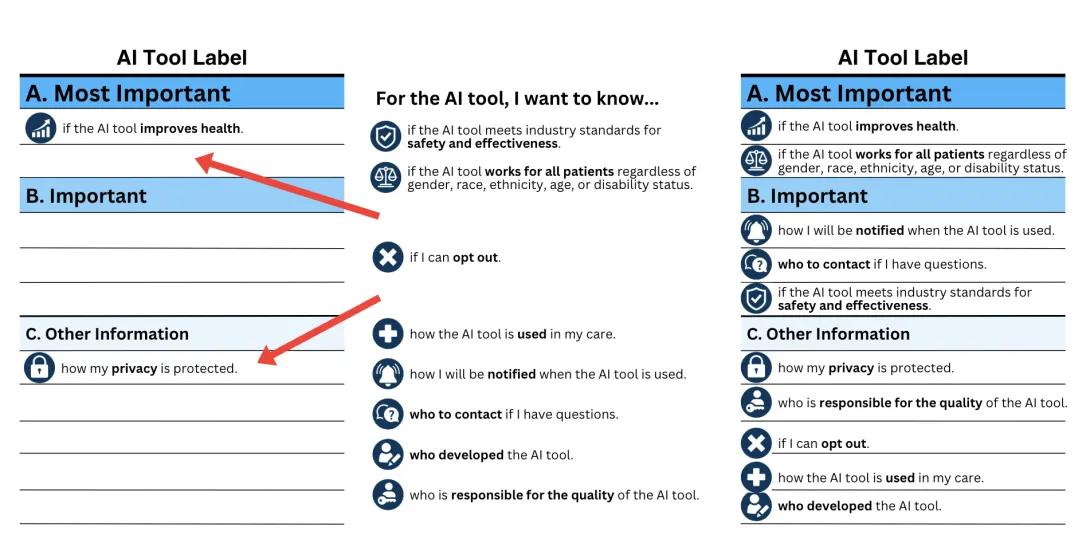
AI tool label, with two components sorted into categories:
A. Most Important
if the Al tool improves health
B. Important
C. Other Information
how my privacy is protected.
The following are the remaining components to be sorted into categories:
For the Al tool, I want to know...
if the Al tool meets industry standards for
safety and effectiveness.
if the Al tool works for all patients regardless of
gender, race, ethnicity, age, or disability status.
If I can opt out.
how the Al tool is used in my care.
how i will be notified when the Al tool is used.
who to contact if I have questions.
who developed the Al tool.
who is responsible for the quality of the Al tool.
Final AI Tool Label is sorted into
A. Most Important
If the Al tool improves health
if the Al took works for all patients regardless of gender, race, ethnicity, age, or disability status.
B. Important
how I will be notified when the Al tool is used.
who to contact if i have questions.
Is the Al tool meets industry standards for
safety and effectiveness
C. Other Information
how my privacy is protected.
who is responsible for the quality of the Al tool
if I can opt out
how the Al tool is used in my care.
who developed the Al tool.
What information is important to put on a label?
Participants discussed additional items that were not on the given list such as:
- Who is funding the AI tool?
- Will there be any impact on healthcare costs for patients?
- Who is liable if the AI tool causes harm or fails to work as intended?,
- Does the developer have any conflicts of interest?
- How does the tool compare to traditional care by a provider?
Figure 2 displays the final combined label that was created based on 5 deliberations (n=159) and a post-deliberation survey. Privacy, health equity, and safety and effectiveness were identified as the top 3 “Most Important” information.
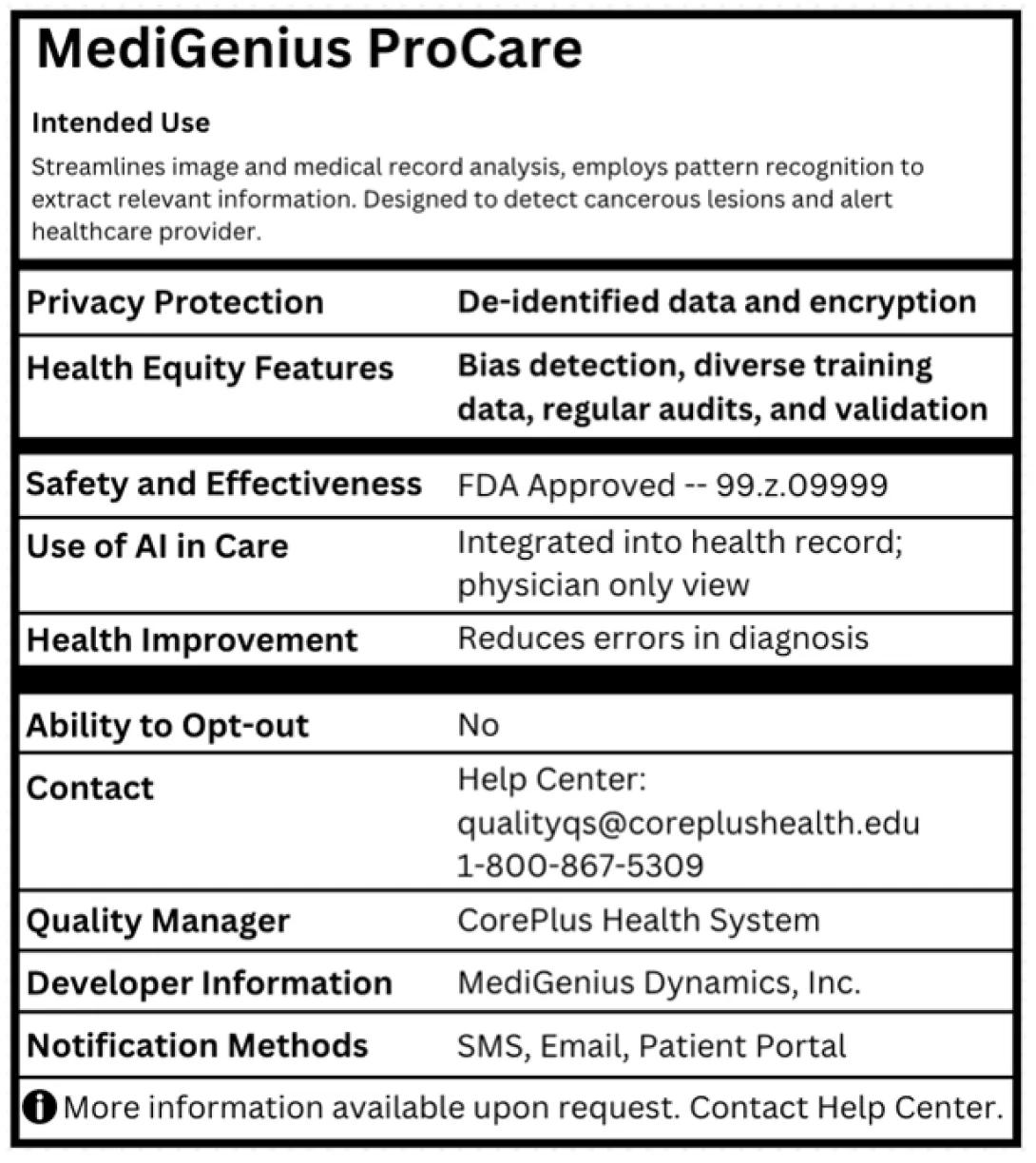
MediGenius ProCare
Intended Use: extract relevant information. Designed to detect cancerous lesions and alert healthcare provider.
Safety and effectiveness FDA Approved -99.z.09999
Health Improvement: Reduces errors in diagnosis
Health Equity Features: Bias detection, diverse training data, regular audits, and validation
Privacy Protection: De-identified data and encryption
Use of Al in Care: Integrated into health record; physician only view
Ability to opt-out: No
Quality Manager: CorePlus Health System
Developer Information: MediGenius Dynamics, Inc.
Contact: Help Center: [email protected] | 1-800-867-5309
Notification Methods: SMS, Email, Patient Portal
More information available upon request. Contact Help Center.
What do we do with this information?
Empower communities with resources for informed decision-making.
Engage with policymakers to shape community-informed policies
- Foster collaborative research to advance evidence-based solutions.
- Promote health equity by addressing disparities in access and outcomes.
- Educate clinicians to ensure equitable consent processes of tool use.
- Disseminate best practices through conferences, publications, and partnerships
