
Frankel Lab Research
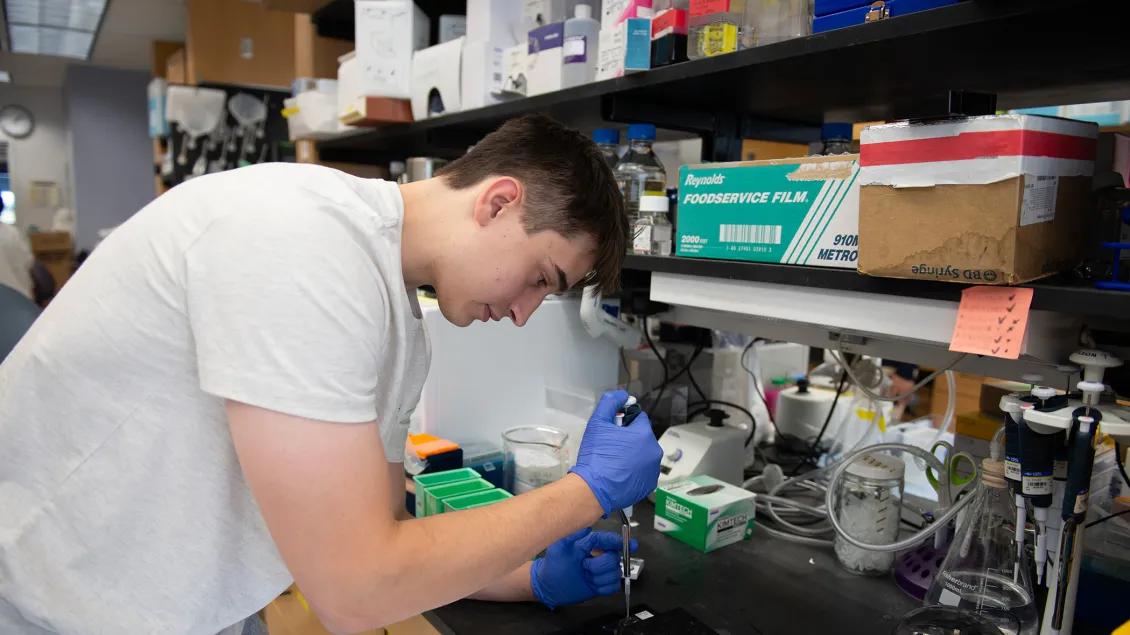
Discover Our Research
Learn more about the Frankel Lab’s work and impact.
Our lab has continued to study complex immune interactions in the pancreatic microenvironment. This includes cross-talk between myeloid cells, fibroblasts and epithelial cells. We have authored multiple papers characterizing the pancreatic immune microenvironment and have recently published an important work in Nature Cancer and Gastroenterology.
Our studies in this arena have garnered national interest with presentations at over 10 national and international meetings to present our findings. We have also published seminal papers on intercellular cross-talk in pancreatic cancer and pancreatitis. The University of Michigan Comprehensive Cancer Program partners with the lab to study unique samples, which have allowed us to develop models to enhance the translation of our work to enhance patient care.
Our laboratory uses a unique blend of mouse models and human derived tissues to understand the complexities of the pancreatic tissue microenvironment. A unique partnership with our local organ procurement organization Gift of Life Michigan has given us access to tissue harboring the earliest neoplastic lesions affording us the opportunity to study cancer before it has formed. The decades-long investment in a tissue biorepository as well as establishment of a tumor derived organoid bank provides avenues to test therapeutics in preclinical models, accelerating translation of findings.
Strong evidence implicates chronic inflammation as the link between exposure to toxins and PDAC tumorigenesis, but specific immune mediators remain poorly defined. Interleukin-22 (IL22) has emerged as an important cytokine in host defense and tissue repair within the gastrointestinal tract. Unique among cytokines, its receptor (IL22R1) is found only on non-immune cells, positioning IL22 as a key mediator of immune-epithelial cell communication in the pancreas. A defining feature of IL22-producing cells is their reliance on aryl hydrocarbon receptor (AhR), a critical ligand-dependent transcription factor involved in both production of IL22 and cellular differentiation. Thought to represent an “environmental sensor” of the immune system, a recent study found that aryl hydrocarbon receptor ligands (AhRL) present in cigarette smoke dramatically increase IL22 in the pancreas, promoting fibrosis via activation of fibroblasts.
We recently demonstrated that IL22 production induces early malignant transformation of pancreatic epithelial cells through enhancement of ERK signaling. The critical role of IL22 in PDAC tumorigenesis is highlighted by our in vivo data demonstrating that abrogation of IL22 signaling prevents tumor formation in a genetically engineered mouse model (GEMM) of PDAC. Together, these observations suggest activation of IL22 producing cells may represent the missing link between environmental exposures and PDAC initiation and progression. Our findings present a compelling need to better understand IL22 production and signaling in the pancreas
The two principal factors that underlie the poor prognosis of pancreatic cancer are resistance to currently available therapies and early spread of cancers. Our access to tissue harboring the earliest neoplastic transformation gives us the opportunity to develop early detection methods to identify those most at risk for developing disease. By implementation of a more rigorous screening program on high risk individuals, we may be able to diagnose pancreatic cancer while still at a curable stage.
Unlike other cancers, pancreatic cancer is resistant to currently available immunotherapies. Underlying this is a complex network of immunosuppressive cells that block the ability of inflammation to eradicate tumors. Understanding and interrupting these signals will provide a path forward.
- Marina Pasca Di Magliano, PhD
- Filip Bednar, MD, PhD
- Costas Lyssiotis, PhD
- Kyeung Lee, PhD
- Jiaqi Shi, MD, PhD
- Vaibhav Sahai, MD
- NIH/NCI R01: Mechanisms of myeloid cell driven pancreatic plasticity and carcinogenesis
- NIH/NCI U01: Fibroblast orchestration of the immune response in pancreatic cancer
- Veterans Administration: Role of environmental toxins in shaping the tumor immune microenvironment
- NIH/NIDDK R01: Epithelial-immune cell crosstalk during injury and recovery in acute pancreatitis
Support Our Work
We greatly appreciate your support in further advancing our research. Please contact the Office of Development with any questions.
Explore Clinical Trials
The University of Michigan offers a wide range of clinical trials through the Michigan Institute for Clinical & Health Research (MICHR) in which volunteers can participate.
