
Research | DBI Lab
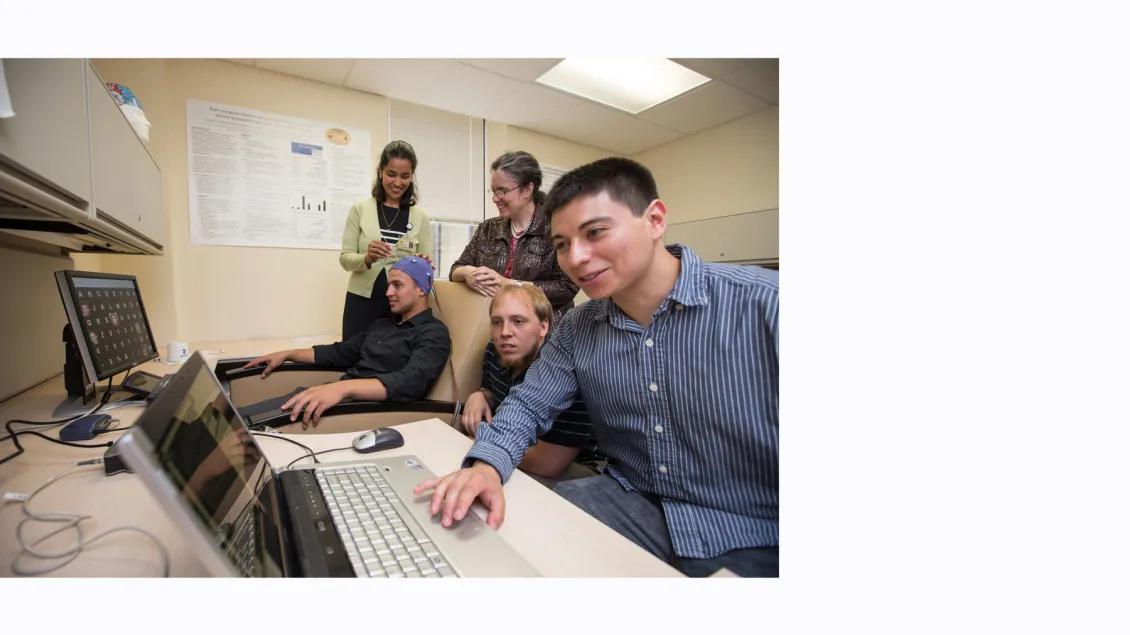
Advancing Brain-Computer Interface Communication
Current projects work together to improve brain-computer interface (BCI) communication for people with severe physical impairments who cannot reliably use speech or movement-based assistive technology. The research focuses on making BCI systems faster, easier to use, and clinically practical, especially when paired with high-efficiency augmentative and alternative communication (AAC) tools.
Accessible and Inclusive Autonomous Vehicles: Prototype Implementation and Testing with People with Disabilities (PWD)
Funding from: General Motors (GM)
Many people with disabilities are unable to drive because of their health conditions. Further, the control systems in present-day vehicles were not designed to meet their needs. The autonomous vehicles (AVs) currently in development need new control systems (with features that include physical, digital, electronic, or voice interfaces) that are designed for maximum accessibility by people with many different disabilities. Funded by GM since 2023, we completed over 50 interviews of people with disabilities to identify “pain points”, desired gains, and product expectations as well as to identify desired AV control system features and variations in preferences by disability type. Currently, we are using this information to develop and test a minimal viable prototype of an AV control system that meets the priorities and expectations of people with disabilities.
Smarter Statistical Learning for Faster BCI Communication
Funding from: National Science Foundation (NSF), Smart Health program
Principal investigator: Dr. Jian Kang (Department of Biostatistics)
One of the most successful non-invasive communication BCIs is the P300 BCI, which uses EEG brain signals to detect which letter or key a person is trying to select on an on-screen keyboard. While this approach can work well (including for people with ALS), it can still be slow and often requires time-consuming calibration, which is especially hard for people with limited stamina and for children with shorter attention spans.
This project develops new statistical machine learning methods that aim to:
Reduce BCI calibration time
Use prior data from other BCI users to make setup easier for new users
Increase communication speed through dynamic changes to stimulus patterns
The University of Michigan Direct Brain Interface (UM-DBI) Laboratory supports this work by providing experimental BCI data and helping implement and test these improved methods with research participants.
The AAC-BCI Project: Creating BCI Access to Commercial High-Efficiency AAC
Augmentative and alternative communication (AAC) devices are an existing class of assistive technology that provide access to language for people who are non-verbal or have difficulty communicating. BCIs are often developed with integrated communication capabilities, but the most effective communication will be achieved with BCI acting as an access method to the most advanced, high-efficiency AAC.
Through many grants and partnerships with organizations and government entities such as the Department of Education, National Institute on Disability, Independent Living, and Rehabilitation Research (NIDILRR) in the Administration for Community Living, the University of Pittsburgh, the Prentke Romich Company (PRC) and the ICAN Talk Clinic. This mission could not happen without the generosity of volunteers with health conditions like amyotrophic lateral sclerosis, cerebral palsy, spinal cord injury, and neuromuscular disease and of course their caregivers and loved ones.
We have a long list of achievements that we've obtained and continue to strive for.
• Testing an AAC-BCI prototype that advances the effectiveness of current BCI communication with dry electrode technology.
• Survey data on quality and ease of BCI communication is being collected from individuals with amyotrophic lateral sclerosis (ALS), brainstem strokes, severe cerebral palsy (CP), and traumatic brain injury (TBI)
• Creating a language sample repository for data sharing.
• Improving the procedures and tools for comprehensive assessment to provide clinical evidence to support AAC-BCI funding.
• Developing in-home training materials and resources necessary for successful daily communication using an AAC-BCI We developed a novel P300 BCI functionality in which activation and deactivation (hold-release) of a P300 BCI speller can be separately controlled. This allows for control of the duration of activations, faster response time for the deactivations and a more analog-like control than using the traditional P300 BCI method. It was tested with a vocabulary test for people with physical challenges to prove its efficiency.
We've also been focusing on:
• Optimizing long-term design for everyday use (including automatic standby mode).
• Advancing pathways for regulatory clearance and reimbursement.
• Testing training models to ensure practitioners can deliver services competently.
• Conducting a small in-home clinical trial to support future larger trials.
The long-term impact is a scalable, clinically supported AAC-BCI option that helps individuals communicate more effectively, with realistic pathways toward CMS reimbursement and broad service delivery through an established commercial AAC provider.
On-Going Research Projects
P300 BCIs are functional, but provide only very, very slow communication. Using such BCIs in conjunction with commercial augmentative and alternative communication systems and/or language models could greatly improve the efficiency of BCI communication.
We developed a novel P300 BCI functionality in which activation and deactivation (hold-release) of a P300 BCI speller can be separately controlled. This allows for control of the duration of activations, faster response time for the deactivations and a more analog-like control than using the traditional P300 BCI method. Dr. Ramses Alcaide, a graduate of the lab, leads a start-up company, Neurable, that is commercializing this groundbreaking BCI functionality for computer games and virtual reality.
P300 BCIs generally rely on a fixed model of the brain activity related to the target stimulus to identify the user's desired target. However, variations in brain activity may occur naturally due to fluctuations in user attention or mental workload. We have created a classifier based latency estimation (CBLE) method and identified a relationship between variance in the latency of the P300 signals and BCI performance. Accommodation of this variability could improve BCI performance.
An important aspect of all interfaces is operation only when the user intends to interact with the interface. BCIs, however, are always in contact with the user. Therefore, a BCI must determine from the user's brain activity whether an activation is intended. Identifying periods in which the user does not intend to use the interface (no-control periods), can improve overall BCI performance accuracy by eliminating errors that may occur due to user distraction or fatigue.
Past Work
The project was supported by the National Institute on Disability, Independent Living, and Rehabilitation Research (NIDILRR) in the Administration for Community Living.
For the most vulnerable individuals who cannot otherwise access augmentative and alternative communication (AAC) devices, access through brain computer interfaces (BCIs) offers the opportunity to obtain AAC’s vital quality-of-life benefits. However, little evidence exists on the features, clinical services and resources needed to effectively deliver an AAC-BCI. The University of Michigan partnered with the University of Pittsburgh, the Prentke Romich Company (PRC) and the ICAN Talk Clinic, as well as patients and caregivers, to meet this need.
Current Status for NIDILRR grant:
- Testing an AAC-BCI prototype that advances the effectiveness of current BCI communication with dry electrode technology.
- Survey data on quality and ease of BCI communication is being collected from individuals with amyotrophic lateral sclerosis (ALS), brainstem strokes, severe cerebral palsy, or traumatic brain injury (TBI)
- Creating a language sample repository for data sharing
- Improving the procedures and tools for comprehensive assessment to provide clinical evidence to support AAC-BCI funding.
- Developed in-home training materials and resources necessary for successful daily communication using an AAC-BCI.
Dr. Huggins was given a career development award from Cerebral Palsy Alliance Research foundation to fund travel to build collaborations to study making BCIs functional for people with cerebral palsy.
- This grant supported dissemination of results from a completed grant from Cerebral Palsy Alliance Research Foundation on Innovative Assessment of Receptive Language in People with Cerebral Palsy who are nonverbal: A Comparison of Eye-Gaze Interface and Brain-Computer Interface Test Administration Methods.
The goal of this project was to prepare for in-home testing of BCIs through the involvement of potential BCI users and the development of improved BCI capabilities. Current BCI operated cursor movements require a long learning time and provide limited accuracy. To potentially reduce the learning time, a more engaging training environment was developed and tested using a mu-rhythm BCI. A new cursor movement algorithm based on P300 event related potentials was also developed and compared to physical interfaces for cursor movement that are currently used by people with disabilities. This project increased the involvement of potential BCI users in design and development so that commercial BCIs would fit the lifestyle and needs of these users. Potential users tested BCIs and also participated in surveys and focus group discussions about BCI design and function.
The project was supported by the National Institute of Disability and Rehabilitation Research (NIDRR) in the Department of Education. The content is solely the responsibility of the authors and does not necessarily represent the official views of NIDRR or the Department of Education.
Current Status for NIDRR Grant:
- A focus group of people with ALS regarding BCI design priorities has been published.
- Survey data on BCI design was collected from people with spinal cord injury, cerebral palsy, and neuromuscular disease.
- A P300 interface for mouse emulation has been developed
- The P300-mouse was tested with people who use alternative mouse interfaces.
- BCI usage to operate commercial assistive technology in a plug and play manner has been tested with people with ALS.
- EEG differences between people with ALS and people without ALS while using the BCI were studied.
The goal of this project was to create and evaluate plug-and-play brain-computer interfaces (BCIs) that can operate commercially available assistive technology (AT). This would be a simple and cost-effective strategy for people with disabilities and AT practitioners, since previously purchased AT devices (and the time and effort invested in them) could still be utilized, with the BCI replacing a previously used physical interface. Creating the new BCI functionality within the NIH-funded BCI2000 research platform, which is utilized by many research labs worldwide, could benefit the entire field of BCI research.
The project was supported by the National Institute of Child Health and Human Development (NICHD), the National Institutes of Health (NIH). The content is solely the responsibility of the authors and does not necessarily represent the official views of the NICHD or the NIH.
Overview of the NIH funded work (2008-2012):
- A prototype multi-purpose BCI output device (MBOD) was developed. The MBOD identifies itself as a USB keyboard or mouse and can also produce switch closures.
- The MBOD was tested as a keyboard replacement device for operating a communication system and typing on a laptop.
Brain Computer Interfaces (BCIs) are a new technology that could provide people with complete paralysis with the ability to operate assistive devices independently. The proposed work tested a BCI as a clinical management tool for people with amyotrophic lateral sclerosis (ALS, aka Lou Gehrig's Disease) to independently adjust the tilt seating position on a power wheelchair. This would help with comfort and improved respiration in their home environments. By examining the realistic effort/benefit trade-offs the subjects' experience while using a BCI, the proposed work created a foundation for the clinical use of BCIs by people with physical impairments resulting from a variety of diseases and injuries, such as ALS, muscular dystrophy, spinal cord injury, and brainstem stroke, and it will inform the further development of BCIs into practical clinical tools.
The project was supported by the National Institute of Child Health and Human Development (NICHD), the National Institutes of Health (NIH). The content is solely the responsibility of the authors and does not necessarily represent the official views of the NICHD or the NIH.
Overview of the NIH funded work (2008-2012):
- Information on the BCI design preferences of people with ALS was collected to assist with BCI system design.
- An interface to operate the tilt of a power wheelchair was created and tested by a person with ALS in the home environment for a period of several months.
- An algorithm for hold-release functionality that could be used for control of tilt position was created and tested.
The University of Michigan Direct Brain Interface Laboratory began pioneering work in electrocorticogram (ECoG) for brain-computer interfaces (BCI). This work was funded by NIDRR and NIH. The collection of new ECoG data ended in 2008, but the extensive database of recorded ECoG is still being analyzed.
The project was supported by the National Institute of Biomedical Imaging and BioEngineering. The content is solely the responsibility of the authors and does not necessarily represent the official views of the National Institute of Biomedical Imaging and BioEngineering or the National Institutes of Health.
Overview of the NIH funded work (2001-2008):
- Titles and Participants
- Preliminary Work -- University of Michigan and Henry Ford Hospitals
- Concept and Goals
- Signal Source and Subjects
- Experimental Paradigm and Template Extraction
- Signal Detection
- Results
- Conclusion
- Preliminary Work -- Technical University Graz
- Methods
- Results
