Obstetrics & Gynecology Research

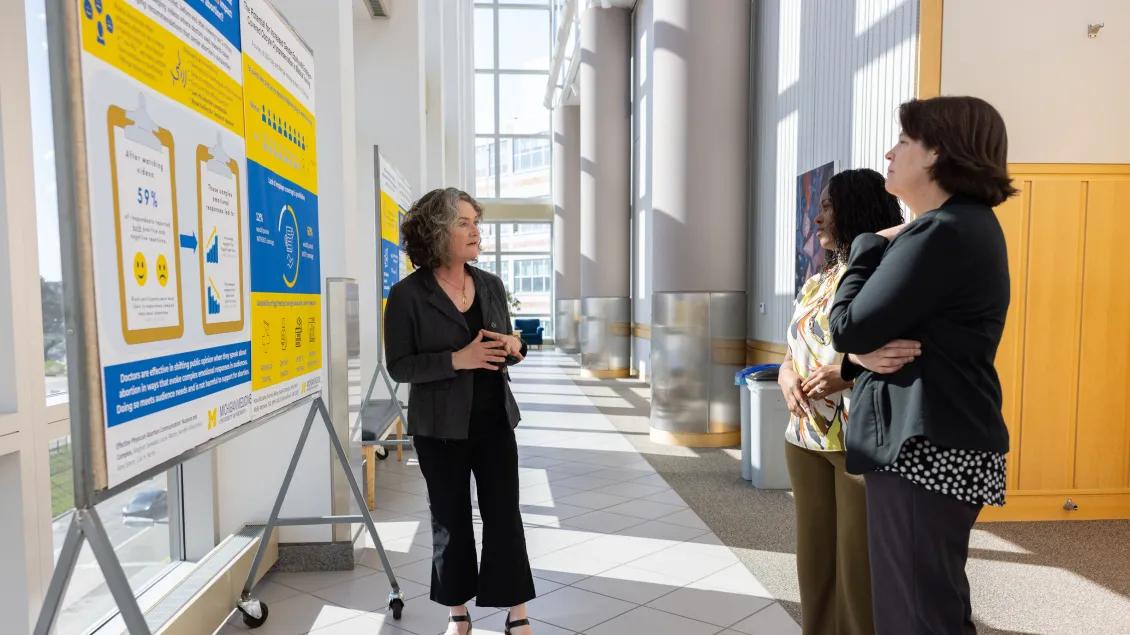
a group of women standing in front of a poster

Championing Research & Collaboration

We’re advancing knowledge, providing evidence-based solutions and training the next generation of researchers and physician-scientists.

world-class programs in research

The U-M Medical School Department of Obstetrics and Gynecology is nationally recognized for research excellence, with a robust portfolio of multidisciplinary, world-class programs.

Our research is strategically focused on driving transformative advances in women’s health and improving the well-being of individuals and families locally and globally. Faculty members lead initiatives spanning bench science, translational research, health services research, and clinical trials—addressing critical areas such as optimizing maternal outcomes, expanding access to quality health care, supporting women’s health across the lifespan, enhancing medical education, and tackling global health challenges.

Our research team supports faculty by helping secure funding, developing proposals, navigating regulatory processes, managing and analyzing data, ensuring compliance, and disseminating discoveries. We also provide educational opportunities and mentorship to foster career development.

We are dedicated to pioneering innovative, evidence-based solutions through interdisciplinary collaboration, advancing knowledge, and preparing the next generation of academic researchers and physician-scientists.

Key Research Areas

M-PROGRESS

The Michigan Program for Reproductive and Obstetric-Gynecologic Research, Education, and Scientific Success (M-PROGRESS) Women's Reproductive Health Research (WRHR) Scholars Program seeks to recruit, train, and empower exceptional obstetrician-gynecologist researchers at the forefront of women’s health.

Program on Women's Healthcare Effectiveness Research (PWHER)

PWHER is committed to improving the quality, access, and affordability of healthcare services for individuals at community, national, and global levels using diverse research methods to address pressing policies and clinical questions.

Pelvic Floor Research Group (PFRG)

PFRG is an internationally recognized, interdisciplinary research group working to improve the understanding and treatment of pelvic floor disorders. PFRG’s goal is to identify risk factors for developing pelvic floor disorders, work with high-risk women to prevent them, and provide the most effective and newest treatments for pelvic floor dysfunction.

Program for Research and Innovation in Maternal and Neonatal Outcomes (PRIMO)

PRIMO is a collaborative obstetric research group focused on closing critical knowledge gaps, improving the safety of modern obstetric care, and translating this knowledge onto national platforms.

Women’s Health and Reproductive Disparities Collaborative (OnWHARD)

The OnWHARD Collaborative is dedicated to advancing reproductive health through meaningful research, empowering education, and committed advocacy.

Innovative Solutions for Pelvic Pain and Endometriosis Initiatives, Research, and Education (INSPIRE)

The Department of OBGYN’s pain research program includes independently funded investigators from the University of Michigan in partnership with external investigators, focused on gynecology pain across the life course.

Leadership

labcoat

Vanessa K Dalton, MD, MPH

Timothy R B Johnson M.D. Legacy Professor of Global Women's Health
Associate Chair, Department of Obstetrics and Gynecology
Professor of Obstetrics and Gynecology and Section Head, Research, Gynecology
Medical School
Stacey Missmer

Stacey Missmer, ScD

Fudy Frankel Research Professor of Women's Health and Professor of Obstetrics and Gynecology
Medical School

Featured News & Stories

See all news
The Fundamentals Podcast Hero Card Final 1800 x 1350
The Fundamentals

The Bioethics of Data and A.I. in Healthcare

Season four of The Fundamentals is here, and we're celebrating by doing a special two-episode release to launch the season! On this episode of the Fundamentals, we talked to Professor Kayte Spector-Bagdady, the George E. Wantz Professor of Bioethics, about the use of massive amounts of data, artificial intelligence, and more. Be sure to check out our second launch episode and our entire back catalog on The Fundamentals website, or on your favorite podcast player.
UMich Med Mosaic on blue background with colorful geometric shapes
UMich Med Mosaic

Beyond the White Coat: Finding Your Voice at the Patient’s Bedside

In this episode of UMich Med Mosaic, host Mackenzie Kay speaks with MD students Josh Chen and Gabriel Culian about what it feels like to step onto the hospital wards for the first time. They reflect on their earliest patient encounters, the transition from standardized patients to real clinical settings, and the role medical students play in building trust, explaining care plans and supporting patients and families. They also discuss witnessing serious illness, grief and life-changing conversations, while exploring how early clinical experiences shape confidence, empathy and the kind of physicians they hope to become.
Health Lab Podcast in brackets with a background with a dark blue translucent layers over cells
Health Lab Podcast

Could preeclampsia become a thing of the past?

The findings position VGLL3 as a promising novel treatment target for the pregnancy-related condition.
University of Michigan Medical School
Medical School News

Nearly 200 University of Michigan Medical School faculty earn promotions

On May 21, the University of Michigan Board of Regents approved promotions for 191 Medical School faculty members. Their new appointments take effect Sept. 1, 2026.
mother with four kids smiling
Health Lab

A heart attack 9 days after giving birth: Mother of 4 shares her SCAD experience

A mother of four shares journey with a rare heart attack just days after birth called Spontaneous Coronary Artery Dissection, a leading cause of heart attacks in women under 50.
Health Lab Podcast in brackets with a background with a dark blue translucent layers over cells
Health Lab Podcast

Serious disparities persist in maternal death rates in the U.S.

U.S. maternal death rates have largely returned to pre-pandemic levels, but serious disparities persist. A recent study finds that the rate of maternal deaths in the United States disproportionately impacts Black women.