
Angeles Lab
The Angeles Lab studies the role of the immune system in fighting cancers, specifically, sarcoma and melanoma.
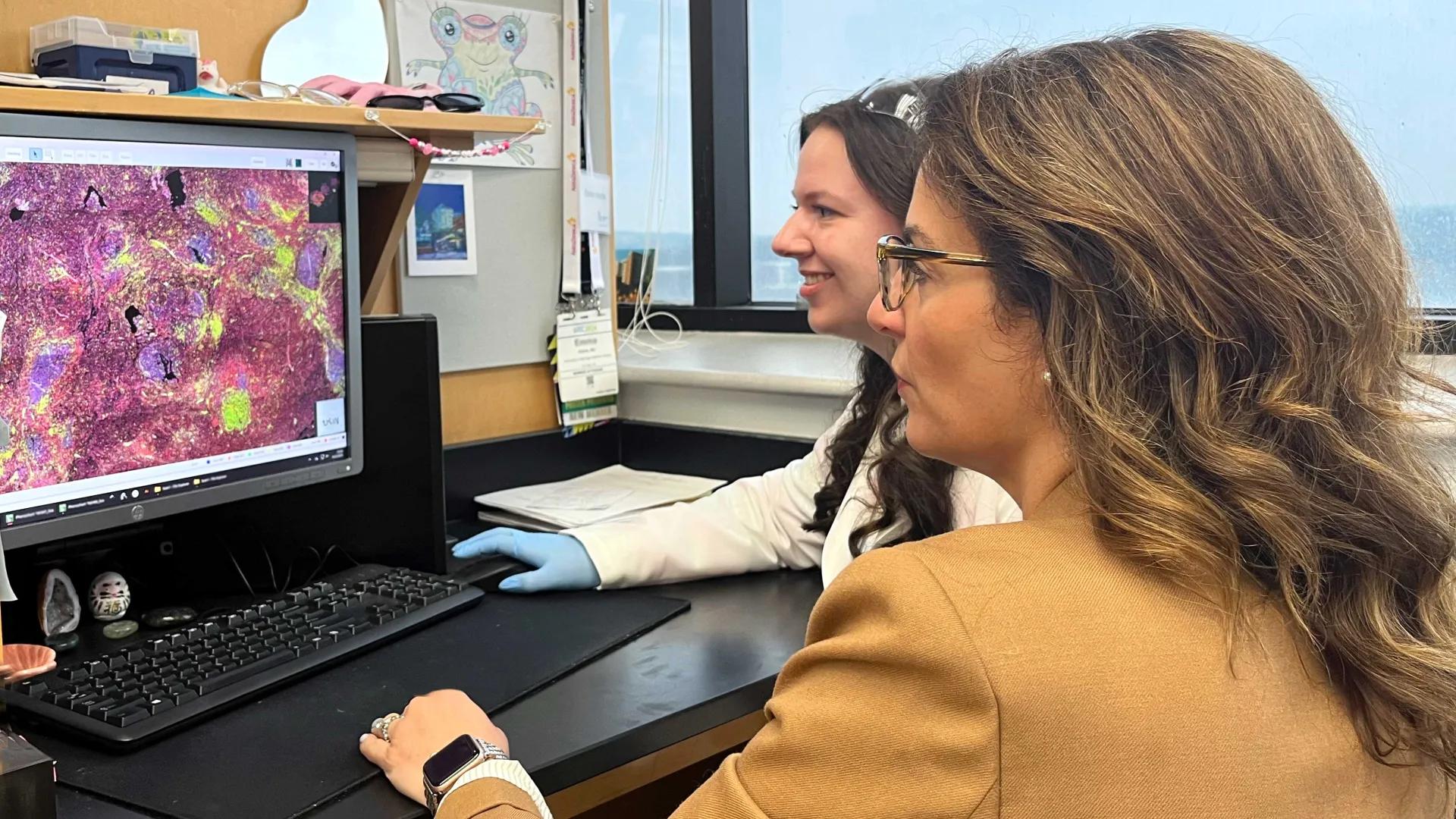
Explore the Angeles Lab
The Angeles lab is focusing on the mechanisms that underlie durable immune responses to immunotherapy, at the level of the type of cancer and individual patient. More specifically, we are investigating the role of a specific type of immune cell, the resident memory T cell (TRM). Our publication in Nature Cancer 2021 highlights our exciting findings which shed light on the mechanism of durable response to immunotherapy. These studies revealed that melanoma survivors can maintain durable T cell memory as functional, broadly-distributed TRM in tissues and tumors and effector memory T cells (TEM) in circulation.
The Angeles lab is also investigating the immune biology of sarcomas which has been slower than other cancers due to their rarity. We have successfully established the first well characterized genetically engineered immunocompetent mouse model of liposarcoma and syngeneic cell lines. These models will ultimately lead to more precise, mechanism driven immunotherapy clinical trial design for both melanoma and sarcoma patients.
Your support drives our research to find innovative therapies for patients with cancer. Learn more about opportunities to contribute to our work.
The Angeles Lab research program has developed from the mission to improve the outcomes for cancer patients. Before 2011, the median survival for metastatic melanoma patients was less than one year. This has significantly improved with the discovery and use of immune checkpoint inhibitor (ICI) immunotherapies. Now, more than 60% of patients have a meaningful response to immunotherapy. However, many patients are still left with detrimental adverse effects without any benefit. We do not have ways to identify who will or will not respond to these therapies, leaving an unmet need for identifying who will have a better response to treatment. Our research program is investigating the underlying immune responses responsible for durable responses to immunotherapy.
While the treatment for advanced melanoma patients has improved drastically with the use of immunotherapy, we continue to have suboptimal treatments for patients with liposarcoma. Retroperitoneal sarcoma patients continue to be offered the same ineffective first line chemotherapies since the 1960s. While there have been some improvements in systemic therapies, surgical resection, which commonly requires multi-organ resection, results in high recurrence rates and distant metastatic disease. With poor systemic options, immunotherapy has been tried and failed to benefit patients with liposarcoma.
The laboratory focuses on the immune microenvironment of melanoma and sarcoma, specifically investigating the role of resident memory T cells that we have shown to provide durable cancer immunity. Our research program has grown substantially in the past 5 years and will ultimately lead to more precise, mechanism driven immunotherapy clinical trial design and improved immunotherapeutic approaches for cancer patients.
At the Angeles Lab, we are passionate about improving cancer treatment and patient outcomes. We start by studying real data and samples from cancer patients to understand how different genes and immune cells affect how people respond to cancer. To dig deeper, we use mouse models to test how these factors actually cause—or prevent—certain responses to therapies.
We harness the power of cutting-edge sequencing technologies, like whole exome sequencing, RNA sequencing (including single cell and single nuclei methods), T-cell receptor (TCR) sequencing, and ATAC-seq, to get a detailed look at the many layers (“multiomics”) of cancer. Our team uses advanced bioinformatics to turn this complex data into meaningful discoveries.
Importantly, what we learn in the lab doesn’t stay in the lab: we translate our findings into real-world applications by helping design new clinical trials that bring promising treatments to patients. Collaboration is at the heart of everything we do. We work closely with experts across the University of Michigan—including dermatology, medical oncology, biomedical engineering, and many other fields—to speed up discoveries and create innovative, patient-focused research.
- Uncovered the role of resident memory T cells (TRM) in durable cancer immunity: Our Nature Cancer 2021 publication revealed that survivors of melanoma maintain long-term, cancer-fighting memory by retaining functional TRM cells in their tissues and tumors, and effector memory T cells (TEM) in circulation over many years from the time of the primary melanoma.
- Advanced understanding of immunotherapy response mechanisms: Through patient sample analysis, we are investigating how the initial immune response in primary melanomas can impact long-term patient outcomes and response to immunotherapy.
- Developed the first robust, immunocompetent mouse model of liposarcoma: Our lab successfully created and validated a fully penetrant, genetically engineered liposarcoma mouse model that closely mirrors human tumors, allowing for meaningful pre-clinical immunotherapy investigations.
- Enhanced research into the immune biology of sarcomas: We have enhanced the study of sarcoma immunology by employing state-of-the-art single cell analysis and immunohistochemistry to dissect the complex tumor microenvironment of liposarcoma.
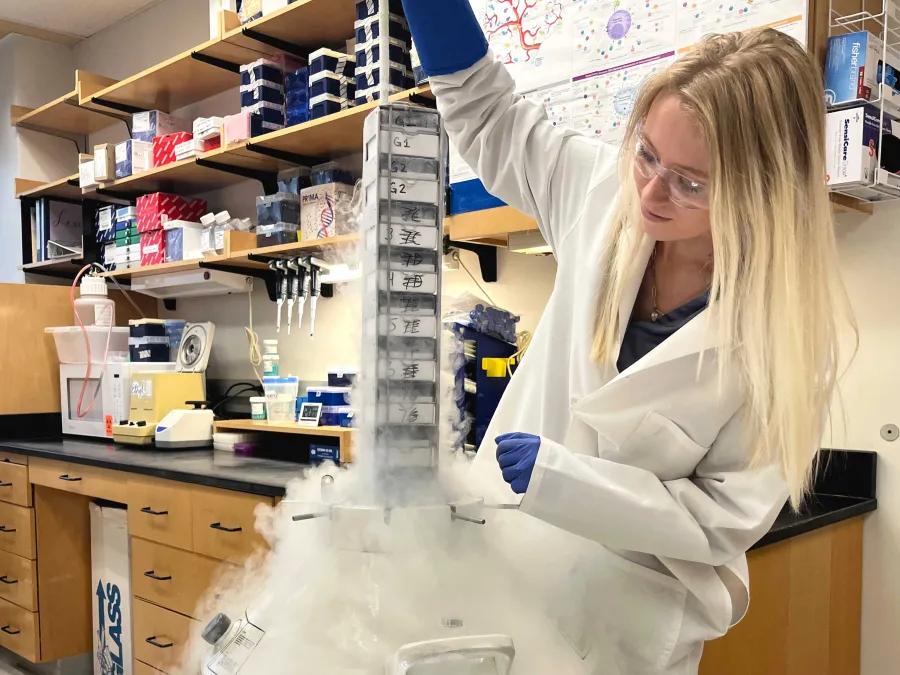
In the Angeles Lab
The Angeles Lab uses the newfound knowledge in melanoma in order to investigate the immune biology of sarcomas which has been slower than other cancers due to their rarity. The lab has been characterizing the tumor immune microenvironment of human liposarcoma using cutting-edge single cell and nuclei sequencing and multicolor immunohistochemistry.
In order to have the ability to test hypotheses and understand how to use immunotherapy effectively in sarcoma, the Angeles lab successfully established the first robust, fully penetrant, genetically engineered immunocompetent mouse model of liposarcoma and syngeneic liposarcoma cell lines that reliably develop orthotopic tumors histologically and transcriptionally resembling human liposarcoma. These models will ultimately lead to more precise, mechanism driven immunotherapy clinical trial design for both melanoma and sarcoma patients.
Support Our Work
We greatly appreciate your support in further advancing our research. Please contact the Office of Development with any questions.
Explore Clinical Trials
The University of Michigan offers a wide range of clinical trials through the Michigan Institute for Clinical & Health Research (MICHR) in which volunteers can participate.
