
Publications | Humphries Lab

Regulating Cancer Behavior
Select Publications - Mitochondria and Cellular Metabolism
Enhanced mitochondrial fission suppresses signaling and metastasis in triple-negative breast cancer
Abstract
Background: Mitochondrial dynamics underlie malignant transformation, cancer progression, and response to treatment. Current research presents conflicting evidence for the functions of mitochondrial fission and fusion in tumor progression. Here, we investigated how mitochondrial fission and fusion states regulate underlying processes of cancer progression and metastasis in triple-negative breast cancer (TNBC).
Methods: We enforced mitochondrial fission and fusion states through chemical or genetic approaches and measured migration and invasion of TNBC cells in 2D and 3D in vitro models. We also utilized kinase translocation reporters (KTRs) to identify single-cell effects of mitochondrial state on signaling cascades, PI3K/Akt/mTOR and Ras/Raf/MEK/ERK, commonly activated in TNBC. Furthermore, we determined the effects of fission and fusion states on metastasis, bone destruction, and signaling in mouse models of breast cancer.
Results: Enforcing mitochondrial fission through chemical or genetic approaches inhibited migration, invasion, and metastasis in TNBC. Breast cancer cells with predominantly fissioned mitochondria exhibited reduced activation of Akt and ERK both in vitro and in mouse models of breast cancer. Treatment with leflunomide, a potent activator of mitochondrial fusion proteins, overcame the inhibitory effects of fission on migration, signaling, and metastasis. Mining existing datasets for breast cancer revealed that increased expression of genes associated with mitochondrial fission correlated with improved survival in human breast cancer.
Conclusions: In TNBC, mitochondrial fission inhibits cellular processes and signaling pathways associated with cancer progression and metastasis. These data suggest that therapies driving mitochondrial fission may benefit patients with breast cancer.
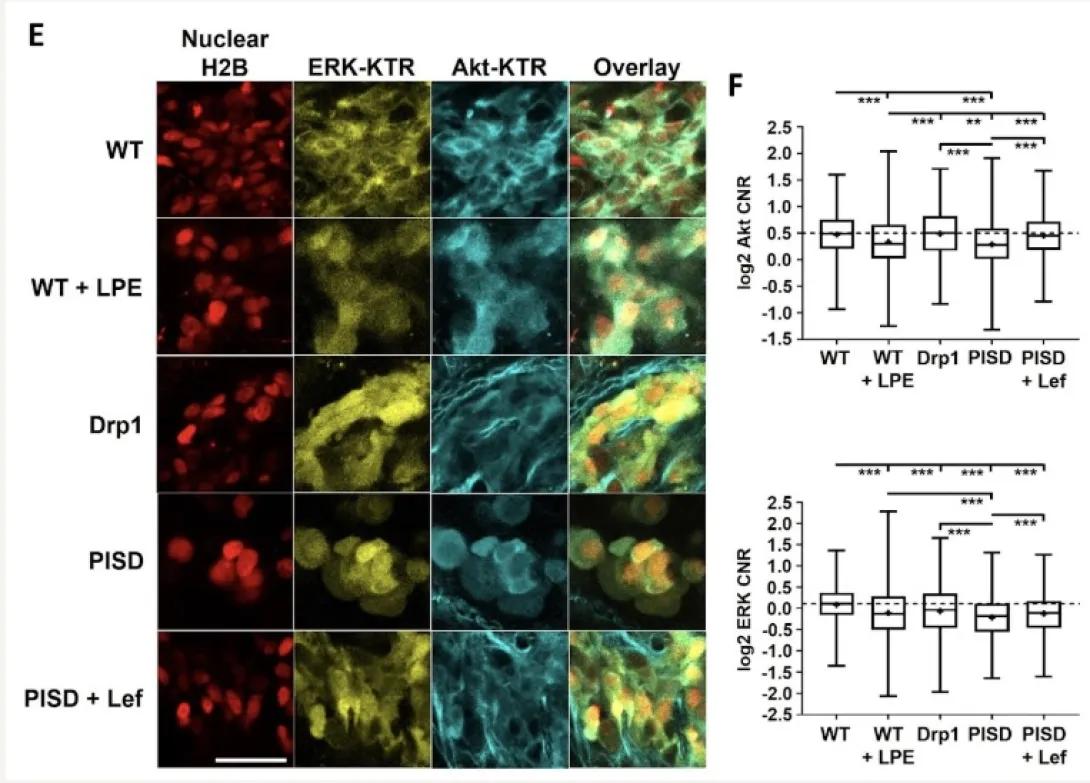
Panel E shows fluorescence microscopy images of breast cancer cells under five conditions: wild-type (WT), WT treated with LPE, Drp1 overexpression, PISD overexpression and PISD treated with leflunomide (Lef). Each row presents four channels: nuclear H2B staining in red, ERK-KTR signal in yellow, Akt-KTR signal in cyan and an overlay combining all channels. WT cells show strong ERK and Akt signaling, while WT + LPE and Drp1 cells display visibly reduced ERK and Akt activity. PISD cells also show dampened signaling, and PISD + Lef treatment partially restores ERK and Akt activity.
Panel F displays two box-and-whisker plots quantifying log2-transformed cytoplasmic-to-nuclear ratios (CNR) for Akt (top) and ERK (bottom) across the same conditions. Both plots show significant differences between groups, indicated by multiple horizontal comparison bars marked with asterisks. Overall, mitochondrial fission–associated conditions (Drp1, PISD) show reduced Akt and ERK activity, while leflunomide treatment increases signaling relative to PISD alone.
Enhanced mitochondrial fission inhibits triple-negative breast cancer cell migration through an ROS-dependent mechanism
Abstract
Mitochondria produce reactive oxygen species (ROS), which function in signal transduction. Mitochondrial dynamics, encompassing morphological shifts between fission and fusion, can directly impact ROS levels in cancer cells. In this study, we identified an ROS-dependent mechanism for how enhanced mitochondrial fission inhibits triple negative breast cancer (TNBC) cell migration. We found that enforcing mitochondrial fission in TNBC resulted in an increase in intracellular ROS levels and reduced cell migration and the formation of actin-rich migratory structures. Consistent with mitochondrial fission, increasing ROS levels in cells inhibited cell migration. Conversely, reducing ROS levels with either a global or mitochondrially targeted scavenger overcame the inhibitory effects of mitochondrial fission. Mechanistically, we found that the ROS sensitive SHP-1/2 phosphatases partially regulate inhibitory effects of mitochondrial fission on TNBC migration. Overall, our work reveals the inhibitory effects of ROS in TNBC and supports mitochondrial dynamics as a potential therapeutic target for cancer.
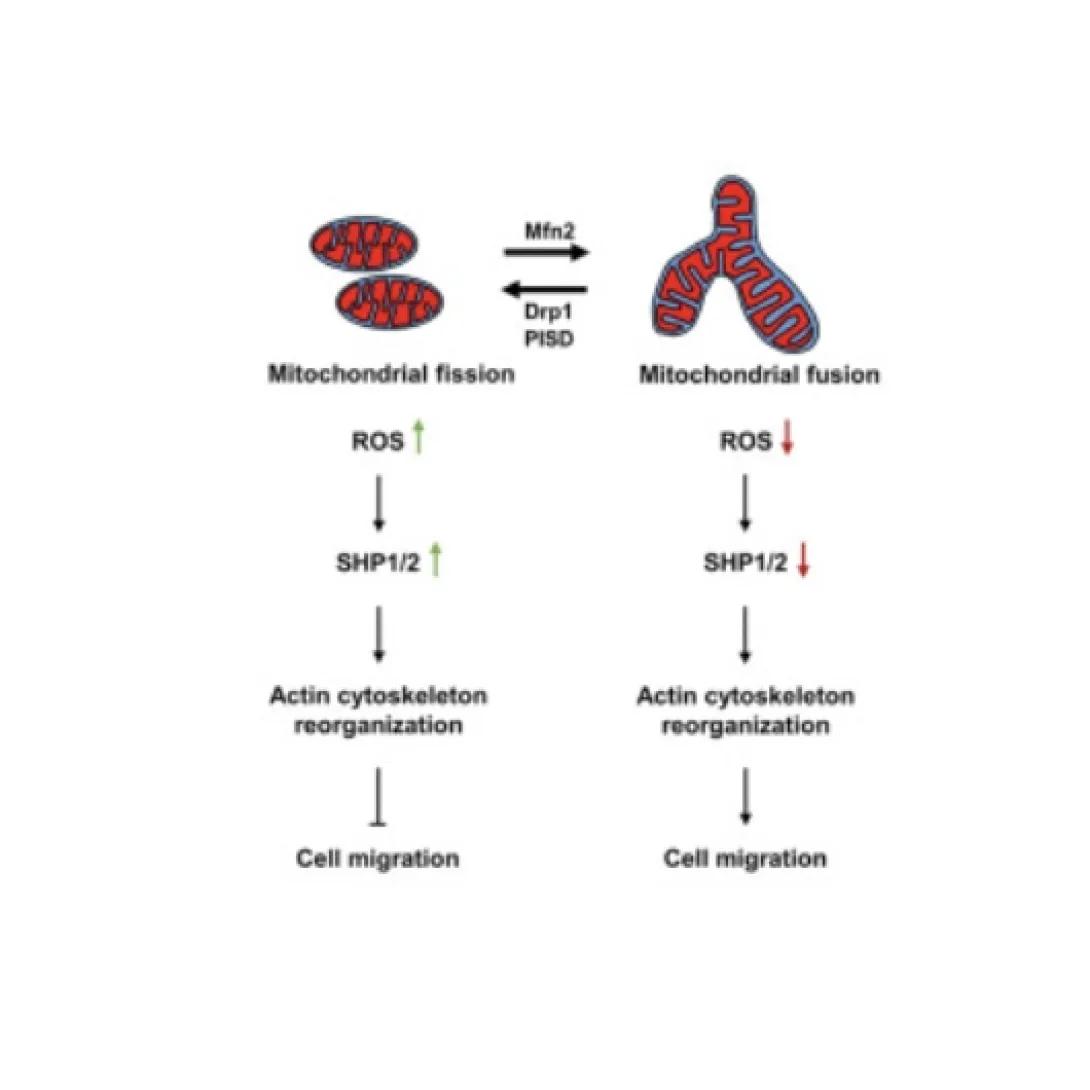
Diagram comparing mitochondrial fission and mitochondrial fusion and their effects on cell migration. On the left, two small, fragmented mitochondria represent mitochondrial fission, driven by Drp1 and PISD. Under fission, reactive oxygen species (ROS) levels increase, which leads to increased SHP1/2 activity, actin cytoskeleton reorganization and reduced cell migration. On the right, a single elongated mitochondrion represents mitochondrial fusion, driven by Mfn2. Fusion decreases ROS levels and lowers SHP1/2 activity, altering actin cytoskeleton organization and promoting greater cell migration. Arrows indicate the direction of each effect, with green arrows for increases and red arrows for decreases.
SELECT PUBLICATIONS - INTERACTIONS WITH THE EXTRACELLULAR MATRIX
Ultrasound-induced mechanical compaction in acoustically responsive scaffolds promotes spatiotemporally modulated signaling in triple-negative breast cancer
Abstract
Cancer cells continually sense and respond to mechanical cues from the extracellular matrix (ECM). Interaction with the ECM can alter intracellular signaling cascades, leading to changes in processes that promote cancer cell growth, migration, and survival. The present study used a recently developed composite hydrogel composed of a fibrin matrix and phase-shift emulsion, termed an acoustically responsive scaffold (ARS), to investigate the effects of local mechanical properties on breast cancer cell signaling. Treatment of ARSs with focused ultrasound drives acoustic droplet vaporization (ADV) in a spatiotemporally controlled manner, inducing local compaction and stiffening of the fibrin matrix adjacent to the matrix-bubble interface.
Combining ARSs and live single cell imaging of triple-negative breast cancer cells, it is discovered that both basal and growth-factor stimulated activities of protein kinase B (also known as Akt) and extracellular signal-regulated kinase (ERK), two major kinases driving cancer progression, negatively correlate with increasing distance from the ADV-induced bubble both in vitro and in a mouse model. Together, these data demonstrate that local changes in ECM compaction regulate Akt and ERK signaling in breast cancer and support further applications of the novel ARS technology to analyze spatial and temporal effects of ECM mechanics on cell signaling and cancer biology.
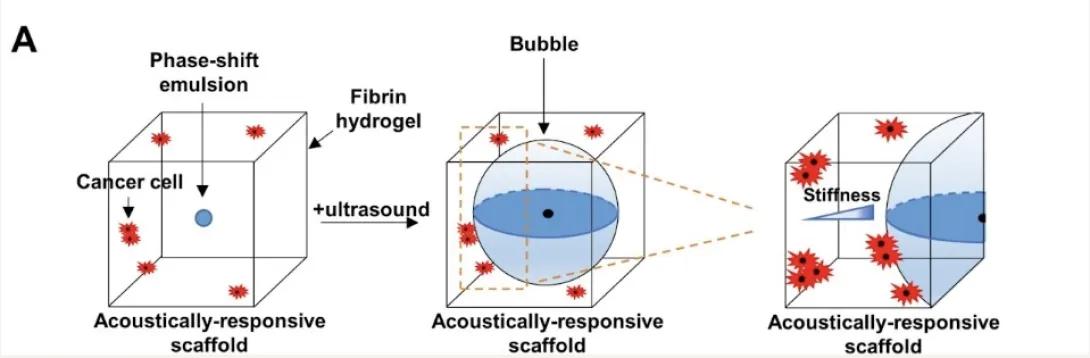
Diagram illustrating how an acoustically responsive scaffold (ARS) changes when exposed to ultrasound. The first panel shows a cubic hydrogel scaffold containing dispersed cancer cells (red star-shaped icons) and a central phase-shift emulsion droplet (a small blue sphere). In the second panel, ultrasound is applied, converting the emulsion droplet into a large bubble that expands inside the scaffold. The bubble occupies much of the cube, displacing the surrounding fibrin matrix and cancer cells. The third panel zooms in on the scaffold near the bubble surface, showing a gradient of increasing stiffness in the fibrin matrix closest to the bubble interface. Cancer cells remain distributed around the stiffened region. The sequence demonstrates how focused ultrasound induces local mechanical compaction and stiffness changes within the scaffold.
